The most useful frozen bakery formats are often the ones that do not look strategic at first glance. A tray of mini Danish pastries on a hotel buffet, a mixed box beside a coffee machine, a bite-size assortment pulled from a bake-off oven in the middle of the morning rush. Small product, modest footprint, little theatre. Yet this is exactly where frozen bakery is learning one of its sharper commercial lessons: indulgence does not always need to be enlarged to be profitable. Sometimes it needs to be made easier to say yes to.
The tray tells the story before the data does
Watch a breakfast buffet after 8 a.m. and the logic becomes fairly plain. Full-size pastries are attractive at opening, less convincing after an hour under lights, and awkward once the tray has been disturbed. Mini pastries behave differently. They keep the table looking active. They let a guest take one piece without appearing greedy, or three without committing to a plate-sized dessert at breakfast. For the hotel, the offer looks generous without making portion cost drift out of control.
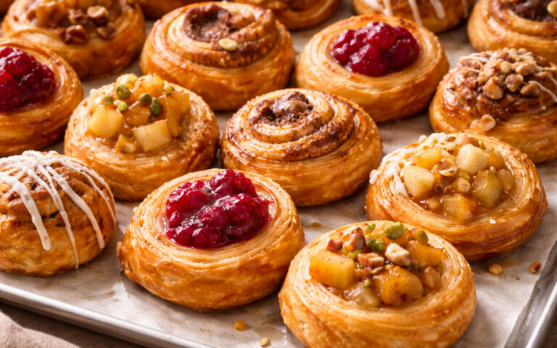
That same logic works behind a café counter. A large Danish asks the customer to make a decision. A mini Danish next to a flat white barely asks at all. It is closer to a reflex purchase, especially when the format is mixed: apple, custard, raspberry, cinnamon, chocolate, maple, maybe a seasonal filling if the supplier has done its job properly. The customer sees choice rather than just size. In bakery, that matters more than many range plans admit.
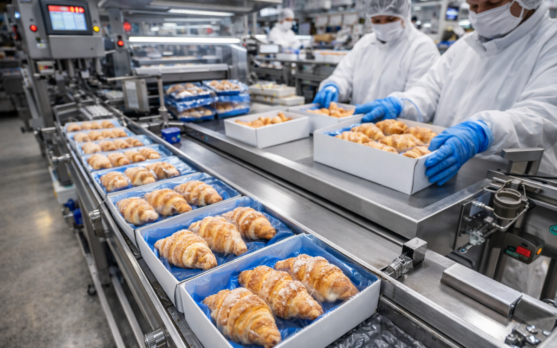
There is a reason the professional market has settled around compact, case-friendly assortments. Bridor sells mini Danish assortments around the 45 g mark, with apple, raspberry, maple and cinnamon-style varieties in the same case. Délifrance lists ready-to-bake mini Danish assortments at 35 g and 120 pieces per box. Europastry works with mini sweet puff pastry assortments around 38 g. These are not boutique curiosities. They are industrial formats designed for repeat handling, controlled baking and visible variety.
Coffee has become the unpaid salesman
Mini Danish pastries make the most sense where coffee is already doing the hard work of creating traffic. In a bakery café, forecourt, railway kiosk or office canteen, the drink anchors the visit. The pastry only has to attach itself to that moment.
This is where the smaller format earns its place. A full pastry can feel like breakfast. A mini pastry feels like an addition to coffee. That difference changes the sale. It lowers resistance, particularly in the mid-morning and mid-afternoon windows when customers are not looking for a meal but still want a small reward. The operator does not need to persuade them into a new occasion. The occasion already exists in the cup.
There is a hard commercial edge here. Coffee operators talk endlessly about beverage margin, speed of service and queue management. Less attention is given to the small bakery item that can lift the ticket without slowing the line. A mini pastry, already baked or finished from frozen, displayed in a tight mixed tray, can do that quietly. It does not require a fork. It does not require explanation. It can be bundled, sampled, boxed, placed on a saucer, sent to a meeting room or sold as a two-bite indulgence at the counter.
The better suppliers understand this. Their assortments are not only flavour ranges. They are coffee companions in frozen form. The item must be neat enough to sit beside a cappuccino, rich enough to feel worth buying, and small enough not to compete with the rest of the menu.
Portion control without the punishment language
There is a clumsy way to talk about this category, and it usually begins with “permissible indulgence.” The phrase is useful in planning decks, less useful on the shop floor. Consumers do not buy mini Danish pastries because they are performing nutritional mathematics in front of the display. They buy them because the pleasure looks contained.
That is a different thing.
A good mini pastry still has to behave like pastry. It needs lamination, aroma, browning, visible filling and a little gloss. If the apple piece looks flat, if the custard disappears, if the raspberry filling feels like a coloured dot added by committee, the format collapses. Smaller is accepted when the pleasure remains intact. Smaller with a stripped-out recipe simply reads as mean.
This is where the category has a useful advantage over larger indulgent bakery. Consumers remain interested in sweet baked goods, but the appetite for heavy, oversized formats is more selective. Price, health cues, GLP-1 medication, sugar awareness and simple fatigue with excessive portions are all pushing some shoppers toward smaller choices. That does not mean they want joyless products. It means the indulgence has to fit more easily into ordinary life.
Mini Danish assortments are well placed because they do not need to pretend to be healthy. Their job is more honest: offer a proper bakery experience in a size that feels manageable.
The frozen case is doing more than preserving product
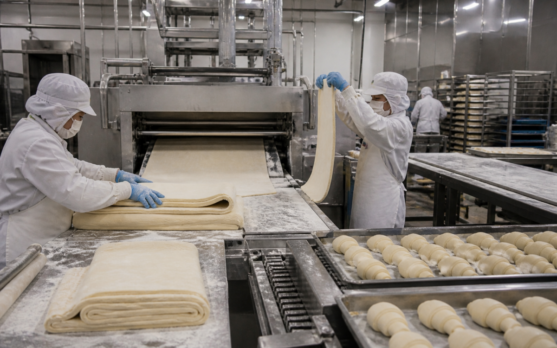
Frozen bakery gives this format its operational backbone. Without the frozen system behind it, mini assortments are just labour-intensive pastry. With frozen, they become a scalable menu tool.
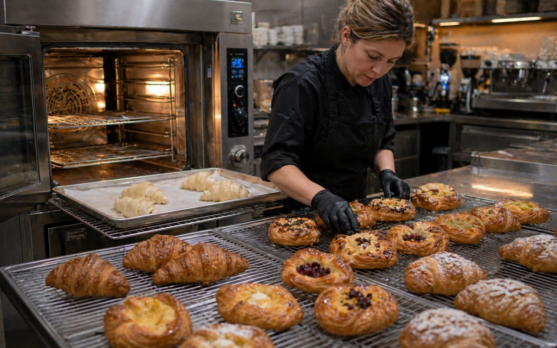
In a real foodservice site, the argument is practical. Staff can bake smaller batches through the day. The counter can be refreshed without overcommitting. Waste at closing becomes less painful. The same case can support breakfast baskets, coffee breaks, meeting platters and impulse retail. A mixed assortment gives the operator range width without forcing the kitchen to manage several separate SKUs with different routines.
Handling still decides whether the product performs. Many professional mini pastries are stored at deep-frozen temperatures, then baked from frozen or after a short defrost, depending on the product. Schulstad, for example, gives bake-from-frozen instructions for mini Danish pieces, with a short bake and cooling window before finishing. Europastry’s mini sweet puff pastry assortment uses a brief room-temperature defrost followed by baking. These details sound small until a site ignores them. Then the pastry tells on everyone.
Underbake it and the centre feels heavy. Leave it too long on display and the texture goes limp. Crowd the tray and the assortment loses its premium signal. Freeze-thaw abuse, poor rotation and careless finishing can turn a format built for controlled indulgence into a dry, anonymous nibble. Frozen bakery is forgiving in logistics, not forgiving in presentation.
Assortment is the product, not decoration
The strongest mini Danish offer is rarely one flavour. The commercial appeal sits in the mixed tray. Variety makes the product look more abundant than its weight suggests. A single large pastry gives the shopper quantity. A mixed selection gives them choice, and choice often feels more valuable.
That is why this format works so well across buffet, catering and sharing occasions. On a meeting table, nobody wants to cut a large pastry with a paper napkin while discussing procurement. Mini pieces solve the social problem. They are tidy. They allow sampling. They let people take something without making the table look attacked after ten minutes.
Retail can use the same behaviour. A frozen or bake-at-home mini pastry box can sit between personal treat and family sharing. It is suitable for weekend breakfast, an after-dinner coffee, children and adults, guests, or the kind of evening where nobody wants a full dessert but everyone somehow wants one more small thing. That flexibility is valuable because it gives the shopper more reasons to buy.
Manufacturers should be careful, though. A mixed case is not automatically a better case. If the flavours are too similar, the customer sees repetition. If the shapes are too weak, the tray looks industrial in the worst sense. A good assortment needs visual rhythm: crowns, swirls, pockets, plaits, fruit marks, different finishes. The tray has to look edited, not merely filled.
Where the format goes next
In the short term, mini Danish and bite-size pastry assortments should keep gaining space in coffee-led foodservice, hotel breakfast, travel catering, office hospitality and retail bake-off. The category fits labour pressure because it is easy to execute. It fits consumer caution because the portion feels reasonable. It fits frozen distribution because the case format is efficient and the product can be staged in small waves.
Over the next few years, the split will become more visible. One side will be value-driven: reliable mixed mini pastries for buffets, canteens, wholesale catering and high-volume bakery programs. The other side will move premium: better butter cues, clearer fruit fillings, cleaner lamination, seasonal editions, smaller cases for boutique cafés and retail packs that feel closer to patisserie than freezer convenience.
The danger sits in the middle. Average mini pastries will be easy to copy and easy to ignore. The format may be small, but it does not forgive weak product development. In a display case, every flaw is closer to the eye: pale bake, collapsed layers, mean filling, sticky glaze, repetitive shapes. Mini products need more character per gram, not less.
For frozen bakery suppliers, this is a useful test of discipline. The winning assortments will not be the ones shouting loudest about indulgence. They will be the ones that understand where the product actually lives: next to the coffee machine, on a buffet tray, in a staff-handled bake-off routine, inside a wholesale case, under the impatient eye of a customer who wants something small but still worth choosing.