A pallet of frozen meals can look strangely respectable after it has lost its commercial life. The cartons are still clean, the sleeves are still bright, the trays are still sealed, and the product is still hard enough to sound saleable when a case hits the table. Then the paperwork catches up: a delisting, a recall, a missed promotion, a temperature incident, a private-label redesign. From that point on, it is no longer food waiting for a buyer. It is organic material trapped inside packaging, and the circular economy has to do something very ordinary before it can do anything clever: open the box.
The dead pallet in the freezer
Frozen food is good at buying time. That is one of its best arguments. A bag of vegetables, a tray of lasagne, a box of croissants or a pizza can sit safely for longer than most fresh equivalents. Retailers like that. Consumers like that. Processors have built a large part of the category’s sustainability case around it.
The case is not wrong. Frozen can reduce waste while the product is still wanted.
But the industry should be careful with that word, wanted. Cold stores still collect pallets that nobody wants anymore. A customer changes specification. A retailer refreshes packaging. A foodservice contract disappears. A freezer door fails. A product is withdrawn. A promotional format arrives too late. Sometimes the product is still physically sound. Sometimes it is not. Either way, the route to the shelf has closed.
That is where the clean language of circularity starts to get dirty. Composting sounds simple until the product is inside a tray. Anaerobic digestion sounds elegant until the film, sleeve, carton and label are still attached. Animal feed may sound sensible until the formulation includes meat, fish, dairy or mixed meal components that trigger additional controls.
The dead pallet is not an ESG sentence. It is a handling problem, parked in expensive freezer space.
Frozen waste is rarely naked
A processor knows the difference between production waste and finished packed waste. Potato peelings, vegetable trim, dough scrap or offcuts already belong to the plant’s internal waste logic. They can be captured close to the line, kept relatively clean and sent to the right outlet if the site has the contracts and discipline.
Finished frozen waste is different. It arrives as a product system. A flexible bag in a carton. A tray inside a sleeve. A multipack inside shrink-wrap. A master case around primary packs. A pallet wrapped again for transport. The food is only one part of the object.
This matters because recovery systems do not process brand stories. They process material. A waste contractor does not look at a rejected pallet of frozen pizza and see a circular opportunity first. It sees labour, transport, temperature, packaging contamination, possible secure destruction, gate fees, paperwork and the risk that the organic stream will not be clean enough for the next step.
If that sounds unromantic, it should. Circularity in packaged frozen food is not blocked mainly by lack of ambition. It is blocked by friction.
That friction has a cost. If the cost of separating the product from the pack is too high, the material falls down the recovery hierarchy. Not because anyone wants that outcome. Because the route that looks best in a sustainability slide may be too slow, too far away, too contaminated or too labour-heavy when the pallet is actually sitting in the freezer.
The package that saves the product can block the recovery
It would be lazy to blame packaging. Frozen food packaging has a difficult job. It must survive freezing, handling, abrasion, pallet pressure, condensation, retail cabinets and the journey home. It protects against freezer burn. It carries cooking instructions, allergens, batch codes and retail identity. It helps the product stay saleable for longer.
Bad packaging creates waste before anyone starts talking about recovery.
The awkward part comes later. The same film that protects vegetables from moisture becomes a contaminant if it shreds into the organic stream. The tray that keeps a ready meal stable becomes another object to remove. The carton that helps a pizza sell becomes another layer between food and digestion. A sleeve that works beautifully at shelf level can become a nuisance once the product is withdrawn.
Most packaging scorecards still spend too much time looking at the empty pack. Is it recyclable? Is it mono-material? Does it meet the next regulation? Those questions matter, especially with Europe’s new packaging regulation cycle. But frozen food needs a second test.
The full-pack failure test.
What happens when the pack is still full, still frozen, still palletised and no longer saleable? Does it separate cleanly? Does it fragment? Does the carton stay intact long enough to remove? Does the film contaminate the organic fraction? Can a depackaging line handle it, or does it require manual work nobody priced into the system?
A pack that performs well only when sold is not a complete circular design.
Depackaging is where the promise becomes mechanical
Depackaging is not a fashionable word. It belongs to equipment rooms, waste contracts and preprocessing yards. That is exactly why it matters.
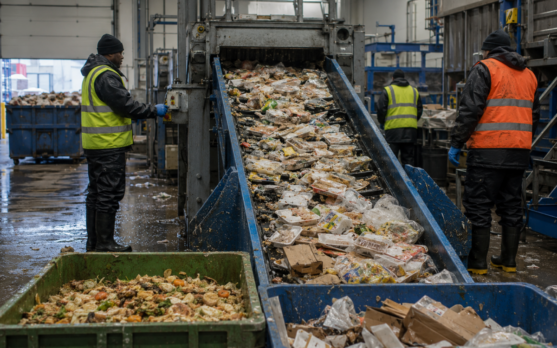
The job is blunt: separate food from packaging at industrial speed. Depending on the system, packaged material may be torn, pressed, squeezed, screened or pulped. One stream becomes organic material that may go to anaerobic digestion, composting or, in some cases, feed routes. The other becomes packaging reject. Wet reject. Contaminated reject. Often low-value reject.
That is the part the circular economy often under-describes. Depackaging does not make packaging disappear. It creates two streams that still need management.
Frozen material adds its own complications. Keep it frozen and it may be hard, slow to break and awkward for systems designed around softer food waste. Let it thaw and it can become wet, heavy, odorous and harder to store cleanly. Ice cream behaves differently from vegetables. Frozen dough behaves differently from frozen meals. A pallet of fish portions is not the same recovery problem as a pallet of pastry.
There is also the question of purity. Anaerobic digestion facilities and composters do not want a feedstock full of plastic fragments, film, labels or bits of tray. Plastic contamination can reduce the quality of compost or digestate and create operational problems. The more packaged the stream, the more preprocessing has to earn its keep.
That is the physical gate in this story. Not the digester. Not the compost pad. The separation step before either of them can do useful work.
Retail does not have time to perform surgery in the back room
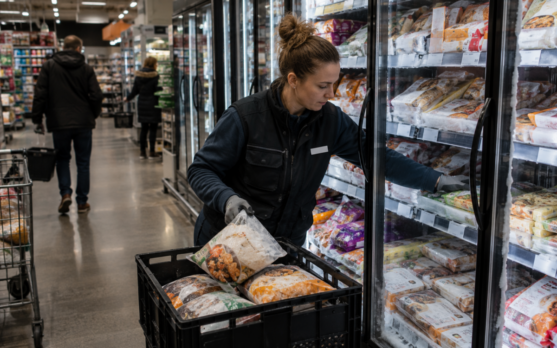
The retail side exposes the problem quickly. Store teams are being asked to separate more, report more, donate more and divert more. They are also short of time. A supermarket back room is not a depackaging facility.
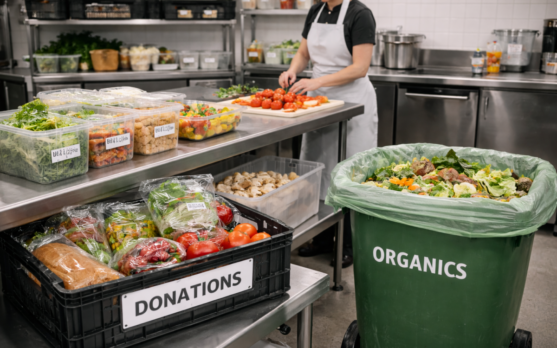
A colleague can pull stock from sale. They can put it in a cage. They can scan it, record it and move it to a collection point. What they cannot realistically do is open hundreds of packs, scrape trays, separate film from food, stack cartons and maintain a clean organic stream while still running the store.
That is why bundled services are becoming more attractive: collection, depackaging and downstream processing together. The value is practical, not poetic. It removes manual separation from the store and pushes it into a system built for the work.
Frozen retail and cold storage add another layer: space. Dead frozen stock occupies the same pallet position as live stock. It still needs controlled handling. If it remains frozen, the cost continues. If it thaws, the waste profile changes quickly. Leakage, odour, pest risk and hygiene pressure arrive faster than most sustainability charts admit.
In a distribution centre, a failed pallet can turn into a quiet argument between quality, operations, finance and sustainability. The sustainability manager wants diversion. Operations wants the space back. Finance wants the lowest compliant cost. The waste contractor wants a stream it can process without fighting the packaging all day.
Someone has to decide how much circularity is worth when the freezer slot is needed tomorrow.
Not every recovery route wants the same frozen waste
It is tempting to talk about composting, biogas and animal feed as if they are interchangeable green exits. They are not.
Some former foodstuffs can fit feed routes, especially where products are cereal-based, bakery-related or otherwise suitable under local rules. Many frozen products will not. Mixed meals, meat, fish, dairy and products of animal origin bring controls that cannot be waved away because a pallet is inconvenient.
Anaerobic digestion can be a strong route for many food waste streams, including depackaged material. But digesters prefer feedstocks that fit their process. A wet system wants material it can pump and digest without constant problems from film, grit or fragments. Composting is also sensitive. A compost operator has to think about the final product going onto land. Food is welcome. Plastic confetti is not.
This is why frozen waste needs routing discipline. A damaged pallet of frozen croissants, a withdrawn batch of seafood, expired ice cream and mixed ready meals are all "frozen waste" in broad language. Operationally, they are different jobs.
The better question is not whether the product can be diverted. It is whether the product, packaging, temperature state, regulation and local infrastructure allow a credible route after separation.
The design brief has to include the product after failure
Europe’s food waste targets for 2030, the new packaging regulation cycle and stricter separation rules in markets such as England will make this issue harder to ignore. In the United States, retail food waste reporting is already showing more attention around composting, anaerobic digestion and packaged food streams. These pressures will not automatically solve packaged frozen waste. They will make the gap more visible.
Frozen food companies should not leave that gap to the waste contractor.
When a new pack is developed, someone should ask how it behaves when it is still full and unsold. When a retailer asks for a tray, a sleeve, a premium board wrap or a multipack format, someone should ask how a full rejected pallet would be separated. When sustainability teams claim diversion, someone should know whether there is depackaging capacity close enough to make the claim practical. When private-label packaging changes, someone should think about the old stock if it does not sell through.
These are not decorative questions. They affect disposal cost, recall handling, cold-store capacity, contamination risk and the credibility of reporting.
Frozen food has spent years making the case that it can prevent waste before it happens. It now needs a harder conversation about the waste that still happens anyway. The circular economy does not begin at the biogas plant. It begins at the pallet nobody wants, with packaging still wrapped around the food.