In a Dutch cold store, a Moroccan raspberry no longer has to look perfect in a retail punnet to matter. It can be broken, small, late, too uneven for fresh, or simply better suited to a factory than a shelf. Once frozen, the same fruit enters a different market: bakery fillings, smoothie blends, dairy preparations, desserts, foodservice and industrial fruit systems. Morocco has been treated for years as one of Europe’s fresh produce extensions. The more interesting question now is whether part of that fresh story is beginning to harden into a frozen ingredient business.
A fresh origin with a second door opening
Morocco is not new to Europe’s berry trade. Buyers already know the country through fresh raspberries, blueberries and strawberries, shipped into retail programs that depend on speed, appearance and a tight calendar. The model has worked because Morocco is close enough, early enough and organised enough to fill European gaps when northern production is limited.
Fresh berries, though, are a nervous business. The fruit has to behave. The weather has to behave. The truck, the border, the warehouse and the buyer all have to behave at roughly the same time. A beautiful raspberry picked for fresh retail can lose value fast if the week turns against it.
Frozen fruit has a different temperament. It is less romantic, less visible, and often less discussed. But it can rescue commercial value from time. It can turn fruit into an ingredient rather than a race. That matters more as Europe’s food manufacturers look for supply that can survive volatility, not just celebrate a good harvest week.
Morocco’s frozen raspberry numbers are still modest beside the established frozen berry origins. Nobody sensible would call the country a dominant frozen player. But the signal is there. Moroccan frozen raspberry exports to the Netherlands reached about 1,000 tonnes in 2025, four times the volume reported for 2023. France also took record-level volumes of Moroccan frozen raspberries and blackberries in 2025.
The tonnage is not the whole point. The door it opens is more important.
The Netherlands is not just a customer
When frozen fruit enters the Netherlands, it rarely stops there. Dutch traders, cold stores, repackers and distributors sit inside one of Europe’s most important redistribution systems for frozen fruit. Product can be imported, reworked, branded, blended, packed and sent onward. A Moroccan raspberry landing in the Netherlands is not only competing for Dutch consumption. It is being tested for European circulation.
That makes the 1,000-tonne mark more useful than it first appears. It shows that Moroccan frozen raspberries are not only being sold into nearby or familiar channels. They are entering a hub where buyers are used to comparing origins with little sentiment. Serbia, Poland, Ukraine, Chile, Egypt, Morocco. Price matters. So does colour. So does food safety. So does reliability after thawing, processing or baking.
In that environment, a new supplier does not need a speech. It needs repeat orders.
The same applies to France. French buyers know North African fresh supply well, but frozen fruit is a different test. It is less about the season’s shine and more about whether a product can sit inside industrial planning. Can it be used in fruit preparations? Can it go into bakery? Can it meet microbiological requirements? Can the same supplier come back next year with a similar product, a similar spec and fewer surprises?
That is where Morocco’s frozen pivot will either become real or stay a headline.
Frozen berries are factory fruit
Most people still picture frozen berries as retail bags: raspberries for breakfast bowls, blueberries for smoothies, mixed fruit for home baking. That is visible, but it is not the whole market. In Europe, a large share of frozen berries moves into food processing. That is where the better story sits.
A frozen raspberry can disappear into a croissant filling, a yoghurt layer, an ice cream ribbon, a smoothie base, a dessert sauce, a cheesecake topping or a foodservice tub. At that point, the buyer is not shopping like a consumer. The buyer is thinking in Brix, acidity, seed load, colour stability, microbiology, damage, drip loss, foreign body control and batch consistency.
That is a harder business than simply freezing what could not be sold fresh.
For Morocco, this is the fork in the road. If frozen berries are treated as a secondary outlet for fresh-market leftovers, the country will remain a tactical origin. Useful in tight years, useful when price works, but not trusted deeply enough for core programs. If freezing is planned from the field and the packing house, with varieties, harvesting, sorting and process controls aligned to end use, then Morocco becomes more interesting.
There is a big difference between fruit that happens to be frozen and frozen fruit made for buyers who know exactly what they will do with it.
Climate risk is pushing buyers to think differently
Europe’s berry supply has become more exposed to uncomfortable weather. Heat, drought, excessive rain, labour disruption and transport stress do not move neatly around the calendar. Fresh programs feel the shock quickly because they are built around a short window of quality and arrival.
Frozen does not remove the agricultural risk. It gives the supply chain another way to absorb part of it.
For a bakery producer, a smoothie brand or a dairy company, a frozen ingredient origin close to Europe has practical appeal. It can shorten the distance compared with more remote sources. It can support planning beyond the immediate fresh season. It can offer a route for fruit that is commercially valuable but not ideal for fresh retail presentation.
That last point needs care. Frozen should not become the polite name for downgraded fruit. Industrial buyers are not fools. A poor berry is still a poor berry after freezing. But a berry that is too small, too irregular or too inconvenient for the fresh shelf may still be perfectly useful in a filling, a puree, a preparation or a blend.
Fresh rewards the perfect week. Frozen rewards the usable crop.
Morocco has geography on its side. It also has a climate problem sitting underneath that advantage. Water scarcity is not a footnote in North African agriculture. It is the part of the sourcing conversation that is moving from NGO reports into buyer risk meetings. Morocco’s water stress is well documented, and the country is investing in desalination and water infrastructure because the pressure is structural, not seasonal.
That makes the frozen berry story more complicated. European buyers may like the proximity, the season and the growing export base. They will still have to ask whether the crop can be scaled responsibly, whether water risk is being managed, and whether the origin remains reliable in a hotter and drier decade.
The freezer is a trust machine
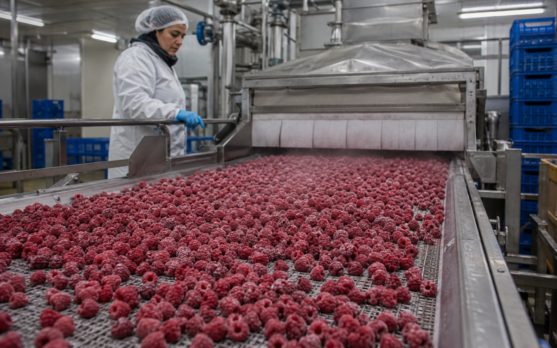
Freezing fruit is easy to describe and hard to do well at scale. The difference between a useful IQF raspberry and a bag of damaged frozen fragments can be brutal. The fruit has to be harvested properly, cooled quickly, sorted hard, frozen cleanly, stored correctly and documented well enough for a European buyer to sleep.
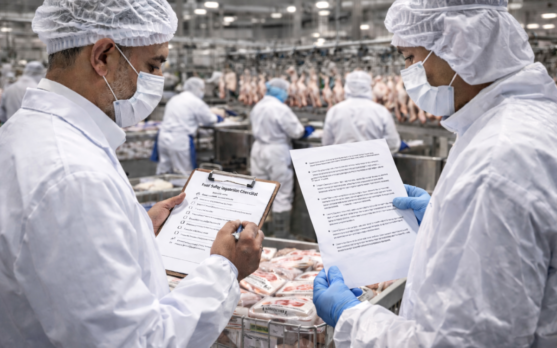
That means certifications. It means residue control. It means microbiological discipline. It means metal detection, traceability, temperature logs and audits that hold up when a buyer’s technical team starts asking boring questions. Boring questions are where serious ingredient supply is built.
Morocco already has companies working in frozen berries and frozen fruit processing. The country also has fresh berry scale, which gives it a base. But the frozen opportunity will not be decided by farm hectares alone. It will be decided in tunnels, sorting rooms, laboratories, cold stores and export documentation.
A buyer can forgive a small origin if it is honest about capacity. A buyer is less forgiving when the product varies too much, the certification is thin, or the supplier treats frozen as the channel for what fresh did not want.
The frozen ingredient market is less visible than retail fresh. It is also less sentimental. Once a fruit preparation fails in a dairy line or a bakery filling behaves badly, the buyer remembers.
The pivot will be judged by repeat programs
The easy story is that Morocco is exporting more frozen raspberries. The sharper story is that Morocco may be learning how to sell time, not only fruit.
Fresh exports depend on urgency. Frozen ingredients depend on confidence. If Morocco can offer both, it gains a more resilient position in Europe’s berry supply chain. The fresh channel can still take the premium fruit when timing and price are right. The frozen channel can support ingredient buyers who need continuity, formats, specifications and planning windows that fresh alone cannot provide.
There are limits. Serbia and Poland are not disappearing. Chile and other global origins remain relevant. Egypt has its own strength in frozen strawberries. Morocco still has to prove depth in processing capacity, consistency and water-risk management. A few strong export figures do not make a platform.
But the market does not need Morocco to become the next frozen berry giant for the story to matter. It only needs Morocco to become a credible additional origin at a time when buyers want more options close to Europe.
That is why the Dutch signal matters. That is why the French numbers matter. Not because they settle anything, but because they suggest Moroccan fruit is beginning to move through channels where ingredients, not only fresh displays, set the rules.
The first 1,000 tonnes can make a headline. The second and third programs will decide whether buyers change their sourcing map.