A French fry is still judged first by colour. Not by a regulation, not by a lab result, not by a paragraph in a technical file. A buyer sees the shade. A QSR operator wants the same basket at noon in every unit. A consumer expects the picture on the frozen bag to come reasonably close to what comes out of the oven or air fryer. That ordinary golden colour is now carrying more risk than the category likes to admit. If Europe moves further from acrylamide mitigation toward binding maximum levels, the brown edge on a fry stops being only a matter of appetite. It becomes a commercial boundary.
The fry looks finished before it actually is
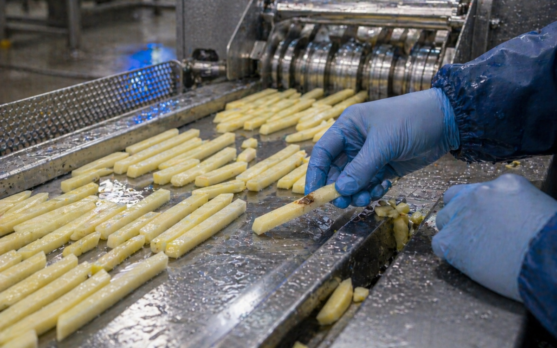
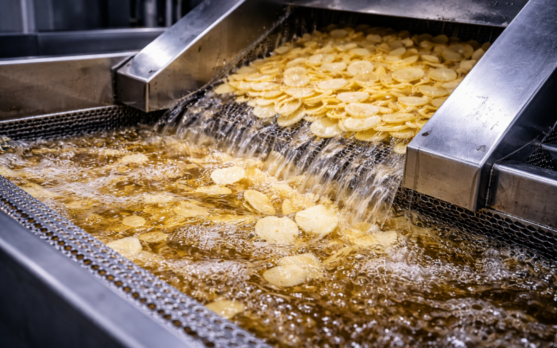
Walk through a frozen potato plant and the process looks controlled almost to the point of comfort. Potatoes come in, are graded, washed, cut, blanched, dried, par-fried, frozen and packed. Operators check length, defects, colour, oil temperature, belt speed and foreign-body risk. Pallets move into cold storage. The cartons look ready for the market.
For acrylamide, that is the awkward part. The product is ready for shipment, but not ready for eating.
Frozen fries are different from crisps. A crisp leaves the plant as the finished product. The manufacturer owns the final colour, the final texture and the final acrylamide number. Frozen fries leave with one more step waiting somewhere else. A restaurant fryer. A school kitchen. A hotel oven. A pub kitchen at peak service. A domestic air fryer on a Tuesday evening, probably pushed a little longer because someone wants more crunch.
That last step is where a neat factory control plan meets real life.
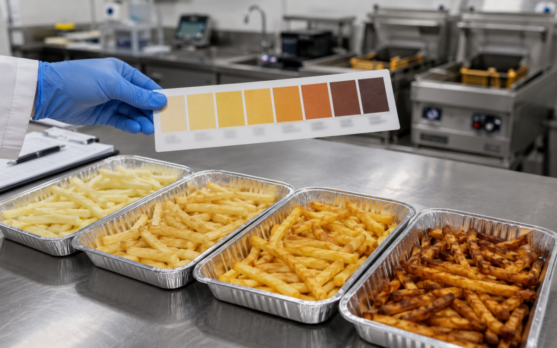
The industry already knows the mitigation language. Choose suitable varieties. Watch reducing sugars. Avoid bad storage practice. Blanch properly. Keep frying temperatures under control. Do not overcook. Cook to golden yellow. Use colour guides. Keep records. None of this is new.
What is changing is the commercial weight behind those measures. A benchmark level tells the operator to monitor, improve and correct. A maximum level, if adopted for the relevant products, has a different tone. Above the line, the discussion is no longer only about process improvement. It becomes about whether a product can be placed on the market at all.
Benchmark levels gave the industry room to manage
The current EU acrylamide framework is built around mitigation. Commission Regulation 2017/2158 sets mitigation measures and benchmark levels for several categories, including French fries, other deep-fried potato products, potato crisps and potato dough products. French fries ready-to-eat have a benchmark level of 500 micrograms per kilogram. Potato crisps and comparable potato-based products have a benchmark level of 750 micrograms per kilogram.
Those figures matter, but they are often misunderstood outside technical teams. They are not maximum legal limits. They are reference points. They help authorities and operators judge whether mitigation is working and whether a process needs attention.
That is a manageable system, at least in principle. It gives processors space to investigate raw material, process conditions and final cooking practice. It recognises that potato is not a uniform industrial input. Crop year, variety, storage and sugar levels all move.
The 2026 discussion is more sensitive because Europe has been moving closer to the idea of maximum levels for acrylamide in certain foods. FoodDrinkEurope's March 2026 position on the Commission's risk-management proposal shows that the industry is already reading the direction of travel. The final legal shape is not settled, and a new EU maximum level for frozen fries is not yet in force. That point has to stay clear.
Still, a processor would be foolish to wait for the final wording before acting. Retail technical teams will not wait either. Once market-access language enters the room, specifications start to change before the law has finished changing.
Colour is leaving the sensory file
For years, the advice has been simple enough for a back-of-pack panel: cook to golden yellow, not brown. It is good advice. It is also harder to live with than it sounds.
Retail packaging wants appetite. Foodservice wants tolerance. QSR wants repeatability. Consumers want a fry that looks properly cooked. In many kitchens, especially outside tightly managed chains, the darker fry still carries a sense of crispness and indulgence. Pale can be read as underdone, even when it is technically the safer direction.
The colour link is not a vague industry instinct. A study of French fries prepared in Spanish primary school canteens found acrylamide levels ranging from below 20 to 4000 micrograms per kilogram, with an average of 329. Fries made from frozen par-fried potatoes had a lower average than fries made from fresh potatoes, 229 compared with 460 micrograms per kilogram. That matters for frozen suppliers. Industrial pre-processing can help.
Then the final cook changes everything.
In the same study, golden fries averaged 134 micrograms per kilogram. Dark-golden fries averaged 463. Toasted fries averaged 2274. Same product family, radically different outcome on the plate.
That is the number potato people should keep in their head. Not because one study settles every commercial question, but because it captures the operational truth very cleanly. The last shade of brown can undo a lot of upstream control.
Colour used to sit mainly in the sensory file, the photography brief and the QSR standard. It now belongs much closer to QA, regulatory affairs and customer assurance. It is not a perfect measure of acrylamide. It is, however, one of the few signals everyone in the chain can see.
The field is already in the compliance file
Acrylamide control starts long before a fryer is switched on. Potato processors know this from hard seasons, not from seminar slides.
Reducing sugars sit at the centre of the issue. Variety matters. Maturity matters. Bruising, damage, storage temperature and storage length matter. A crop that behaves well in October may be less forgiving months later. A lot that looks acceptable at intake may become more difficult after storage. No fryer operator can fully repair a raw-material problem that arrived weeks earlier.
That is where strong grower programmes begin to matter commercially. A processor with better control over variety selection, field history, intake testing and storage has more options. One buying more opportunistically has less room to manoeuvre when sugars move the wrong way.
Inside the plant, the toolbox is familiar. Blanching can remove surface sugars. Process aids may help where permitted. Frying temperature, residence time, strip size, oil condition, fines removal and colour sorting all play a role. None of them is free. Push too hard and the product may lose texture, flavour, yield, appearance or line efficiency.
This is where the acrylamide discussion becomes more than a laboratory file. It affects variety contracts, storage discipline, line settings, customer specifications and even the courage to reject a lot that may be commercially attractive but technically troublesome. Under a stricter regime, those decisions become evidence.
Foodservice is where the neat file gets messy
The factory can validate its instructions. The technical team can cook samples under controlled conditions. The pack can tell users not to overcook. Then the fries enter foodservice.
Large QSR chains have more control than most. They can set fryer temperature, basket load, cook time, oil management, hold time and target colour. They can train staff and audit stores. Even there, the fry station is not a laboratory. Baskets get overloaded. Oil ages. Staff change. The lunch rush arrives and the timer is not always treated with the respect it deserves.
Outside the big systems, the spread is wider. A caterer may follow the case instructions closely. A pub kitchen may chase crunch. A school canteen may judge trays by eye. A hotel kitchen may use equipment that behaves nothing like the fryer used in validation tests. The product is the same in the case. The cooking environment is not.
The air fryer has added another layer. It has been good for frozen potato consumption, but it has also moved final cooking into millions of small, inconsistent kitchens. Some users follow the guidance. Others add minutes until the fries look right to them. Often, that means darker.
If maximum levels become part of the legal picture for relevant categories, responsibility will not sit neatly in one place. Processors will need to prove that their products are controlled when cooked as instructed. Retailers and foodservice customers will want more evidence across equipment types. Pack instructions will carry more weight. Colour guidance will need to be clearer, not prettier.
The buyer conversation will get less forgiving
Acrylamide will not dominate every potato tender. It will arrive quietly, through the technical questionnaire, the product specification, the audit file and the request for trend data. Then it will become part of the commercial negotiation.
Retailers will want to know how suppliers manage crop-year variation. QSR teams will want fries that hold a familiar colour without pushing the process too close to the line. Foodservice distributors will need instructions that survive ordinary kitchens, not just pilot trials. Private label buyers will ask for assurance without always wanting to sacrifice the colour shown on the pack.
That is the difficult trade. The market has been trained to like a certain degree of browning. Regulation pulls in the other direction. A safer fry may be slightly less visually generous than the fry consumers think they want.
Potato crisps have a cleaner exposure. They are ready-to-eat, so the manufacturer controls the end result. Frozen fries sit in a more awkward chain. The processor sets up the product. Someone else often decides the final shade.
In the short term, expect more testing, more conservative cooking instructions and more attention to colour standards. Over the medium term, customer specifications are likely to become tougher, especially in private label and large foodservice accounts. Longer term, acrylamide control may favour processors with stronger raw-material programmes, better sugar data and the discipline to push back when a customer asks for a darker fry without accepting the technical consequence.
The French fry will still have to sell appetite. Nobody builds a frozen potato business on caution alone. But the old colour language is narrowing. Golden still works. Golden-brown now needs evidence behind it. Dark brown is becoming harder to defend.