Continuous frying is back in the spotlight for a very practical reason: processors are no longer looking at the fryer as a hot steel box that simply gets the job done. They are treating it as one of the biggest control points in the whole line, where oil quality, energy draw, product color, texture, yield and day-to-day consistency all collide. That shift is pushing a fresh wave of interest in systems built around tighter temperature profiling, lower oil volume, faster filtration, better oil recovery and cleaner product transfer. For high-volume potato chips and fast-growing root-vegetable snack lines, the message from equipment suppliers is getting sharper: the next gains will not come from frying harder, but from frying smarter.
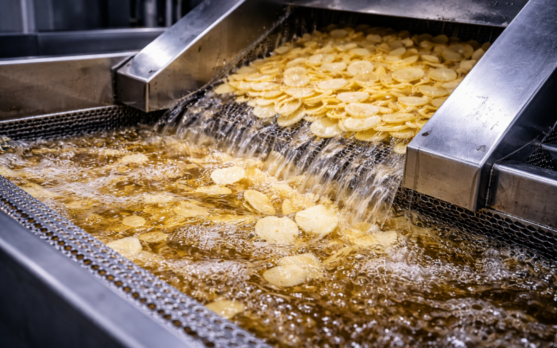
The fryer is no longer just the middle of the line
For a long time, continuous frying was discussed mostly in terms of throughput. Can it run the volume, can it stay stable, can it keep the line moving, can it avoid becoming the place where production goes to argue with itself. All of that still matters, obviously. But the conversation has changed.
Now the questions are more pointed. How quickly does the system react when product load shifts? How tightly can operators hold color and moisture targets across a long run? How much oil is sitting in the system at any one time? How fast are fines being removed? How much energy is being wasted through exhaust, poor insulation, or unnecessary evaporation? That is a very different kind of discussion. It means the fryer has moved from being a capacity machine to being a precision machine.
That change feels overdue. Chips may look simple from the outside, but anyone running a line knows the finished product is annoyingly sensitive to small process drift. A bit too much temperature swing, and color starts wandering. A bit too much oil breakdown, and shelf life starts sulking. A bit too much water carried into the fryer, and energy costs climb for no good reason. The modern sales pitch around continuous frying is really built around fixing those little leaks in performance before they become expensive habits.
Low oil volume is becoming a selling argument, not just a spec
One of the clearest patterns in the latest equipment push is the emphasis on lower oil volume and faster turnover. That makes sense. The more oil a system holds, the more oil has to be heated, monitored, filtered and eventually replaced. A large oil pool can look reassuring on paper, but it also creates drag. Slower response. Higher make-up needs. More thermal mass to manage. More money quietly tied up in a bath of hot capital.
Suppliers are leaning hard into designs that reduce the amount of oil sitting in the fryer while keeping circulation strong and heat distribution stable. That is not just about cost, although cost certainly gets everyone's attention. It is also about product quality. Faster turnover and better filtration help keep oil fresher, which shows up in flavor, color stability and shelf life.
This is especially important in potato chips, where oil quality and finished-product character are tangled together in ways that operators know all too well. If the oil starts aging badly, the chips will gossip about it immediately.
Filtration has become part of the frying story
Older conversations often treated filtration as support equipment. Necessary, yes, but slightly off to the side. That feels less true now. In newer system discussions, filtration is right in the middle of the value proposition.
And honestly, fair enough. A continuous fryer that cannot remove fines quickly is basically being asked to work while someone keeps throwing trouble back into the pan. Burnt particles darken oil, destabilize quality and make consistency harder to maintain across long runs. So the push toward full-flow or near full-flow filtration, short turnover times and continuous fines removal is not decorative engineering. It is central to how the line behaves.
That is one reason newer product messaging sounds more integrated than it used to. Fryer, filter, heat exchanger, oil circulation, defatting and controls are increasingly being presented as one system rather than a row of separate boxes forced into reluctant cooperation.
Tighter frying curve control is quietly becoming the new badge of seriousness
“Frying curve control” can sound a bit grand if you let marketing people hold it too long, but the idea is solid. Processors want more control over what happens to the product across the full length of the fryer, not just one broad average temperature and a prayer.
That is why multi-zone designs, faster feedback sensors, adjustable retention time and better oil-flow management are being pushed so heavily. The goal is not merely to hit a nominal setpoint. It is to shape the product journey more carefully from entry to discharge.
In potato chips, that means managing separation early, moisture removal through the middle, and final color development without tipping into harshness at the end. In stackable or fabricated chips, it means even tighter control because the product is less forgiving and the visual target is stricter. In coated or formed products, it means holding shape and finish without creating a greasy mess.
The important thing here is that consistency is now being sold as a hydrodynamics problem as much as a temperature problem. Oil flow, circulation pattern, belt behavior and submergence control are getting more attention because they directly influence how even the fry really is. That is not glamorous, but it is exactly where better equipment usually wins.
Energy is no longer a side topic
There was a time when energy efficiency in frying could sound like a worthy add-on. Now it sounds like budget survival.
That shift is visible all over current equipment positioning. Heat recovery, insulated hoods, more efficient heat exchangers, reduced exhaust losses, oil recovery and better upstream water removal are all getting stronger billing. Not because the industry suddenly became poetic about sustainability, but because energy has become too expensive and too unstable to ignore.
Continuous frying is inherently energy-hungry. You are evaporating water at scale while trying to hold product quality inside a narrow window. That part will never become cute. But the smarter systems are trying to stop wasting energy on avoidable nonsense. Heating excess surface water. Losing useful heat through poorly managed exhaust. Overheating oil volume that does not need to be there. Running with process interruptions that break efficiency over the week. Those are the kinds of losses suppliers are now targeting much more directly.
And this is where buyers are paying close attention. A fryer does not need to promise miracles. It just needs to show that its design respects physics instead of picking fights with it.
Root-vegetable snacks are shaping the next wave of fryer choices
Potato chips still dominate the conversation, but root-vegetable snacks are adding a useful complication. Sweet potato, beetroot, parsnip, cassava and other vegetable-based chips do not always behave as politely as standard potato slices. Sugar levels, color development, fragility and oil uptake can make conventional frying windows feel uncomfortably narrow.
That is one reason continuous vacuum frying keeps showing up in these discussions. For root-veg snacks, lower-temperature frying under vacuum can help reduce oil absorption, protect color and avoid some of the uglier quality swings that come with more sugar-sensitive raw materials. It is not the answer for every line, and it is not the cheapest path into the category, but it is clearly part of the current product push where processors want a wider product mix without accepting a quality penalty.
So the category is splitting in an interesting way. Standard atmospheric continuous fryers are getting smarter, leaner and better at oil and energy management for mainstream high-volume chips. At the same time, continuous vacuum systems are being pushed harder for premium or trickier root-veg applications where color, oil pickup and natural product character are harder to hold. Different routes, same basic obsession: control more, waste less, drift less.
The real sales pitch is lower drama
Under all the technical language, that may be the simplest way to put it. Processors are being sold lower drama.
Less oil waste. Less temperature wander. Less variation from shift to shift. Less energy leaking out of the line for stupid reasons. Less fouling. Less downtime tied to awkward cleaning and maintenance. Less firefighting when raw material variation starts nudging the process around.
That is why current product pushes around continuous frying feel more convincing than some older “bigger and hotter” messaging. They are not promising a revolution. They are promising a tighter operation. And in high-volume chips and snack processing, tighter operation is usually where the money lives.
There is also a broader strategic point here. As snack producers widen their portfolios, especially into root-veg blends, better-for-you positioning and more premium textures, the fryer has to become more adaptable without becoming temperamental. That is a tricky balance. The new generation of systems is being marketed as exactly that kind of balance: not flashy for the sake of it, but more controllable, more efficient and more forgiving under real plant conditions.
Which, in this strange and lovable industry, is about as close as machinery gets to charm.