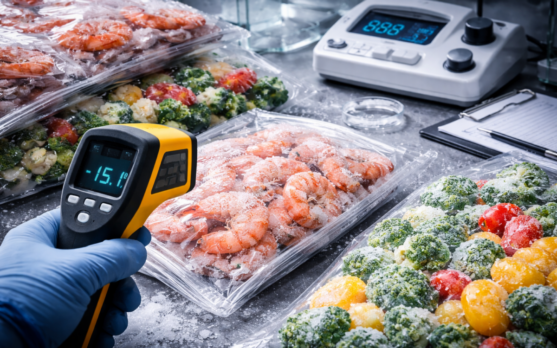
The freezer is often treated as the cold step at the end of the line, the place where a product becomes safe to store, ship and sell. In reality, it is one of the most expensive quality decisions in the factory. A coated chicken piece enters soft, wet and fragile. A pizza carries sauce, cheese and dough with different freezing behaviour. A tray meal moves through the freezer with components that do not release heat at the same pace. A belt is loaded a little too heavily because dispatch is tight. Air misses one corner of the product bed. The centre temperature passes, but the texture has already paid a price.

Frozen quality is made on the way down
Frozen food is not made good at minus eighteen. That temperature is only the storage promise. The more delicate work happens earlier, as heat leaves the product and water becomes ice. The size, shape, moisture, fat, coating, sauce, dough, surface area and starting temperature all decide how the product behaves in the freezer.
That is why a freezer cannot be judged only by nameplate capacity or air temperature. A plant can own an expensive tunnel or spiral system and still damage product through poor loading, weak airflow, excessive residence time or an operating habit that worked for the old SKU but not for the new one. The machine may be cold enough. The process may still be wrong.
The best frozen factories understand the freeze as part of product design. The question is not simply how fast the product can be brought down to target temperature. The better question is how much quality the process buys for each extra minute, each extra metre per second of air and each extra kilowatt spent.
Ice crystals write the texture
The technical language is familiar: ice nucleation, crystal growth, heat transfer, thermal centre. On the line, the result is more direct. A vegetable comes out soft after cooking. A fish fillet loses moisture. A berry collapses. A bakery product dries at the edge. A coated item loses bite. A dessert becomes icy after a rough storage period.
Large or badly managed ice crystals can damage cellular or muscle structure. In seafood and meat, that can show up as drip loss and weaker texture. In fruit and vegetables, it can mean cell rupture, softness and purge. In ready meals, different components may freeze at different speeds, so one part of the meal can be protected while another is stressed. Ice does not care that the product is sold as one SKU.
Fast freezing often helps because smaller crystals tend to be less destructive. That does not mean every product should be attacked with maximum cold and maximum air. A fragile product can suffer from dehydration, surface stress or mechanical disturbance. A robust product may not repay the extra energy. There is no universal freeze that suits the freezer aisle.
The factory has to know the product well enough to stop overcorrecting.
Airflow is not background engineering
Air does the work in most mechanical freezing systems, and air is rarely as obedient as a layout drawing suggests. It moves around product, through gaps, across belts, under trays, over stacked layers and past zones where frost quietly changes performance during the shift.
In a tunnel or spiral freezer, poor airflow distribution can produce a product that passes the average test while hiding weak spots. The edge of a belt may behave differently from the centre. A tray can shield the product beneath. An uneven feed can create clusters that freeze more slowly. A line operator may see good throughput, while quality later sees broken texture, clumping, ice formation or inconsistent reheating.
Air velocity brings its own trade-off. More air can improve heat transfer. Too much can strip moisture from exposed surfaces or waste energy after the quality gain has already flattened. In IQF vegetables, berries or seafood, airflow has to separate pieces without drying them. In bakery or pizza, it has to remove heat without disturbing structure. In coated products, it has to protect the surface before the coating becomes a weakness.
The freezer brochure may show the perfect flow. The plant has to manage the real one.
Residence time is a commercial decision
Residence time sounds technical, but it carries money. A slower belt can protect the centre temperature and give the product a safer freezing window. It also reduces hourly output. A faster belt can free capacity, until the product leaves with a thermal debt that storage or transport cannot fix.
In busy plants, residence time is often pulled into commercial tension. A customer order is late. A promotion has to ship. A line is running a SKU with higher moisture than expected. The product enters warmer after an upstream delay. The temptation is to keep the freezer moving and trust the final check. Sometimes that works. Sometimes the cost appears in claims, broken texture or rework.
Belt loading is where many neat process assumptions fail. A product tested in a clean trial, evenly spaced, does not behave the same way when the line is under pressure. If pieces touch, overlap or arrive at different temperatures, the freezer is being asked to handle several freezing jobs at once. The weakest product on the busiest shift is the honest test of the system.
Factories that treat loading discipline as a minor operator issue often pay for it later in quality variation.
Different products need different freezing logic
Frozen food is too broad for one freezing philosophy. A pea, a fish fillet, a filled pastry, a pizza, a coated chicken strip, a potato product and an ice cream dessert each bring a different structure into the freezer.
IQF systems are strong where separation matters: peas, berries, diced vegetables, shrimp, small potato pieces and other products that must remain individually usable after packing. The key is not just quick cold, but a controlled product bed, enough movement to prevent clumping and enough humidity discipline to limit dehydration.
Impingement systems can make sense for flat or relatively thin products where high-velocity air can break the boundary layer and remove heat quickly. Pizza bases, certain formed foods, bakery items and portions with consistent geometry can benefit. The advantage narrows when the product becomes thick, irregular, fragile or loaded too densely.
Spiral freezers serve many high-volume operations because they give dwell time and capacity in a compact footprint. They are essential in bakery, pizza, protein, ready meals and prepared foods. They also demand discipline: belt hygiene, frost management, airflow balance, loading, maintenance and energy control. A spiral system can be a quality asset or the plant’s most expensive bottleneck.
Cryogenic freezing has its place, especially with delicate, high-value or fast-changeover products, crust freezing, peak demand or constrained space. Its speed can protect surface quality, but gas cost and supply cannot be ignored. A plant using cryogenics for the wrong product may be buying elegance at a price the margin cannot carry.
Energy is part of the quality equation
Freezing faster can protect texture. It can also waste energy if the product does not need that intensity. The uncomfortable truth is that quality and energy are tied together, not enemies and not friends by default.
A frozen fries line, a spiral bakery freezer or an IQF vegetable tunnel can consume serious power. Running colder than necessary, overloading the belt, accepting frost build-up, using poor defrost logic or ignoring uneven airflow can all turn the freezer into an energy leak. Some plants spend money freezing the same product twice: first through excessive cold, then through quality corrections downstream.
The better target is product-specific control. Air temperature, air velocity, belt speed, residence time and loading rules should reflect the product, not the operator’s habit from yesterday’s run. A small portioned snack may need a different profile from a tray meal. A premium seafood product may justify a faster or more gentle approach than a sturdy vegetable mix. A coated product may need surface setting before deeper freezing becomes the main issue.
Energy per kilogram is only useful when quality per kilogram is measured beside it.
The future is a freezer that knows the product
The most credible progress over the next few years will not come from dramatic new freezing language. It will come from better control of existing physics. More sensors in the right places. Better measurement of centre temperature. Zone-level airflow knowledge. Belt-load monitoring. Product-specific recipes. Cleaner data on dehydration, drip loss, texture, clumping and energy use.
Between 2026 and 2028, many plants will get more value from tightening freezer operation than from chasing a new technology label. Better infeed control. More stable loading. Faster detection of frost problems. Smarter defrost. Stronger links between product changeovers and freezer settings. Less over-freezing when the product does not need it.
By the early 2030s, the stronger factories will manage freezing profiles almost the way they manage recipes. Product geometry, moisture, coating, sauce, packaging, target market, cooking method and shelf-life promise will shape the process. The freezer will remain a machine, but it will no longer be treated as a generic cold tunnel at the back of the plant.
The companies that understand this will protect more than texture. They will protect yield, energy, customer trust and repeat purchase.