Industrial refrigeration has always had a brutal weakness that rarely appears in glossy automation decks: the cold store may be controlled, but the day is not. Warm product arrives badly timed. Blast cells fill in bursts. Humidity sneaks in through doors, people, pallets and washdown. Coils frost. Defrost steals capacity at the worst possible hour. Energy prices punish the moments when slowing down is impossible. Freeze Point Suppression is worth watching because it does not merely ask for a better compressor. It asks whether cold itself can be stored, shaped and released with more intelligence.
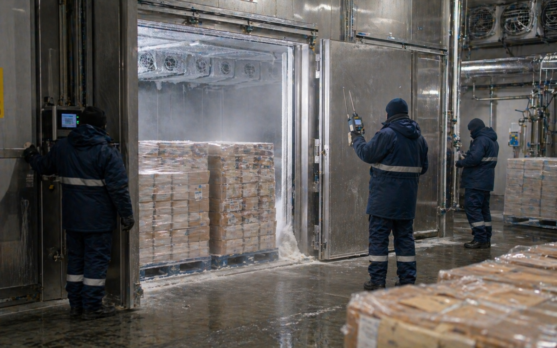
The cold room is controlled. The business around it is not.
A frozen warehouse gives the impression of discipline. Thick insulated walls, heavy doors, hard temperature limits, alarms, engine rooms, procedures. Everything suggests order.
Then the operating day starts.
A trailer waits too long at the dock. Pallets arrive warmer than expected. Production finishes a batch late and suddenly the blast freezer has to catch up. A door is held open because the paperwork, the truck, the forklift and the people are not moving in the same rhythm. Moisture builds where nobody wanted it. The coils begin collecting frost. Defrost is scheduled, postponed, forced, argued over, then paid for.
This is the part of cold storage that rarely gets enough attention. The refrigeration plant may be technically capable, but the load it serves is uneven, physical, wet, human and badly timed. Frozen food operations do not consume cold in a polite straight line. They consume it in waves.
That is why Freeze Point Suppression deserves a serious look. Its importance is not that it sounds chemically unusual. Its importance is that it speaks to one of the oldest frustrations in industrial refrigeration: the plant is powerful, but the operation often needs flexibility more than raw horsepower.
The difficult hour is where the money disappears
Cold stores are not really designed for the average hour. They are designed, directly or indirectly, around the difficult hour.
The hour when product load is high. The hour when humidity is worse than usual. The hour when frost has already reduced coil performance. The hour when the freezer needs to recover quickly but energy prices are high. The hour when slowing down would create a problem for production, dispatch, customer service or inventory.
Those hours are expensive. Sometimes the cost appears as energy. Sometimes it appears as lost freezing capacity. Sometimes as delayed product movement. Sometimes as extra defrost. Sometimes as a future capex discussion because the site feels short of capacity even though the plant looks adequate on paper.
Conventional refrigeration is very good at making cold. It is less good at making cold available in the exact shape the operation wants.
That distinction matters. A cold store does not simply need low temperature. It needs cold at the right time, with the right intensity, without humidity turning the system against itself. The compressor is not the villain here. The peak is.
What Freeze Point Suppression tries to change
Rebound Technologies' IcePoint approach is built on a different thermal logic. In simple terms, the system uses water and a freeze-point suppressant in a closed cycle. Ice is combined with the suppressant to create a very cold working fluid. That cold can then be used when the facility needs it, after which the mixture is separated and reused.
The technical explanation can become complicated quickly. The operational meaning is clearer: cold does not have to be produced and consumed in the same narrow moment.
That creates the possibility of a cold reserve.
For a plant manager, that phrase is more interesting than the chemistry. A reserve means the site may be able to charge cooling capacity when conditions are favorable, then release it harder during a blast cycle, a peak load, a humid window or an expensive energy period. It is the difference between a system that chases the load and a system that has something held back for the ugly part of the day.
That is why this technology should not be filed away as another energy-efficiency gadget. Energy is part of the story, but not the whole story. The more valuable question is whether Freeze Point Suppression can make refrigerated operations less trapped by their peaks.
Lineage made the idea harder to dismiss
The first full-scale commercial IcePoint installation at Lineage's Greeley, Colorado facility gave the concept a level of credibility that pilot language alone cannot provide. Lineage is not a minor buyer testing a novelty. It is one of the largest temperature-controlled logistics operators in the world, and it has already treated blast freezing and refrigeration optimization as strategic work, not back-room maintenance.
The Greeley project matters for another reason too. It was described as an installation that could add cooling capacity and moisture management without requiring critical integration into the ammonia engine room. For anyone who knows cold storage, that is not a small detail.
The industry is full of existing buildings with existing ammonia systems, existing pipework, existing safety routines and existing production pressure. A refrigeration innovation that only makes sense in a clean-sheet greenfield building has a limited path. A system that can sit beside existing infrastructure, if the numbers work, enters a much larger market.
One installation does not prove a category. It proves the question is worth asking in public.
The next proof will be less glamorous: more sites, more seasons, more product types, more humidity loads, more maintenance records, more utility tariffs, more skeptical finance teams.
Moisture is where refrigeration gets punished
The energy story is easy to tell. Moisture is harder to sell, but often more important inside the building.
Moisture enters a frozen operation in ordinary ways. Doors. Dock traffic. Warm product. Washdown. People. Pallets. Packaging. Air movement. None of this looks dramatic. Then it becomes frost.
Frost is not just ice on a coil. It is poorer heat transfer. It is more fan work. It is capacity slowly being taken away. It is a defrost event waiting to happen. When defrost comes, the facility stops doing part of what it is built to do. Heat is introduced into a space designed to remove heat. Afterward, the plant has to recover.
Everybody knows this cycle. That may be the problem. Familiar costs have a way of becoming invisible.
Freeze Point Suppression becomes more interesting if it can pair cooling with meaningful moisture control. Not just moving cold from one hour to another, but reducing the amount of frost pressure the site has to fight. In a blast freezer, a processing room or a busy cold dock, that can be worth more than a neat percentage on a slide.
Defrost is an operating tax
Defrost is usually treated as a technical routine. In business terms, it is a tax.
The facility pays to create cold. Frost reduces the usefulness of that cold. The facility then pays to melt the frost. Then it pays again to remove the heat created by melting it. Somewhere in that loop are lost minutes, stressed equipment, maintenance time and an operator wondering whether the next load can wait.
A technology does not need to eliminate defrost to create value. That is too clean a promise. It may be enough to reduce the frequency, shorten the interruption, slow the performance decay or make freezing windows more predictable.
For some facilities, the best metric will not be annual kilowatt-hours. It will be usable capacity.
How much more product can the same blast cell handle? How much less time is lost to frost management? How much peak exposure is avoided? How much conventional expansion can be postponed because the site now uses its existing cold more intelligently?
Those are not laboratory questions. They are finance questions.
The early winners will be the messy sites
Freeze Point Suppression will not be equally compelling everywhere. A stable freezer room with predictable loads and low humidity pressure may be better served by basic discipline: doors, airflow, coils, controls, insulation, maintenance.
The first strong cases are more likely to be the uncomfortable ones.
Blast freezing with uneven loads. IQF, spiral or tunnel freezing where bursts matter. High-moisture processing areas after washdown. Cold stores with heavy dock activity. Sites with painful demand charges. Facilities where adding conventional refrigeration capacity would mean serious disruption. Buildings where the engine room is not the only constraint, but the business still needs more freezing power.
In these places, cold is not simply a utility. It is a bottleneck.
If a flexible cold layer can make those hours easier, the argument becomes practical very quickly.
The future is probably layered, not revolutionary
The dramatic story would be that Freeze Point Suppression replaces the compressor. Industrial refrigeration almost never changes that neatly.
The more believable future is layered refrigeration.
A conventional base system keeps doing the steady work. Compressors, ammonia or CO2 systems, evaporators, controls, airflow, all the familiar machinery remains. Around it sits another layer that handles the difficult work: peak cooling, burst freezing, moisture control, demand response, defrost pressure, maybe even some avoided capex.
That would still be a meaningful change.
It would move cold storage away from thinking only in installed capacity and toward thinking in usable, time-shifted, process-aware capacity. The plant would not only ask, "How much cooling can we produce?" It would ask, "When do we need that cooling, how hard do we need it, and what humidity cost comes with it?"
That is a more mature refrigeration conversation.
The grid will make this less optional
Cold stores are large electricity users. Refrigeration often dominates the site load. At the same time, energy markets are getting less forgiving. Demand charges, time-of-use tariffs, renewable volatility and carbon pressure are all pushing operators to think harder about when they consume power, not only how much.
Cold storage has always had some thermal inertia. The product, the room and the building envelope can carry a little time. But inertia is blunt. A designed cold reserve is different. It gives the operator a more active way to move cooling work away from the worst hour.
This is where the conversation moves beyond the plant room. A cold store with flexible refrigeration is not just a building that consumes electricity. It starts behaving like an energy asset with a food-safety obligation attached to it.
That last part matters. The product still comes first. Nobody in frozen food gets to gamble with temperature because the grid is complicated. The opportunity is to become more flexible without becoming less reliable.
What buyers should demand before believing the story
Industrial buyers should be skeptical. Not hostile, just skeptical. New refrigeration ideas often arrive with attractive language. Facilities live with the consequences.
The questions need to be blunt.
How much peak demand was actually reduced? How many defrost hours were avoided? What happened during humid weeks? Did freezing time improve on real product, in real packaging, at real load density? How did maintenance change? How much floor space was needed? How did the system behave after months of operation, not days? What happens if production schedules shift? How difficult is integration with the existing ammonia or CO2 plant? What is the payback when energy, throughput, avoided expansion and downtime are counted together?
The best case studies will not sound too polished. They will show ugly operating reality before and after: frost, defrost, load curves, coil performance, freeze time, product movement, maintenance notes, operator experience.
That is the evidence the market needs. Not a cleaner story. A dirtier one.
Why the idea feels larger than one company
Rebound's system is the named technology in this discussion, but the bigger theme goes beyond a single supplier. Cold storage is being forced to become less passive.
For years, refrigeration efficiency meant improving the machine: compressor optimization, controls, refrigerants, doors, insulation, fans, airflow, defrost schedules. That work will continue. It has to.
The next layer is different. It is about giving the operation more room to maneuver. More room around peaks. More room around humidity. More room around power prices. More room around blast freezing bottlenecks. More room around old buildings that cannot easily be rebuilt.
Freeze Point Suppression is important because it belongs to that second layer. It is not just a colder coil or a smarter valve. It is an attempt to change the timing and behavior of cold inside the site.
That is why the story should be treated with both interest and restraint. It is promising. It is not proven everywhere. It may fit certain operations far better than others. It still needs broader commercial data. All true.
But the direction is serious.
Cold is becoming a controllable resource
The frozen food industry already knows how to make cold. The harder question is how to make cold behave.
How to have it ready before the blast freezer fills. How to stop moisture from becoming frost. How to reduce the punishment of peak tariffs. How to give brownfield sites more effective capacity without tearing out the heart of the plant. How to make defrost less of an accepted tax.
Freeze Point Suppression will succeed or fail on practical evidence, not novelty. But it points toward a useful future: refrigeration that is less rigid, less reactive and less exposed to the worst hour of the day.
That would be a real shift for frozen food.
Not because the industry needs another elegant technology story. It needs something more basic: cold that shows up when the operation needs it, without dragging so much frost, cost and lost time behind it.
If Freeze Point Suppression can deliver that, the story is not just beyond the compressor.
It is beyond fixed-capacity thinking.