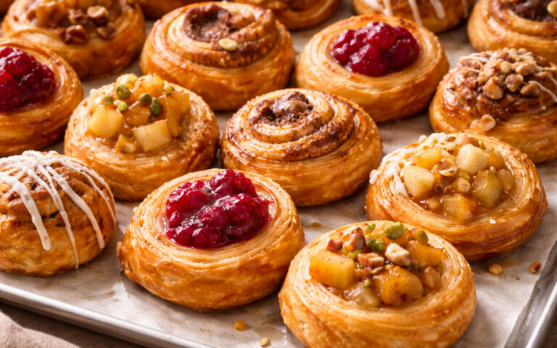
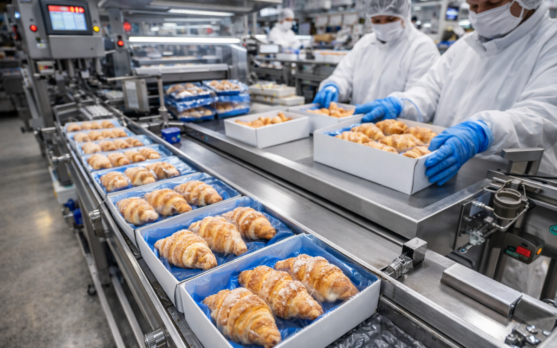
The next premium frozen bakery product will not win because it has the most fashionable filling. It will win because it behaves correctly after freezing: the crust breaks instead of bending, the layers lift instead of collapsing, the filling stays clean instead of soaking into the dough, the cookie edge crisps while the center stays soft, and the product still feels alive after storage, transport and reheating. In frozen bakery, texture is becoming the new proof of competence. Flavor may bring the first purchase. The bite decides the second.

A frozen pastry has to be born twice
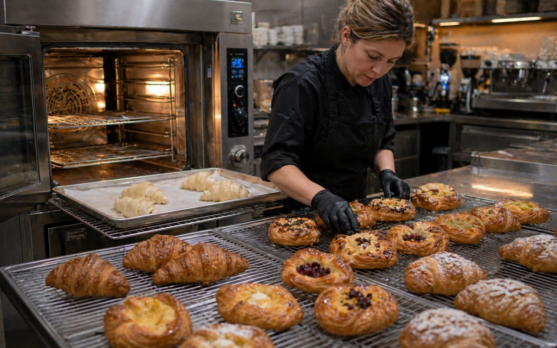
A fresh bakery has the advantage of immediacy. The product is made, baked, displayed and eaten while the sensory structure is still close to its best moment. The crust has not softened too much. The layers have not been compressed by time. The filling has not had weeks or months to move into places it should not. The baker is selling texture while it is still alive.
Frozen bakery works under a harsher contract. The product has to be created once in the factory and then created again by someone else, somewhere else, much later. That second birth may happen in a supermarket oven, a hotel kitchen, a cafe, a convenience store, an air fryer or a tired home oven that has not been calibrated in years. The consumer does not care. The product either comes back properly or it does not.
This is why texture has become such a serious subject. Frozen bakery is not only selling convenience anymore. It is selling recovery. The promise is not simply "this was baked" or "this contains butter" or "this has pistachio cream". The promise is that the product can return from frozen storage with a believable bakery bite.
That is much harder than it looks. A pastry can smell good and still eat flat. A croissant can brown nicely and still bend like bread. A filled cookie can look generous on the box and still arrive dry in the center. A Danish can carry a beautiful fruit filling and still fail because the dough underneath turns wet. The failure is often not dramatic. It is worse than that. It is slightly disappointing.
Flavor gets attention. Texture gets the reorder.
Bakery marketing has always loved flavor because flavor is easy to name. Pistachio. Salted caramel. Ube. Cinnamon. Chocolate hazelnut. Raspberry. Speculoos. Matcha. Lemon cream. Brown butter. These words work quickly. They give buyers something to list, shoppers something to recognize and brands something to photograph.
But flavor is also easy to chase. Once a filling becomes popular, everyone can follow. A trend that starts in a pastry shop can move into industrial formats very quickly. Before long, what looked original becomes another version of the same idea.
Texture is harder to imitate. It is not a single ingredient and it cannot be fixed with a stronger flavor system. Texture comes from the whole architecture of the product: dough strength, fat behavior, hydration, sheeting, folding, proofing, filling stability, freezing rate, packaging, storage, final baking and the time between baking and eating.
That is why texture is becoming a better premium signal than flavor alone. A competitor can copy "pistachio croissant". It is much harder to copy a croissant that opens in clean layers after freezing, holds its cream without leaking, browns evenly, flakes properly and still feels pleasant ten minutes after baking.
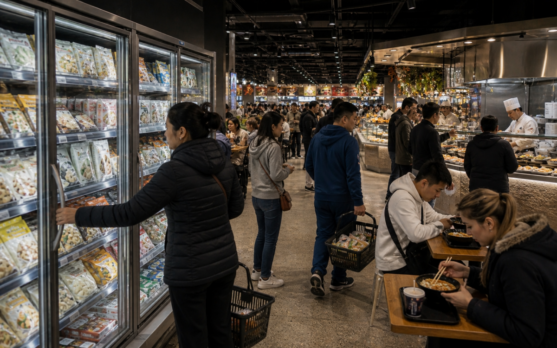
The freezer aisle has reached a point where a good flavor idea is not enough. The product has to prove that it was built for the journey.
The freezer punishes weak product architecture
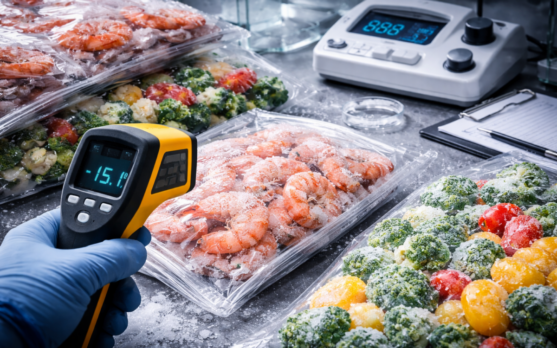
Freezing is useful, but it is not gentle. Frozen storage changes the way water, fat, starch, gluten, filling and crust behave over time. Even when the product is technically safe and commercially stable, its eating quality can drift. Crumb can firm. Crust can lose snap. Fillings can migrate. Toppings can soften. Layers can lose definition. A product that looked promising in the development kitchen can become tired after the real distribution chain.
This is where frozen bakery separates true product development from recipe adaptation. A fresh bakery concept cannot simply be moved into frozen and expected to behave. It has to be rebuilt for freezing.
The most important question is often not "does this taste good today?" It is "does this still taste and feel good after the chain has finished with it?"
That means testing after storage, after thawing stress, after different baking methods, after imperfect handling and after the product sits for a realistic serving window. A pastry that is excellent for two minutes and poor after twelve may work for a tasting panel, but not for a cafe display. A product that performs in a perfect oven but fails in common household conditions has not finished development. It has only passed the easy test.
The bite has become a specification
The industry still uses simple words for texture: crispy, flaky, soft, creamy, gooey, chewy, crunchy. They are useful words, but they are not enough anymore.
In serious frozen bakery development, those words need to become measurable targets. How much force should break the crust? How open should the crumb be? How separate should the layers remain after frozen storage? How long should the crust keep its appeal after baking? How much moisture can move from the filling into the dough before the product loses quality? How much topping can survive packing, freezing and reheating without turning into dust or paste?
This is not overthinking. It is the difference between a product that looks premium and a product that eats premium.
The consumer will never ask about water activity, starch retrogradation, fat crystallization or crust fracture. But the consumer will know immediately when the product feels wrong. The technical language stays in the factory. The verdict happens in the mouth.
Contrast is the new indulgence
Uniform texture can feel safe, but it rarely feels memorable. The bakery products that people talk about usually contain a small moment of contrast. A crisp edge and a soft center. A flaky shell and a cream pocket. A chewy layer inside a delicate pastry. A crunchy topping on a soft bun. A warm filling inside a structured crust.
That contrast is not decoration. It gives the product movement. The first bite is not the same as the second. The product changes slightly as it is eaten. This is why hybrids, layered pastries, filled cookies, croissant-cookie formats, mochi textures and multi-layer desserts keep attracting attention. Some are gimmicks. Some are genuinely smart. All of them point to the same consumer instinct: people want more than one sensation.
Frozen bakery has to handle this carefully. It cannot simply add more cream, more filling, more topping and more layers until the product looks exciting in a cutaway photo. That creates a product built for a launch image, not for eating. The best frozen bakery textures will be controlled, not chaotic.
One clean contrast is often enough. A pastry that flakes and then gives way to a stable filling. A cookie that resists at the edge and softens in the middle. A cinnamon roll that is soft without becoming wet. A savory pastry that stays crisp outside while the filling remains juicy.
Lamination is now a balance-sheet issue
Lamination used to be discussed mainly as craft. In frozen bakery, it has become economics.
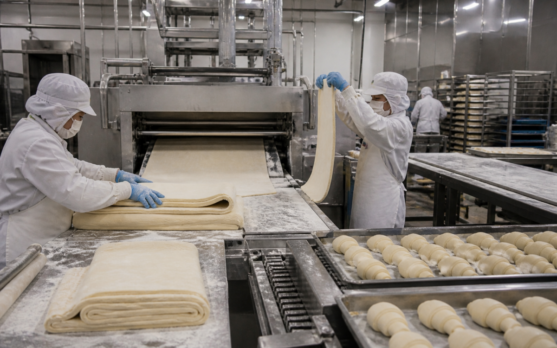
A laminated product is expensive to produce, demanding to handle and very easy to disappoint. If the layers do not open, the premium story disappears. If the fat system fails, the product becomes heavy. If the proofing is wrong, the bite changes. If the filling releases moisture, the bottom suffers. If the final bake is weak, the product looks golden but eats dull.
For a frozen croissant, Danish or laminated savory snack, the layer is not only visual. It is the product's credibility. The consumer reads it before tasting. A good laminated product has height, separation, lightness and fracture. A weak one has a bread-like chew pretending to be pastry.
This is why lamination control will matter more in the next phase of frozen bakery. Better sheeting, better folding, better fat management, better freezing profiles and tighter process control will be commercial weapons, not just technical refinements.
The product that flakes correctly earns the right to charge more.
Fillings can be the hero or the saboteur
Fillings sell the product visually. They make the pack image richer. They give the buyer a story. They create generosity. They also create many of the category's failures.
A filling is not passive. It brings water, fat, sugar, acidity, heat behavior and migration risk into the structure. It can soften the pastry, leak through seams, collapse the center, make the base wet, separate during reheating or turn a crisp product into something heavy.
That is why the filling has to be treated as part of the engineering, not as a late-stage flavor decision. The question is not only what the filling tastes like. It is how it behaves under freezing, storage and final heating. Does it stay where the consumer expects it? Does it remain creamy without flooding the crumb? Does it create contrast or destroy it?
There is a simple rule here: a filling that improves the photo but weakens the bite is not premium. It is expensive damage.
The air fryer changed the consumer's patience
The air fryer has changed expectations across frozen food. It has made crispness feel more accessible at home, and that expectation is now moving into bakery-adjacent products.
Not every bakery item belongs in an air fryer. Some products need oven heat, slower baking or a more controlled finish. But smaller pastries, filled bites, savory bakery snacks, cookie portions and hybrid formats will increasingly be judged by whether they can recover texture quickly and reliably.
This changes product development. Cooking instructions are no longer the boring panel at the back of the pack. They are part of the product's sensory design. A product may need different recommended paths for oven, air fryer and foodservice bake-off. The final preparation method is not just convenience. It is the last stage of texture engineering.
A product that only works in the ideal test kitchen is not ready for the way people actually cook.
Foodservice will ask the hardest questions
Retail wants excitement, but foodservice may be the sharper battlefield. Cafes, hotels, convenience stores, forecourts, coffee chains and QSR operators want bakery quality without always employing bakery skill. They need products that can be finished by regular staff, under time pressure, with equipment that is good but not magical.
For them, texture is not only sensory. It is operational. Can the pastry hold in a display case? Can the crust stay attractive through a breakfast rush? Can the product forgive a slightly imperfect bake? Can it look fresh enough to justify the price even though it arrived frozen?
This is why frozen bakery has such strong potential in foodservice. It can replace part of the labor, but only if the texture survives. If a frozen pastry needs expert handling to perform, it has not solved the buyer's problem. If it bakes consistently and holds well enough for service, it becomes more than a product. It becomes labor insurance.
The next products will be designed as eating sequences
The strongest frozen bakery products will be built less like static recipes and more like eating sequences.
A filled croissant should start with surface fracture, move into airy layers, then reveal a clean center. A cookie should resist at the edge, soften in the middle and release chocolate at the right moment. A Danish should keep its rim flaky, its center creamy and its fruit bright. A savory roll should hold a structured crust while the filling stays moist. A cinnamon roll should feel soft and warm without becoming a wet spiral of sugar.
This is the new development logic. The product needs a beginning, a middle and an ending. Not in a theatrical way. In a practical way. Each bite should make sense.
The old approach was to ask: what flavor are we launching? The sharper question now is: what is the bite supposed to do?
What changes over the next few years
In the short term, more frozen bakery products will use texture language on pack. Flaky layers, crisp outside, soft center, gooey middle, creamy filling, crunchy topping, bake-at-home crispness. Some of these promises will be real. Others will be ordinary products with better adjectives.
In the medium term, the real work will move behind the pack. More companies will formalize texture targets in development briefs. Crust break, filling migration, layer separation, crumb softness, topping adhesion and post-bake hold quality will become harder measures in premium projects. Sensory panels will still matter, but they will be supported more often by texture analysis, imaging and shelf-life validation under realistic conditions.
Longer term, texture may become a category language in its own right. Products will still be grouped as croissants, Danish pastries, cookies, rolls, breads and cakes, but the real shopper promise may become more sensory: flaky-creamy, crisp-soft, gooey-center, crunchy-layered, bake-to-crisp, warm-and-melting, coffee-pairing, display-case stable.
This will change how frozen bakery is bought, developed and merchandised. The category will not only sell what the product is. It will sell what happens when you bite it.
The risk is texture theatre
Every strong trend eventually produces bad versions of itself. Texture will be no different.
There will be products with too many layers, too much cream, too many toppings, too many inclusions and too much visual drama. Some will photograph well and eat badly. Some will be too sweet, too heavy, too greasy or too fragile. Some will ask frozen storage to protect a structure that should never have been frozen in the first place.
The more mature opportunity is not excess. It is precision. Frozen bakery does not need to become louder. It needs to become better controlled.
A single crisp edge can be enough. One stable cream pocket can be enough. A clean crack in the crust can be enough. A soft center that actually stays soft can be enough. Consumers are not asking for engineering tricks. They are asking for the product to deliver the pleasure it suggested.
The bite is now the brief
The future of frozen bakery will not be decided only by the next fashionable flavor. It will be decided by which products feel fresh enough, controlled enough and pleasurable enough after the frozen chain has had its say.
That is the hard part. Frozen bakery has to make convenience invisible. The consumer should not taste the compromise. They should taste crust, layer, cream, crumb, snap, softness and warmth. They should feel that the product came back properly.
That is why texture engineering is becoming the new product development war. It is harder to copy than flavor, more honest than pack design and more decisive than most claims. It turns premium from a word into a physical experience.
If it does not break right, flake right, soften right or recover right, it will not sell twice.