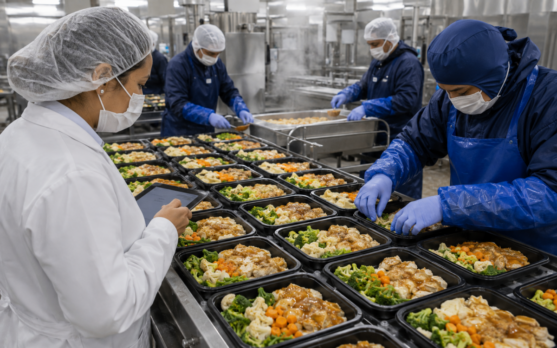
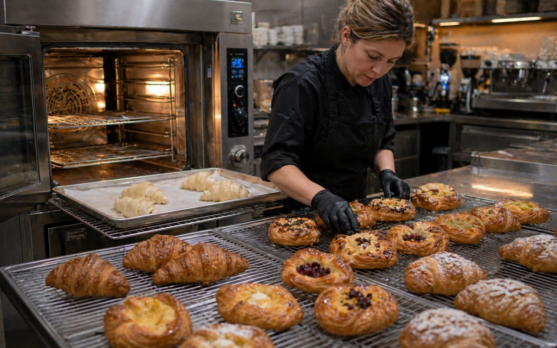
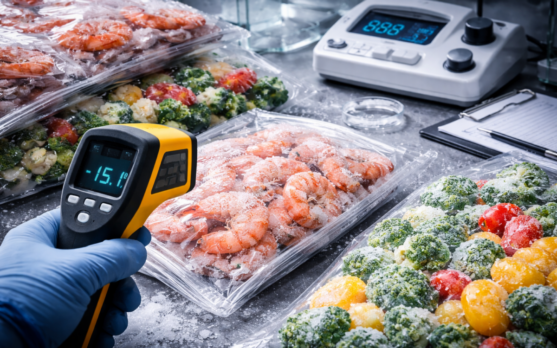
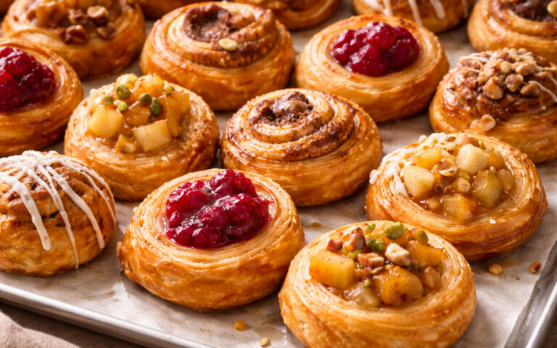
The customer hears the crack of the crust in the café, smells butter near the oven, sees a loaf cooling in a basket and believes the story begins there. Often it does not. In modern frozen bakery, the most important work may have happened days or months earlier, in a plant where dough temperature, lamination, proofing, freezing and final-bake behaviour were controlled more tightly than any small shop could manage on a busy morning. That is the uncomfortable, commercially powerful truth behind premium frozen bakery: craft has become something the factory must make repeatable.
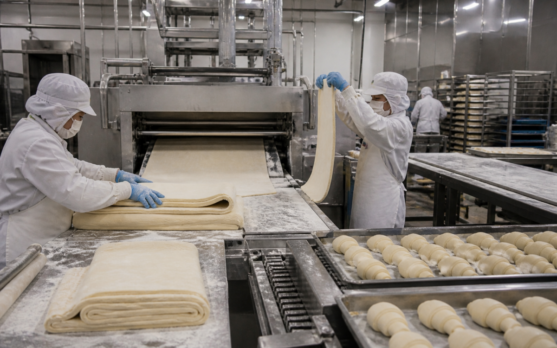
The smell is local. The work may not be.
A supermarket bake-off corner at 7:30 in the morning can look almost theatrical. Staff slide trays into the oven, the first baguettes are moved to the rack, and the bread section suddenly feels alive. In a hotel, small rustic rolls arrive warm just as breakfast traffic starts to thicken. In a café, croissants appear from the back with enough flake and colour to make the counter look more artisanal than the labour model behind it.
That is not a fraud. It is a system.
Frozen bakery has become good at separating the place where skill is concentrated from the place where freshness is performed. The factory handles the difficult parts: flour behaviour, dough development, lamination, pre-fermentation, shaping, proofing strategy, freezing curve, packaging, storage tolerance. The store or kitchen handles the last visible act. The customer experiences the finish, not the full chain.
This matters because the old argument, fresh versus frozen, is too narrow for the category now. Many operators are no longer choosing between a local artisan baker and a cheap industrial substitute. They are choosing between uncertain craft and controlled craft signals: crust, aroma, lift, crumb, scoring, butter note, open structure, irregular shape and a final bake that can be repeated across sites.
Craft has become an output
The word artisan has been stretched almost to breaking point. It appears on breads shaped by machine, pastries rolled in industrial lamination lines and sourdough-style loaves produced at volumes no village bakery could imagine. Still, the word survives because consumers recognise certain signals. They know what a believable crust looks like. They can see a dead crumb. They know when a croissant looks tired before they touch it.
Industrial frozen bakery has learned to produce those signals with discipline. Bridor’s public bread language, for example, separates classic bread from artisan-style bread through crust, honeycomb crumb and fermented dough taste. That is telling. The craft promise is no longer only about hands. It is broken down into sensory evidence.
For a bakery manufacturer, this is where the work becomes more serious. A rustic loaf cannot look rustic on one shift and careless on the next. A croissant cannot have beautiful layers during the customer presentation and collapse after three months in frozen storage. A part-baked bread cannot finish well only when handled by a trained baker. It has to survive a weekday operator, a short-staffed hotel kitchen, a convenience store oven and a retail team working from printed instructions.
The consumer may buy the romance. The operator buys the tolerances.
The factory now controls what bakers once judged by hand
Traditional bakers read dough by touch, smell, temperature, resistance and memory. Industrial frozen bakery has to translate that judgement into process windows. Mixing time. Dough temperature. Resting. Sheeting. Fat plasticity. Proofing humidity. Blast-freezing rate. Core temperature. Packaging. Thawing response. Final bake.
In laminated pastry, the romance of flake depends on something very unromantic: the behaviour of fat and dough under pressure, temperature and time. If the line is too warm, layers suffer. If freezing is too aggressive or poorly managed, yeast activity and structure can be damaged. If proofing is misjudged, the product may look acceptable before freezing and disappoint after baking.
Proofing is one of the least glamorous parts of the story and one of the most important. Raw frozen dough, pre-proofed frozen dough and par-baked bread all move risk to different places in the chain. Raw frozen gives flexibility but leaves more responsibility at the point of use. Pre-proofed and par-baked formats reduce local skill requirements but ask more from the producer’s process control and from frozen distribution discipline.
Anyone who has stood in a back room beside a rack of thawing pastry knows the difference between a product designed for real operations and one designed for a product photo. The better item forgives a little. The weak one exposes every mistake.
Scale is where the artisan promise gets dangerous
At one site, a good team can cover imperfections. At 300 sites, process becomes reputation. At 2,000 sites, language becomes risky.
Panera’s move in the United States toward a par-baked model shows the tension clearly. Operationally, the logic is familiar: improve availability, reduce shortages, simplify production, extend reach and allow more flexible baking through the day. Reputationally, it is more delicate. A brand built around bakery freshness has to be careful when the production story changes, because customers do not always separate final baking from breadmaking.
That is the larger lesson for premium frozen bakery. The model can be excellent, but the story cannot be lazy. “Freshly baked” is true only up to a point. If a product was shaped, partially baked, frozen and finished in store, the final bake matters, but it is not the whole craft. Hiding that complexity may work for a while. It also leaves a brand exposed when consumers or staff explain the process in harsher language.
Industrial artisan bakery needs better honesty. Not a technical confession on every shelf tag. Not a lecture about blast freezers. Just a more mature vocabulary: baked in store, crafted for final bake, part-baked for freshness, finished here, made to be baked close to the moment of sale. Words matter because bakery is emotional. Bread especially.
Equipment is now part of the recipe
The rise of premium frozen bakery is also an equipment story. A strong recipe will not carry poor control. Commercial proofers, tunnel ovens, sheeters, dividers, freezing systems, cooling tunnels, vision checks and packaging lines are no longer background machinery. They decide whether an artisan-style product can keep its promise across batches.
Proofers matter because rise and texture are not decorative. Cooling matters because moisture migration can ruin crust and crumb before the product even reaches frozen storage. Freezing matters because ice formation, yeast viability and structural stability decide how the product behaves later. Quality control matters because a rustic look is not permission for random output.
The market’s interest in bakery processing equipment is therefore not separate from the artisan trend. It is part of it. Operators want the theatre of bakery without depending on scarce skilled labour in every location. Manufacturers want products that look less industrial while being produced with more industrial control. The result is a strange but logical bargain: more machinery behind a more human-looking product.
The final bake is where trust is won
Premium frozen bakery can travel far, but it only becomes convincing at the last oven. A good part-baked loaf still needs the right finish. A croissant still needs proper spacing, heat and rest. A rustic roll still needs enough colour to sell freshness without turning dry. The final bake is where the factory hands the product to the operator and hopes the system was designed well enough.
That makes instructions, training and format choice more important than many range reviews admit. Foodservice does not need products that perform only in demonstration kitchens. Retail bake-off does not need bread that looks excellent on day one of a trial and drifts under normal staff pressure. Hotel breakfast does not need rustic rolls that are beautiful for fifteen minutes and leathery by 9 a.m.
The most successful premium frozen bakery products will probably be the ones that understand the operator as clearly as the consumer. They will carry craft cues, yes, but they will also tolerate real service: imperfect timing, changing traffic, staff turnover, tight freezer space, ovens shared with other products and managers watching waste at the end of the day.
That is where the industrial artisan paradox becomes less like a contradiction and more like the category’s working model. The factory makes the craft repeatable. The operator makes it believable.