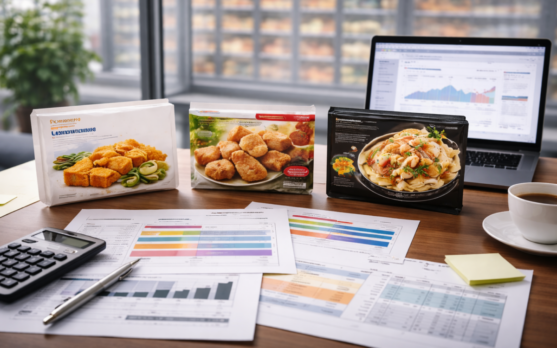
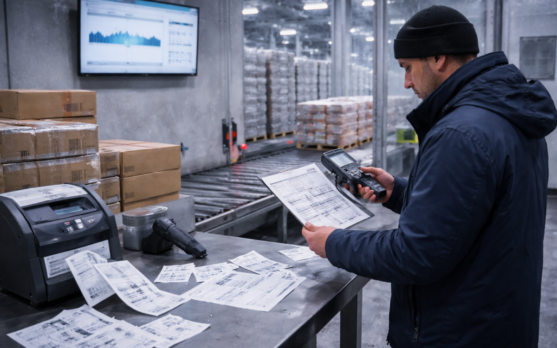
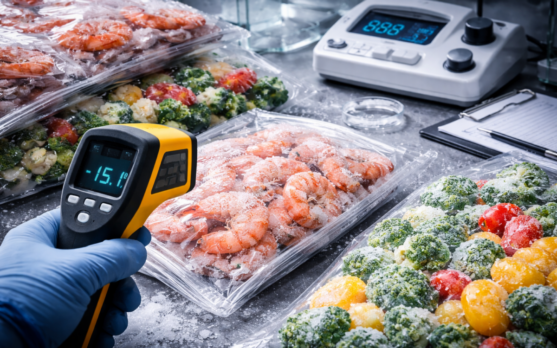
AI forecasting has a neat promise for grocery retail: fewer empty shelves, less waste, tighter inventory, cleaner promotions. In frozen food, that promise is easy to sell. Freezer space is expensive, promotions can swing demand overnight, and a missing SKU can send the shopper straight to a competitor or private label. But a forecast does not stop inside the retailer’s system. It travels upstream, where it becomes production, packaging, cold storage, transport and cost. The shelf may be getting smarter. The supplier may be getting less sleep.
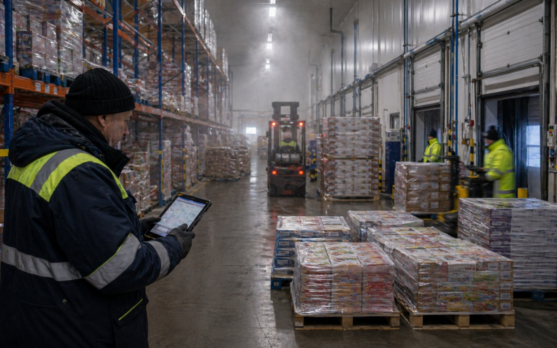
The number changes quietly. The factory feels it loudly.
A forecast update does not look dramatic. It appears in a portal, a dashboard, an export file, a replenishment recommendation. Maybe the volume is down because the promotion opened softer than expected. Maybe it is up because one region is selling faster. Maybe demand has shifted from a branded SKU into private label. Maybe the model has corrected for store stock, weather, substitution or lost sales.
For the retailer, that is the whole attraction. The system reacts. The shelf is protected. Inventory risk comes down. A buyer or replenishment team can move before the old weekly rhythm would have noticed anything.
For the supplier, the same change can arrive too late to be elegant.
The pizza run may already be scheduled. The vegetable packs may already be printed. The frozen bakery supplier may have booked a co-packer window. The potato processor may have allocated raw material and line time. A ready-meal manufacturer may have trays, protein, sauce batches and labor planned around last week’s number. Somewhere in a cold store, pallets may already be sitting under a tariff that does not care how clever the forecast became overnight.
The portal changes. The pallets do not.
That is the conflict now sitting underneath grocery AI. Forecasting is being improved at the shelf edge, but the physical cost of a moving forecast is often paid much further back in the chain.
Retailers are not wrong. They are solving their problem first.
It would be lazy to turn this into a complaint about technology. Retailers have a real problem. Frozen shoppers do not always switch politely when a product is missing. A family looking for a pizza promotion, a parent buying fries for the weekend, a shopper picking up frozen veg for the week, someone grabbing a ready meal after work - these are not abstract demand events. If the product is not there, the sale may be gone.
AI forecasting is attractive because it gives retailers a sharper eye. It can read patterns across store, SKU, season, promotion, local demand and inventory position. It can move faster than a manual planner. It can reduce slow stock before it turns into a cabinet problem. It can push availability in stores where the opportunity is real.
That is good retailing. The problem starts when better retailing becomes supplier volatility by another name.
Frozen food has always depended on planning discipline. The product lasts, yes, but the system behind it is not liquid. Factories still run in batches. Lines still need changeovers. Cold storage still costs money. Packaging still has lead times. Co-packers still need commitments. Imports still sit on calendars that cannot be rewritten every time a model changes its mind.
The retailer sees demand moving. The supplier sees the machinery required to chase it.
Frozen looks flexible only to people who have never paid for freezer space.
The common assumption is that frozen is easier than fresh because the product does not expire quickly. That is only half true, and sometimes the less important half.
Frozen mistakes can survive longer. That is not the same as being harmless.
Wrong stock sits in expensive places. In store cabinets, it blocks doors and facings. In distribution centers, it blocks frozen capacity. At suppliers, it sits in third-party cold stores, eats margin and waits for a promotion, a discount or a second buyer. It may be safe to sell for months, but commercially it can age very quickly. A range review comes. A pack changes. A retailer shifts space. A promotion is cancelled. A competitor moves first.
The product is frozen. The cash is not.
This is why AI forecasting in frozen is more sensitive than it looks. A model can improve the retailer’s cabinet position and still leave a supplier holding stock that exists because an earlier signal was treated as firmer than it really was.
Iceland and Afresh show where the market is heading.
Iceland’s partnership with invent.ai is not just another AI announcement. It matters because Iceland lives close to the frozen category. For a frozen-led retailer, availability and replenishment are not back-office topics. They are part of the commercial promise. If AI helps Iceland reduce gaps, manage stores more precisely and cut poor stock positions, the business case is obvious.
Afresh expanding beyond fresh into frozen and center store points in the same direction. Grocery AI is leaving the fresh perimeter and becoming a full-store operating layer. Frozen dinners, frozen packaged foods, center-store categories and general merchandise are all being pulled into the same logic: better forecasting, better replenishment, tighter inventory, more automated decisions.
That can be good news for frozen. The category has plenty of planning noise. Promotions are difficult. Store execution varies. Demand can be seasonal, local and weather-sensitive. Better tools are needed.
But a better tool in the hands of the retailer does not automatically create a better deal for the supplier.
A buyer may still understand that a frozen innovation needs time. An algorithm may not. A buyer may value a brand because it brings theatre or difference to the freezer. A system may mainly see velocity, stock, margin and substitution. A buyer may accept that a first promotion was poorly executed in store. A model may simply mark the uplift as weak and move on.
Data does not remove commercial power. It can make it cleaner, faster and harder to challenge.
The model can be right and still leave a mess.
This is the uncomfortable part. The AI may not be wrong.
A promotional forecast may have been too high. A supplier may have been optimistic. A brand may have expected more pull than shoppers delivered. A model that reduces the next order after a weak first read may be doing exactly what the retailer asked it to do.
Still, the cost of the earlier expectation remains somewhere.
If production has already run, the supplier owns real stock. If packaging was printed, the supplier owns real material. If cold storage was booked, the supplier owns real invoices. If a co-packer held capacity, someone pays for the slot. The model can protect the retailer from overstock and still leave the supplier with the residue of the old plan.
The factory does not get to undo Tuesday because the model learned something on Wednesday.
This is where the industry needs a more honest conversation. Forecasting accuracy is not enough if the accuracy arrives after the cost has been triggered.
Promotion is the battlefield nobody wants to admit is chaotic.
Frozen promotions can look tidy in a joint business plan. The reality is rarely tidy.
Take a frozen pizza event. The volume is agreed. The supplier builds stock. The retailer expects uplift. Some stores give the product the space. Others do not. One region sells well, another disappoints. A competitor goes deeper on price. Private label takes more share than planned. Weather changes the weekend. The first signal comes in. The AI trims the second wave.
Inside the retailer’s system, that may look like control.
Inside the supplier’s warehouse, it looks like pallets.
This is where the freezer aisle becomes different from a digital dashboard. You cannot always redirect frozen promotional stock neatly. You cannot always turn branded stock into private label stock. You cannot always move one country’s pack into another market. You cannot always turn a cancelled promotion into normal demand without discounting the margin away.
The dashboard has become cleaner. The supply chain has not.
Forecast accuracy is a narrow victory.
Retailers and vendors like forecast accuracy because it gives everyone a number to celebrate. But in frozen, a forecast can be statistically better and operationally worse.
It can reduce the retailer’s stock and increase the supplier’s stock. It can be right at category level and painful at SKU level. It can improve after the fact while being unusable at the moment production decisions had to be made. It can reduce waste in one balance sheet and create write-offs in another.
The better question is not simply, "Was the forecast accurate?"
It is, "Was the forecast usable before the supplier had to act?"
Frozen needs a wider scoreboard: forecast stability inside production lead times, late-change cost, promotional execution quality, supplier stock created by retailer revisions, confidence ranges, the difference between demand signal and order commitment, and the cost of volatility that never appears in the retailer’s inventory report.
Because the most dangerous forecast is not the one that is obviously wrong. It is the one that looks precise, changes late, and leaves someone else holding the cost.
The missing line: signal versus commitment.
A live forecast should move. That is the whole point of using better data. If sales change, if the weather changes, if stores are overstocked, if a promotion is underperforming, the signal should update.
But production cannot be planned against a number that never stops moving.
The industry needs a firmer distinction between forecast as signal and forecast as commitment. Three months out, a forecast is a conversation. Three weeks out, it may be a planning guide. Three days out, after production has run or packaging has been committed, it may be a commercial obligation, at least in part.
There will never be one perfect rule for every SKU. Ice cream is not frozen vegetables. Private label pizza is not a niche ethnic ready meal. Frozen bakery is not imported seafood. But the principle matters: the closer the forecast gets to physical commitment, the less casual revisions should become.
Without that line, AI gives the retailer a live signal and the supplier a moving target.
The supplier’s defense is evidence, not emotion.
Suppliers will need to become more forensic.
Not just complaining that the forecast changed. Showing when it changed. Saving each version. Matching changes to production decisions, packaging orders, cold-store bookings, raw material allocation, co-packer slots and transport plans. Putting a cost next to volatility: overtime, idle time, obsolete packs, emergency freight, extra frozen storage, forced discounting, write-offs.
The useful argument is not, "Your forecast was bad."
The useful argument is, "Your forecast changed after these costs had already been triggered."
That is a much harder argument to dismiss.
Suppliers also need to stop letting retailer forecasts flow straight into production as if every number had the same authority. They need their own interpretation: likely, upside, downside, committed, not committed, promotional risk, execution risk. A forecast is not an order from God. It is a signal from a system built around someone else’s incentives.
Retailers should not hide behind the machine.
The weakest version of AI forecasting is a black box with a purchase order attached.
The model changed it. The system reduced it. The platform updated it. The recommendation moved.
That is not collaboration. It is automation without accountability.
Good retailers will share more than the output. They will share the assumptions behind major changes. They will separate base demand from promotional uplift. They will show confidence ranges. They will mark whether a revision is driven by sell-through, stock distortion, lost-sales correction, substitution, weather or poor store execution. They will review promotions honestly after the event, especially when stores did not deliver the space or visibility used in the original plan.
Most importantly, they will accept that forecast error does not disappear when it leaves the retailer’s system. It usually reappears as supplier cost.
Ignoring that cost is not efficiency. It is deferred conflict.
The middle of the supply base is most exposed.
The largest suppliers will adapt. They have planners, account teams, data capability, cold-store options and enough leverage to challenge the retailer when the number moves too late.
The smallest brands may stay outside the most complex programs, at least for a while.
The pressure sits in the middle: frozen meal specialists, potato and vegetable suppliers, private label producers, frozen bakery manufacturers, dessert makers, importers, ethnic frozen brands, co-packers and challenger brands big enough to carry serious commitments but not always powerful enough to push back.
These companies are being asked to behave like software while paying for factories.
If retailers use AI to demand more flexibility without paying for the flexibility, suppliers will respond. Not always loudly. They may price in risk. Reduce promotional ambition. Avoid certain listings. Push for safer volumes. Prefer private label arrangements with clearer commitments. Launch fewer risky innovations.
The freezer aisle may not collapse. It may simply become more cautious.
Private label may be the quiet winner.
Private label is naturally suited to an AI-led forecasting world. The retailer controls more of the system: data, shelf, margin, range architecture, promotional mechanics and often the manufacturing relationship. The forecast and the commercial priority sit closer together.
Brands still matter, especially strong brands that generate real demand. But weaker brands and new entrants may get less patience. If the model reads velocity quickly and cuts exposure early, a product has less time to prove itself. A buyer may see strategic value in category diversity. A system may see slower movement.
That does not make the system wrong. It makes it narrow.
Frozen categories need efficiency, but they also need discovery. If AI only rewards what already moves fastest, the freezer becomes easier to manage and less interesting to shop.
The next negotiation will be about the forecast itself.
Forecasting used to sit behind the commercial deal. That will change.
Retailers and suppliers will increasingly negotiate the machinery behind volume: access to data, version history, confidence ranges, commitment windows, promotional assumptions, late-change rules, store execution evidence and compensation when revisions create material cost upstream.
Joint business planning will not only ask what volume both sides want. It will ask when that volume becomes real.
This is where AI forecasting becomes more than a supply-chain tool. It becomes a commercial instrument. The retailer may own the model, but that does not mean the supplier should silently own every consequence of the model’s revision.
In frozen, the issue will come early because the category has so much physical cost behind the shelf: freezer space, frozen storage, batch production, energy, packaging, transport, promotion stock. A forecasting mistake does not evaporate. It sits somewhere, usually below zero.
The uncomfortable truth.
AI forecasting will help grocery retail. It will fill shelves more intelligently, cut some waste, sharpen replenishment and make frozen space work harder. The direction is not going away.
But it will also expose the oldest imbalance in the chain. Retailers can change signals faster than suppliers can change factories.
The solution is not less AI. It is more accountability around the AI.
Who sees the assumptions? Who owns the late change? When does a signal become a commitment? Was the promotion actually executed? Did the model protect the shelf by creating cost in the factory? Who pays when the forecast changes after the supplier has already acted?
Until those questions are answered, AI forecasting will remain a split-screen story.
On one side, a cleaner freezer aisle.
On the other, a supplier trying to find a home for pallets the model no longer wants.