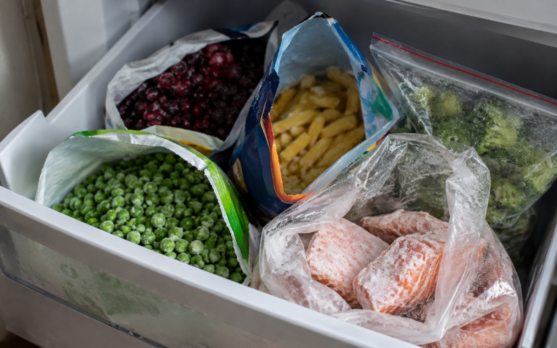
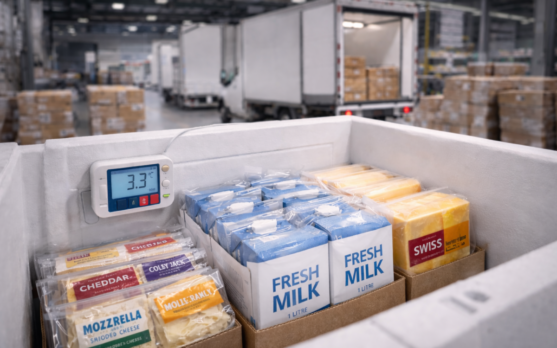
A frozen pack can pass a sustainability review and still fail at the receiving dock. The film may be lighter, the carton may use better fibre, the label may sit neatly on a prototype in the meeting room. Then the real chain takes over: frost, pallet wrap, condensation, gloves, scuffed cartons, scanners, warehouse impatience. If the barcode will not read, if the lot code has smeared, if the label has lifted from the corner, the pack has stopped being a circular packaging success and has become an operational problem.
The small failure that slows a cold chain
Packaging discussions have become big and abstract: recyclability, carbon, mono-materials, fibre transition, recycled content, reuse systems, PPWR readiness. All of that matters. It also leaves room for a very ordinary failure to hide in plain sight.
The label comes off.
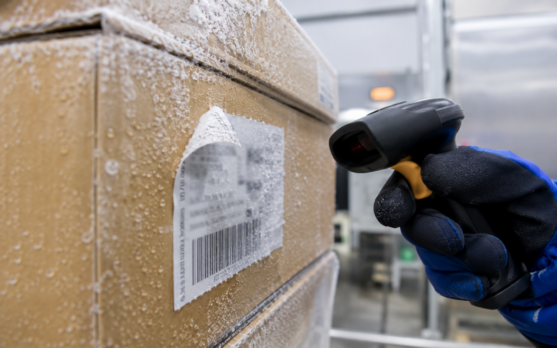
Not dramatically. Maybe one edge first. Maybe the adhesive never really bit into the cold, damp carton. Maybe the print looked sharp at the packing line and blurred after a few hours in the freezer. Maybe the pallet label was fine until the wrap tightened, the forklift nudged the corner and the receiving team had to scan it from a bad angle in poor light.
In a frozen warehouse, nobody has much patience for packaging theory. The case scans or it does not. The pallet matches the ASN or it does not. The lot code can be read or it cannot. If the operator has to stop, turn the case, wipe frost, key data manually or call QA, the label has already failed in the place where it was meant to do its least glamorous work.
A sustainable frozen pack still needs to move.
The pack is not only material. It is identity.
Frozen food does not travel as product alone. It travels with identity attached to it: GTIN, lot, date, allergen information, handling instructions, retailer data, case codes, pallet SSCC labels, sometimes QR or 2D codes carrying more information than the old barcode ever did.
That identity layer is what lets the product move through receiving, storage, picking, rotation, recall checks and shelf execution. A frozen lasagne with a beautiful new tray but a weak case label is not a complete packaging improvement. It is a better-looking object with a weaker passport.
Retailers know this. Wakefern’s supplier requirements say pallet labels must be temperature-sensitive to prevent smearing in freezing conditions, and that SSCC barcodes must correspond to the pallet contents and the ASN. Kroger’s traceability material says much the same: clear, legible, scannable labels, temperature-sensitive labels, and a physical pallet identity that matches the electronic record. Ocado’s supplier manual describes the SSCC label as the physical barcode that identifies what is on the pallet and links it to the ASN message.
That is not decoration. That is the nervous system of inbound logistics.
Freezers punish optimism
Ambient packaging can flatter a label. Frozen packaging exposes it.
A carton may look dry at the packing line and meet condensation later. A flexible pouch may have a low-energy surface that dislikes the chosen adhesive. A fibre-based sleeve may behave differently once moisture, cold and abrasion start working together. A pallet label may sit under stretch wrap, then be rubbed by movement in a truck or rack. A code printed on a curved or wrinkled surface may scan in the office and fail in the depot.
Frost is not just cold. It is interference. Condensation is not just water. It is a test of whether the adhesive bonded to the pack or to a temporary wet surface. Once the water moves, the bond can move with it.
That is why freezer-grade adhesives exist in the first place. Suppliers do not develop deep-freeze label materials because the problem is imaginary. They develop them because ordinary adhesive behaviour can be too weak for cold, damp and low-temperature environments. The detail that matters is not only service temperature. Application temperature matters too. A label may survive at minus 20 degrees after bonding, but still perform badly if applied to a cold or moist substrate before the bond has formed properly.
The freezer does not care whether a label was chosen for a sustainability presentation. It cares whether it sticks.
Sustainable redesign can disturb the old label system
A packaging change is rarely only a packaging change.
Switch from a laminated structure to a mono-material film, and surface energy may change. Move from plastic to paperboard or fibre, and moisture behaviour changes. Reduce material weight, and stiffness can change. Add a different coating, varnish or barrier, and print or adhesive performance may change. Replace a pressure-sensitive label with direct print, linerless label, wash-off label or a smaller identification area, and the warehouse may discover the compromise before the sustainability team does.
There is also the recycling question. A pouch can be designed for better recyclability, then weakened by a label, ink, coating or adhesive that does not fit the intended stream. PPWR is pushing companies to think about packaging as a full system. Frozen food should take that seriously. The main substrate is not the whole pack. The label and adhesive are part of the pack’s end-of-life behaviour and part of its operating life.
Food-contact rules add another layer. Packaging materials, including paper, plastic, metal and glass, must not release substances that endanger health or affect food composition, taste or smell. Labels and adhesives may not always touch the food directly, but frozen packs are squeezed, flexed, frozen, thawed at the surface, rubbed and handled. A new label system needs the same discipline as the visible packaging material.
The green pack cannot be approved in pieces while the cold chain has to handle it as one object.
The cost arrives in dull places
Label failures rarely make headlines. They show up in dull places, which is exactly why they get underestimated.
A warehouse operator scans a case twice, then keys the code manually. A pallet sits in exception flow while the team checks whether the SSCC matches the ASN. A retailer applies a compliance charge. QA blocks a lot because the date code is unreadable on part of the shipment. A picker grabs the wrong case because the label has curled under frost and the human-readable text is partly gone. A customer complaint triggers a traceability search that should have taken minutes and takes hours.
None of this is glamorous. All of it costs money.
Frozen food adds pressure because time in the wrong place matters. A pallet delayed at a dock is not the same as a pallet of shelf-stable biscuits waiting quietly. Cold-chain delays become labour, temperature risk, dock congestion, service failure and irritation. Operators may work around a bad label once. If it becomes a pattern, it becomes a supplier reputation problem.
A recyclable pouch with an unreadable code is still a failed pack at the receiving dock.
The test has to leave the conference room
Frozen packaging trials should be harder on labels than many companies make them.
A clean prototype in a boardroom does not say much. The useful test is uglier: apply the label on the real substrate, at the real line speed, under realistic moisture and temperature conditions, then send it through freezing, storage, palletisation, wrap, transport, abrasion, thaw-condensation cycles and scanning from normal warehouse angles.
Then check it again. Not only once. Check the barcode grade. Check whether the lot and date remain legible. Check whether the pallet label can still be read through the physical mess of a real load. Check whether operators wearing gloves can handle the pack without lifting an edge. Check whether the label material supports the recycling claim rather than quietly damaging it.
GS1 barcode guidance is clear that barcode quality must hold long enough for normal supply-chain use. That is the right mindset. Frozen brands should stop asking whether the code scanned in the test room and start asking whether it scans after the pack has lived the life it was designed for.
Cold-chain packaging has to be designed for scanners, gloves, frost, condensation and impatience. Especially impatience.