The next margin battle in French fry processing will not be won only in the fryer, the freezer, or the packaging hall. It will be fought much earlier, around the small dark spot that decides whether a potato strip is thrown away, downgraded, trimmed, recovered, or sold. For years, processors have talked about defect detection as a quality-control function. That language is already too narrow. In a market where raw potato quality is less predictable, skilled labor is harder to secure, specifications are tighter, and long production cycles leave little room for waste, the real prize is no longer just seeing the defect. It is saving the good product around it.
The industry has been trained to worship detection. That is no longer enough.
French fry processors have spent years improving the ability to find problems: dark spots, green discoloration, bruises, rot, sugar ends, length variation, off-color strips, foreign material, and anything else that threatens final quality. Detection matters. It always will. But the sharper question now is what happens after the defect is found.
A conventional reject decision can be brutally simple: if the strip is defective, remove the strip. That protects quality, but it also throws away usable potato. In a lower-cost environment, that loss might have been absorbed as part of doing business. In the current processing economy, it looks different. Potato supply is under climate pressure. Raw material variation is harder to smooth out. Energy, labor, oil, water, maintenance, and downtime all carry more weight. A small over-rejection problem repeated across thousands of kilograms per hour is not small anymore.
This is why defect salvage deserves its own language. It is not the same as sorting. Sorting asks whether a product belongs in the accept stream or the reject stream. Salvage asks how much good product is trapped inside the reject decision, and whether the process can recover it without weakening customer specification, food safety, or brand trust.
A dark spot is not just a defect. It is a value decision.
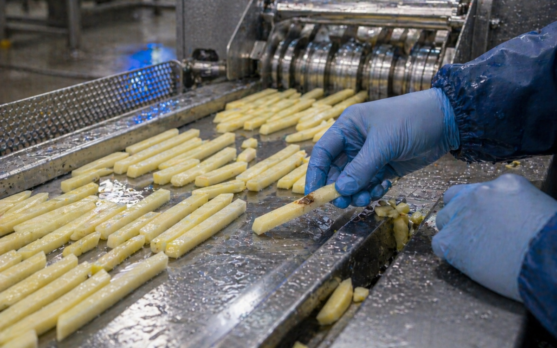
The commercial logic is simple, but powerful. A French fry strip with a local defect is not always a worthless strip. If the affected section can be removed precisely, the remaining portion may still be usable. That changes the economics of the line. The value is no longer only in rejecting the bad part. The value is in keeping the good part from becoming invisible waste.
That is the strategic difference between defect detection and defect salvage. Detection protects the product. Salvage protects the product and the margin. In practice, this means the processor has to understand the mass of product being lost, the quality of what is being rejected, the amount of good-in-bad product, the accuracy of trimming, the value of recovered strips, and the commercial destination of material that cannot stay in premium specification.
The most dangerous waste in a French fry plant is not always the waste that looks obviously bad. It is the good potato quietly leaving the line because the system made a broad rejection when a precise cut would have been enough.
Why this matters more now
The timing is important. Potato processors are not operating in a stable raw-material environment. Weather variability, storage conditions, bruising, reducing sugars, handling damage, and variety performance all affect what reaches the line. A lot may look acceptable at intake and still create trouble after peeling, cutting, blanching, or frying. Blackspot bruising is a classic example because it can be difficult to see in intact tubers before the skin is removed. Sugar-related browning is another, because the defect may express itself more clearly after heat treatment.
At the same time, final-product expectations are not becoming looser. Large QSR chains, retail brands, and foodservice customers want consistency. They want fries that meet length, color, texture, defect, and appearance standards with minimal variation. The gap between variable input and fixed output is widening. That gap is where technology vendors are now positioning the next generation of sorting and trimming systems.
The old answer was more inspection. The better answer is more intelligent yield control.
ADR X is a signal, not just a machine launch
Key Technology's new ADR X is one of the clearest recent signals that the industry conversation is shifting. The message is not simply "we can detect defects better." The message is that wet potato strips can be aligned, inspected, and trimmed so that only the affected area is removed, allowing more usable product to be recovered.
That detail matters. Precision trimming changes the commercial role of inspection. The system is no longer just a gatekeeper. It becomes a recovery tool. Multi-spectral sensing, advanced lighting, recipe-driven adjustment, hygienic design, clean-in-place functionality, and high-capacity operation are all important. But for executives, the core issue is simpler: can the system turn a defective strip into a sellable strip often enough to justify the investment?
That is where the conversation should move. Not how much "AI" or sensing the equipment has in abstract terms, but how much margin is recovered from defect streams that would otherwise be lost, downgraded, or manually handled.
Optimum Sorting points to the same economics
Optimum Sorting is pushing a similar public message from another angle: every fry counts. Its modular approach, including 360-degree inspection, metal detection, Sort-to-Spec, and Sort-to-Length, speaks directly to processors that want more value from existing lines, not necessarily a full replacement of their sorting infrastructure.
The interesting part is not only the hardware. It is the logic behind Sort-to-Spec. In French fry processing, not every customer specification is identical. A slight imperfection might be unacceptable for one premium contract, acceptable within a defined limit for another, and commercially better redirected to a different use in a third case. That turns sorting from a fixed quality decision into a dynamic margin decision.
This is where the industry is going. The future is not one universal definition of defect. It is defect tolerance by customer, by batch, by product grade, by risk, and by value.
The hidden KPI: good product inside the reject stream
Executives should pay much closer attention to what is sitting inside the reject stream. The reject stream is not one thing. It may contain severe defects, foreign material, unsafe material, out-of-spec product, short pieces, off-color strips, and perfectly usable potato lost through conservative ejection or broad trimming.
That last category is the money leak. A plant that does not measure good-in-reject is partly blind. It may know its yield, but not fully understand why yield is being lost. It may know its defect rate, but not know how much sellable mass is being sacrificed to protect that defect rate. It may know its sorter performance, but not know the economic cost of false rejects.
The next generation of potato processing performance should include a more precise KPI set:
- good-in-reject rate
- recoverable defect mass
- false reject cost
- trim efficiency
- salvage yield
- customer-specific defect tolerance
- downgrade value versus recovery value
- operator intervention per ton
These are not just engineering metrics. They are margin metrics. Once processors can quantify them, defect salvage becomes easier to defend as a capital decision.
This is not a shortcut around food safety
There is one important line that should not be blurred. Defect salvage is not an excuse to save unsafe product. Foreign material, rot, contamination risk, severe decay, and microbiological concerns belong in a different category. They are not margin opportunities. They are food safety decisions.
The business case for salvage exists where the defect is local, visual, measurable, and removable, while the remaining product can still meet the relevant specification. That discipline is essential. A processor that becomes too aggressive in recovery can damage quality and customer trust. A processor that is too conservative can destroy yield. The value sits between those extremes.
In other words, the future is not "save everything." The future is "know exactly what can be saved, why it can be saved, and where it should go."
What changes next
In the short term, more French fry processors will ask vendors to prove recovery on real reject streams, not only on ideal demonstration samples. The key question will be direct: from 100 kilograms of rejected or defective flow, how many kilograms of good product can be recovered, at what quality level, and with what operational stability?
In the medium term, defect salvage will become more connected to customer specification management. Lines will increasingly adjust not only to product condition, but to commercial destination. Premium QSR, retail private label, foodservice, coated fries, formed potato products, flakes, and other secondary outlets will each carry different value logic. Sorting and trimming will have to reflect that reality.
In the long term, salvage data will move upstream. Growers, storage managers, procurement teams, and plant managers will not only discuss tonnage and defect percentages. They will discuss value lost and value recovered by lot, field, variety, storage regime, handling profile, and processing condition. That could make defect salvage one of the most useful feedback loops in potato processing.
The new economics of the imperfect fry
The French fry business has always lived with imperfection. Potatoes are biological raw materials. They bruise, age, vary, store differently, react to weather, and behave differently under processing stress. What is changing is the ability to make more precise commercial decisions around that imperfection.
That is why the dark spot is becoming a strategic object. It is small, but it reveals the whole economics of the line. How good is the inspection? How precise is the trimming? How much good product is being lost? How flexible are the specifications? How much does the plant really know about its reject stream? How quickly can the line adapt when raw material changes?
For decision-makers, this is the bigger story. The next wave of potato processing technology will not be won by systems that simply promise better detection. It will be won by systems that help processors convert imperfect raw material into the highest possible commercial value, without losing control of quality.
Every dark spot is not only a defect. In the modern French fry plant, it is a margin question waiting to be answered.