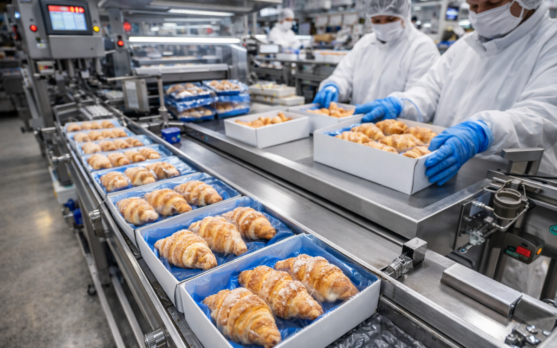
A frozen artisan pastry has a difficult promise to keep. It has to look a little handmade, travel like an industrial product, bake reliably in a store or café oven, and still give the customer that short, warm, buttery moment that feels closer to a bakery counter than a freezer case.

The artisan look is no longer enough
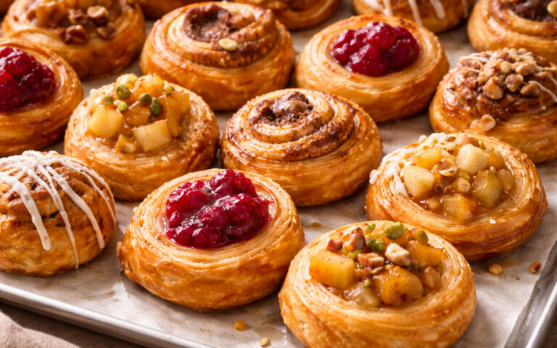
Frozen pastry has become very good at borrowing the visual language of the patisserie. Uneven edges. Deep golden colour. Almond flakes. Pistachio cream. Dark chocolate lines. A label that speaks of French recipes, long fermentation, butter and craft.
That language still matters. It gets the product noticed. It gives the retailer a stronger story than another basic croissant multipack. But the market has moved past decorative artisan cues. A product cannot survive on rustic styling if the final bake is flat, the filling leaks, the layers collapse or the aroma disappears before the tray reaches the display.
The harder question now sits behind the look. Can the product carry the artisan impression through industrial production, freezing, storage, transport, final baking and service? If it cannot, the claim becomes fragile. In frozen bakery, romance has to survive logistics.
That is the quiet tension in the category. The shopper wants bakery pleasure without planning. The retailer wants a premium signal that lifts the fixture. The operator wants products that work even when the person handling the oven is not a baker. The manufacturer has to make all three believe the same pastry.
Frozen pastry now has to carry the bakery moment
The bakery moment is not just taste. It is smell, heat, surface, sound and timing. A croissant cracking slightly when it is picked up. A Danish that still looks generous after bake-off. A filled pastry that shows enough centre to feel indulgent, without becoming messy or unstable.
Fresh bakery can rely on proximity. The oven is nearby. The staff may know the product. The batch can be adjusted. Frozen pastry has to carry that impression from much further away. The product is built in one place and finished somewhere else, sometimes weeks later, sometimes by a retail employee working between a delivery, a coffee machine and a queue of morning customers.
This is why premium frozen pastry is becoming less about decoration and more about built-in resilience. Lamination has to lift. Butter aroma has to release at the point of baking. Fillings have to remain stable after freezing and still feel generous after heat. Toppings must survive packing and handling. A pastry that looks artisanal before freezing but tired after bake-off has missed the commercial brief.
In the freezer aisle, the promise is slightly different. The home shopper wants control and convenience. They want a bakery-style product waiting in the freezer for Sunday breakfast, a last-minute dessert, a brunch tray, an indulgent snack. The product still has to perform, only now the final oven may be domestic, impatient and poorly calibrated.
Bake-off is where premium becomes operational
The most important stage in frozen artisan pastry may be the one the factory does not control directly. Bake-off is where the category either earns its premium language or loses it.
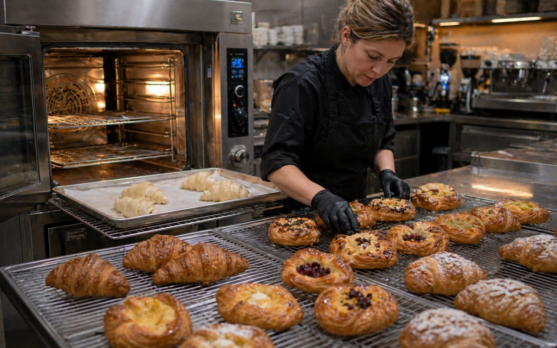
In a hotel kitchen, a tray of croissants needs to look right at breakfast without a pastry chef rebuilding the product. In a convenience store, the smell of baking has to pull people from the coffee machine to the display. In a forecourt, a Danish or filled croissant must tolerate a short service window and still look worth buying. In a small-format supermarket, bakery theatre may depend on equipment, timing and staff who are already stretched.
That makes operational tolerance a premium feature. Not glamorous, but decisive. A good frozen artisan pastry should not need perfect handling to look acceptable. It should forgive minor variation in baking time, staff routine and display conditions. It should hold enough visual quality for the sales window. It should not punish the operator with excessive waste.
There is also a labour argument. Skilled bakery staff are expensive and not always available. Frozen bake-off gives retailers and foodservice operators a way to sell freshness cues without running a full bakery operation. The better the frozen product, the more convincing that compromise becomes.
Retailers are turning artisan cues into category value
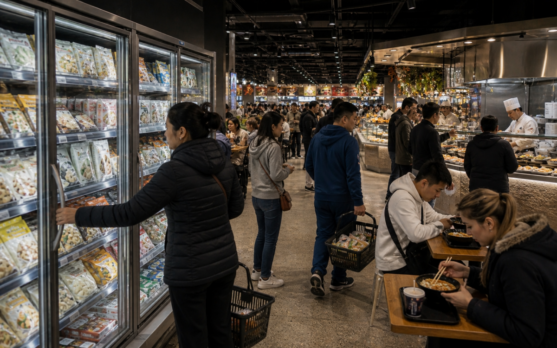
Retailers understand the power of bakery better than almost any category. It creates smell, impulse and a sense of store activity. Even when the product is frozen upstream, the customer reads the final bake as freshness.
That is why artisan-style frozen pastries fit so neatly into premium own-label and in-store bakery strategies. They can act as affordable indulgence. They can stretch a private-label tier upward without forcing the shopper into café pricing. They can create seasonal drops around almond, pistachio, chocolate-hazelnut, maple, custard, fruit or savoury fillings. They can sit in breakfast, brunch, snacking, dessert and coffee occasions with relatively small changes in format.
The danger is sameness. Once every retailer has a premium croissant, a filled Danish and a few nut-topped pastries, the difference becomes harder to see. The stronger ranges will have clearer roles. A large butter croissant for breakfast. Mini viennoiserie for sharing. A filled pastry for afternoon coffee. A savoury laminated item for food-to-go. A limited seasonal line that feels like a reason to visit, not just another flavour.
Premiumization in this category cannot mean adding more decoration to the same base product. It has to mean better eating quality, better bake-off reliability and a sharper reason for the SKU to exist.
The supply chain decides what survives
The cold chain is not a neutral background. It shapes what kind of artisan cues can be trusted.
A delicate topping may look beautiful in development and break in distribution. A visible filling may help sell the product and create leakage risk. A taller pre-proofed product may look premium but cost more to transport. A compact format may travel better, but only if it can recover volume and texture in the oven. Packaging has to protect appearance without destroying margin or creating too much material burden.
This is why some of the most interesting innovation in frozen pastry is not visible to the shopper. More compact formats. Proof-in-bake systems. Better freezing control. Dough structures designed for transport. Fillings adjusted for stability. Glazes and toppings that can tolerate handling. These are the industrial details that allow a product to look less industrial at the point of sale.
Recent consolidation in frozen bakery also points in this direction. Large players are not only buying capacity. They are buying reach, product platforms, retail relationships, foodservice access and the ability to deliver premium bakery consistently across markets. Artisan cues have become scalable assets, but only when backed by systems that can repeat them.
The forecast: less romance, more repeatability
Short term, the category will keep leaning into visible indulgence. Expect more filled croissants, premium Danish pastries, pistachio and almond formats, chocolate-heavy lines, savoury laminated snacks and seasonal items built around limited retail windows. The strongest products will not be the most ornate. They will be the ones that bake well under ordinary conditions.
Over the next few years, premium own-label will play a larger role. Retailers need products that create trade-up without losing value-conscious shoppers. Frozen artisan pastries are well suited to that brief because they give an accessible version of the café or patisserie moment. The price can sit above standard frozen bakery, but below high-street bakery and coffee-shop treats.
Foodservice will keep pushing the same logic from another angle. Hotels, cafés, convenience stores, forecourts, caterers and smaller retail formats will want bakery quality without the full bakery labour model. That favours suppliers who can provide not just pastry, but an operating solution: case format, bake guidance, waste control, range architecture and reliable sensory outcome.
Longer term, the word artisan will probably lose some of its force. Too many products already use it. The better language may become more specific: all-butter, long-fermented, layered, filled, ready-to-bake, proof-in-bake, sourdough, origin-led, hand-finished where that is genuinely true. The category will still trade on craft, but craft will need evidence.
A frozen artisan pastry does not have to replace the local bakery. That was never the most credible job. Its real task is to give retail and foodservice a repeatable version of the bakery moment, one that can travel through the cold chain and still feel worth paying for when it reaches the customer.