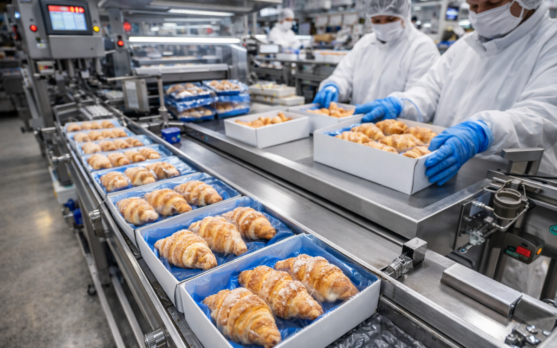
A vegan savoury pastry no longer has to convert anyone. Its harder job is more ordinary: survive a buyer meeting, earn a facing in a crowded frozen set, crisp properly in an air fryer, and make a flexitarian shopper reach for it again after the first discounted trial.
The old vegan story is too small for this category
For years, plant-based bakery was written about as if the shopper were standing in front of the freezer with a manifesto in one hand and a basket in the other. That was always a narrow reading of the market. The stronger commercial read is much less theatrical. Most people buying plant-based food still buy conventional food. They are not asking frozen bakery to solve their identity. They are asking it to give them something quick, hot, crisp and convincing enough for Tuesday night.
That distinction matters. A frozen vegan sausage roll, a peppered steak-style slice or a bean-filled bake does not compete only with other vegan food. It competes with pizza, fries, nuggets, wraps, filled breads, chilled pastry, food-to-go and whatever sits closest to the air fryer. The purchase may start with curiosity, but the repeat purchase is decided by pastry, filling, price and cooking performance.
The wider plant-based market still has momentum in Europe, although it is no longer moving like a simple boom story. The growth is patchy, more disciplined and more dependent on everyday formats. That is good news for frozen bakery, provided manufacturers stop treating vegan pastry as a moral badge and start treating it as a freezer product with a job to do.
Savoury pastry gives plant-based a better vehicle
Plant-based meat alternatives have carried much of the public conversation, but they are unforgiving products. A burger patty has nowhere to hide. A chicken-style fillet either gives the bite people expect or it does not. In savoury pastry, the brief is different. Lamination, steam, sauce, seasoning and fat all work together. The filling still matters, but the eating experience is broader.
That gives bakery manufacturers more room to build products around pleasure rather than mimicry. A mushroom and herb sausage roll can work without pretending too hard. A Moroccan bean bake has its own logic. A chilli bean slice, a red Thai curry slice or a vegetable and gravy pasty can lean on flavour, warmth and pastry architecture instead of chasing the exact bite of meat.
This is where the category becomes interesting for frozen. Frozen bakery already knows how to sell comfort in a controlled format. It knows batch production, portion control, cold-chain discipline, bake-off behaviour and retail theatre. Plant-based fillings bring formulation problems, but they also remove some of the direct comparison pressure that hurts meat analogues. If the product is called a vegetable bake and eats well, the shopper does not inspect it like a failed steak.
There is a small but important lesson in the UK market. Wall’s Pastry has pushed vegan savoury slices into familiar territory, with peppered steak-style and chicken and mushroom-style formats. Country Choice has taken a wider foodservice and bakery route, listing vegan sausage rolls, steak-less bakes, Moroccan bean bakes and pasties. These are not exotic propositions. They look like products a shopper already knows how to use.
The air fryer has changed the product brief
The air fryer has made frozen snacks more demanding. It has also made them more sellable. A frozen pastry that comes out pale, dry or greasy now fails in a much more public way, because consumers have learned to expect speed and crispness from frozen products. The old oven instruction is not enough. The product has to be engineered for short cooking, hard surface heat and moisture control.
For vegan savoury pastry, that raises the standard. The filling cannot leak into the layers. The pastry cannot toughen before the centre is hot. A sauce with pea protein, jackfruit, beans or mushroom has to hold its texture through freezing, thawing at the surface and rapid reheating. Too wet, and the base collapses. Too dry, and the shopper gets a hot pocket of paste.
In a plant trial room, this is not an abstract trend. It is a tray of bakes coming out of a test air fryer, some blistered correctly, some cracked at the seam, some with the filling shifted to one end. The difference between a product that earns repeat purchase and one that becomes a January promotion write-off can be a few grams of water, a sauce viscosity change or a pastry fat that does not behave well after freeze-thaw abuse.
Air-fryer-ready should not be used as a lazy label. It should mean the product has been designed around that appliance. Smaller formats may have an advantage: mini bakes, party rolls, two-bite pastries and snackable filled pockets can heat quickly, control portion size and fit the way younger households graze. Larger slices still have a role, but they have to justify the wait and the calorie load.
Retail trial will be won by price, not ideology
The buyer will ask the blunt questions first. What does it replace? Where does it sit? Is it a Veganuary line, a permanent range extension or a private-label test? What happens after the first promotion? How close is the price to the conventional sausage roll, pasty or bake?
Plant-based pastry has a pricing problem if it behaves like a speciality product. The flexitarian shopper may be curious, but curiosity weakens fast when the vegan option carries a visible premium beside a familiar meat-based pastry. Lidl’s price-parity work with its Vemondo range in Germany points to a wider truth: plant-based can move from experiment to habit only when the shelf does not punish the shopper for choosing it.
Private label is likely to be decisive. Across European grocery, own-brand has become far more than the cheap alternative. It is now where retailers test health, lifestyle, premium tiers and limited editions with unusual speed. A vegan savoury bake fits that machinery well. It can be trialled under a frozen snacking range, a bakery sub-brand, a food-to-go freezer offer or a January seasonal push. If it works, the retailer can scale. If it fails, the lesson is contained.
Branded suppliers still have a place, especially where trust in pastry quality already exists. But a branded vegan pastry has to earn its shelf space with a sharper reason to exist than being plant-based. Familiar taste, better texture, bolder fillings, credible air fryer results and pack architecture matter more than the claim on the front.
The strongest products may not imitate meat
There will still be room for vegan sausage rolls and steak-style slices because shoppers understand them quickly. But the more durable part of the market may sit in products that are plant-based by design rather than by substitution. Potato, mushroom, lentil, chickpea, spinach, onion, beans, roasted vegetables and spiced sauces belong naturally inside pastry. They do not need an apology.
That matters as consumers become more alert to ultra-processed food cues. A long ingredient list trying to imitate chicken can look less appetising than a well-seasoned vegetable filling, especially in bakery where warmth and texture do so much of the selling. The frozen aisle is already full of products that promise convenience. A plant-based pastry that also feels over-engineered has little margin for disappointment.
Global flavour can help, but only if it is used with restraint. Indian, Moroccan, Mexican, Mediterranean and East Asian profiles can make a vegan bake feel intentional, not compromised. A spiced bean filling or mushroom curry slice has a clearer reason to exist than another pale imitation of meat gravy. Retailers know this. The frozen snack set has already become more comfortable with dumplings, bao, loaded bites and handheld street-food cues.
The risk is novelty without depth. A buyer may list a product because the concept looks fresh on a sell sheet. The shopper buys once because the box looks different. After that, only eating quality remains.
The forecast: fewer loud vegan claims, more practical formats
Over the next 12 to 18 months, expect more vegan savoury pastry tests around familiar shapes: rolls, bakes, slices, pasties, mini pastries and sharing formats. January will continue to act as a launch window, but the smarter ranges will be built for life after January. Air fryer instructions will move from secondary cooking guidance to front-of-pack selling language, especially in markets where frozen snacks already perform well.
Over three years, the weaker products will be cleared out. That is healthy. Plant-based frozen bakery does not need dozens of mediocre vegan claims. It needs fewer products with better pastry, cleaner flavour decisions and prices close enough to mainstream to remove hesitation. Foodservice and in-store bakery will be useful testing grounds, particularly for thaw-and-bake, bake-off and hot-hold formats where pastry aroma still does commercial work.
Longer term, the category may lose some of its vegan loudness. That would not be failure. It may be the sign that the products have grown up. A good mushroom and herb roll, a spiced bean bake or a vegetable curry slice can sit in frozen bakery without asking for special treatment. The less the product depends on dietary theatre, the more useful it becomes to retailers.