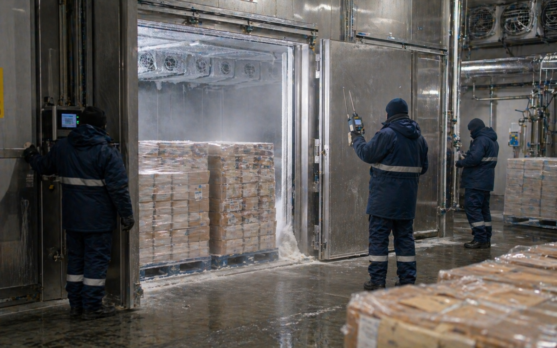
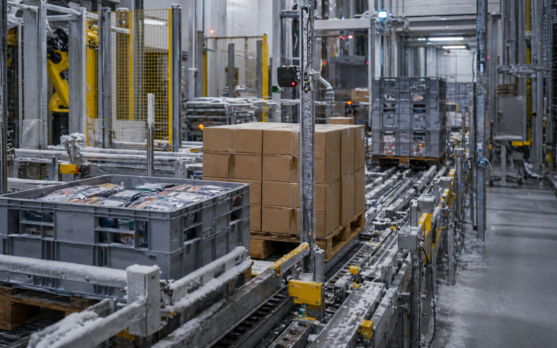
The most important room in frozen food may soon be the one nobody enters: a tall, dark, air-tight freezer where pallets move in steel aisles, cranes run above human reach, cases are sequenced for retail orders, and the weak point is no longer frostbite or forklift traffic, but uptime, software, fire engineering and the quality of the recovery plan when the machine stops.

The cold store has changed from a building into a system
For years, automation in frozen logistics was sold with a simple image: fewer people in freezer suits, fewer forklifts, fewer errors. That was true, but it was also too small a story. The serious cold-store projects now being built in Europe and North America are not just replacing manual work. They are changing the physical shape of frozen distribution.
A conventional freezer warehouse spreads out. It needs aisles, traffic routes, charging zones, marshalling areas, staging space, people moving in and out of the cold, and enough slack to recover from the ordinary mess of daily logistics. A high-bay automated freezer tries to use the cube instead. It pushes product upward, narrows the operating space around pallets, and turns the building into a controlled vertical machine.
That matters in frozen food because cold is not neutral space. Every cubic metre has to be pulled down, sealed, monitored and defended from heat. A badly used freezer is expensive even when nothing moves. A well-used automated freezer can carry more product on less land, with fewer door openings and less human exposure to sub-zero work. The attraction is obvious. The operational bargain is harder.
Once the building becomes a machine, management loses some of the crude flexibility of manual warehousing. You cannot simply add more forklift drivers to solve a failed stacker crane. You cannot easily work around a conveyor section locked by a software or safety fault. A pallet trapped in an automated aisle is not just a pallet in the wrong place. It may be inventory that a customer, a production line or a retailer expected to move that day.
Density is the commercial argument
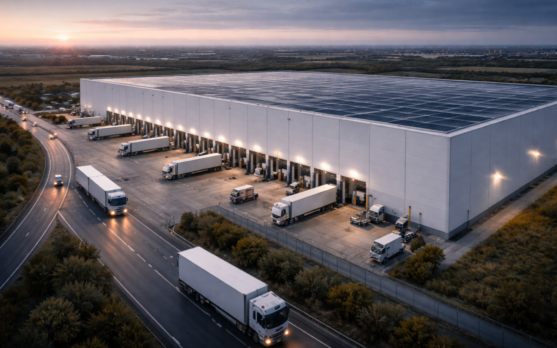
The clearest reason automation is gaining ground in frozen logistics is density. NewCold’s Bucharest project, planned around a 75,000-pallet fully automated high-bay warehouse, shows how this model is moving into Central and South-Eastern Europe, not just the mature logistics markets. Its Nowy Modlin site in Poland, opened with more than 95,000 pallet positions, gives the same signal: modern cold storage is being designed around height, software and repeatable flow.
Lineage has made a similar argument in a different language. Its automated facilities are presented not only as labor-saving assets, but as energy and footprint assets. In a freezer, that distinction matters. Fewer square metres of roof and wall per pallet, fewer wide truck-style aisles, fewer unnecessary air exchanges, tighter control of movement. These are not glamorous details, but they are where the economics live.
Retail buyers rarely ask how beautiful the warehouse is. They ask whether stock is available, whether delivery slots are hit, whether pallet quality holds, whether store-specific loads arrive in the right sequence, and whether the service can scale before peak weeks. Frozen pizza, vegetables, ice cream, bakery, potato products and ready meals all punish weak logistics in different ways. A late ambient shipment is irritating. A late frozen shipment can become a temperature, availability and waste problem at the same time.
That is why density alone is not enough. The best automated cold stores are not merely deep freezers with cranes. They are service platforms. They need picking, mixing, labelling, cross-docking, traceability and transport integration. Storage capacity fills the brochure. Execution fills the retailer’s dock.
The difficult part is no longer only pallet storage
Full pallets are the easier part of the story. Frozen food distribution is increasingly about cases, layers, mixed pallets and orders that need to be loaded in a logic that makes sense at the other end. A supermarket does not want a technically correct pallet that creates extra handling in the back room. A foodservice distributor does not want a beautifully stored pallet if the outbound case flow breaks under morning pressure.
This is where case picking and layer picking become more important than the headline number of pallet positions. Automated storage can feed the system, but somebody, or something, still has to build the order. The growth of automated pallet building in retail distribution shows the direction of travel. Walmart has described systems that inspect cases, identify packaging problems and use store order data to build outbound pallets. That is not frozen-specific, but the logic travels quickly into frozen and chilled categories because damage, temperature exposure and picking accuracy cost real money.
There is also a packaging implication that too many logistics discussions still avoid. A case that survived manual handling may not behave the same way under robotic depalletizing, side pressure, automated layer picking or repeated conveyor transitions. Weak perforations, poor tape, inconsistent carton strength, unstable layer patterns and bad barcode placement become operational problems. In a manual warehouse, a worker may compensate. In an automated one, the system exposes the defect.
Suppliers will feel this. The frozen aisle may look calm to the shopper, but upstream the load has already passed through a chain of mechanical decisions. Automated logistics will quietly raise the standard for secondary packaging, pallet patterns and data quality. Some brands will discover that their products were distribution-friendly only because people kept fixing them.
The labor story is real, but incomplete
It would be dishonest to pretend labor is not one of the drivers. Freezer work is difficult, repetitive and hard to staff. Picking in deep-freeze conditions is physically punishing. Forklift operations in cold rooms bring safety risk, product risk and constant training pressure. Moving people out of the freezer and into control rooms, maintenance roles or supervised workstations is a serious improvement when done properly.
Still, the phrase “warehouses without humans” can mislead. The people do not vanish. Their work changes location and skill profile. The freezer may be dark, but the operation around it becomes more dependent on technicians, controls engineers, software specialists, planners, food safety teams, maintenance crews and supervisors who understand exceptions.
The employment question is therefore more complex than substitution. Automated cold stores reduce exposure to the hardest work, but they also remove some of the informal problem-solving that experienced warehouse teams provide every hour. A veteran forklift driver sees a leaning pallet before it becomes a claim. A picker notices frost damage, a crushed case, a strange odor, a label that does not match the product. Automation can detect many things, sometimes better and faster, but only if the sensing, rules and escalation paths are designed for that reality.
In other words, the cold store with fewer humans needs better humans around it. That is not a slogan. It is a staffing problem, a training problem and eventually a board-level risk issue for operators that sell reliability as their product.
Uptime becomes the new warehouse discipline
Americold’s Russellville automated facility gives a useful glimpse of the mature model: high-bay storage, ASRS, automated trailer unloading, barcode scanning, integrated WMS, WES and ERP flows, and a close link to frozen manufacturing. That kind of facility is not impressive because a robot moves a pallet. It is impressive if the whole chain stays synchronized under pressure.
In an automated cold store, uptime is not an IT metric buried in a service contract. It is the operating heartbeat. A failed crane, jammed shuttle, sensor fault, pallet profile error, WMS issue or dock interface problem can slow more than one aisle. It can change the loading plan, miss a dispatch window, or push product into the wrong staging pattern. In frozen food, where plants, 3PLs, retailers and foodservice operators all run on tight temperature and time discipline, small stoppages have a way of spreading.
Recovery planning should therefore be part of the commercial conversation before the first pallet enters the system. Where are the manual bypasses? Which spare parts are held on site? How quickly can a crane be accessed in a deep-freeze high-bay? What happens if the WES fails but the WMS is still alive? How does the operator prioritize customer orders during a partial outage? Which loads are delayed, which are protected, and who has authority to make the call at 2 a.m.?
These questions sound unfashionable beside the language of AI and robotics. They are also the questions that separate an automated cold store from an expensive demonstration of engineering optimism.
Fire engineering has moved to the centre of the design
The fire-risk discussion around automated cold storage is no longer a side note. High-bay ASRS, stacker cranes, shuttle systems, sensors, cable networks, batteries and dense storage arrays change the risk profile of a freezer. The dry cold-store atmosphere adds its own character. Dense racking can complicate sprinkler design. Access for firefighters and maintenance crews is not the same as in a lower, more open warehouse.
Oxygen reduction systems are part of the conversation, particularly in dark, highly sealed automated freezers. They can make sense in certain designs because cold stores already rely on tight building envelopes. They also bring questions around regulation, worker access, energy use, insurance acceptance and maintenance. Sprinklers, linear heat detection, low-oxygen systems and hybrid approaches cannot be chosen after the logistics concept is fixed. By then, the expensive mistakes may already be embedded in the building.
This is where insurance becomes a practical force, not paperwork. Underwriters will look at density, fire load, access, detection, suppression, recovery, business interruption and proof of maintenance. A cold store fire can be a product loss, a building loss and a customer continuity crisis at the same time. Rebuilding capacity can take years. In a market where the largest food manufacturers and retailers are consolidating flows through fewer, more capable nodes, that risk is harder to shrug off.
The forecast: more automation, fewer casual promises
By 2030, it is plausible that many new cold-storage projects in developed markets will be designed with robots at the centre rather than people. That does not mean the global frozen supply chain becomes fully automated. Retrofit economics will slow adoption in older sites. Smaller operators will continue to compete through flexibility, proximity and customer relationships. Some facilities will automate only parts of the flow: pallet storage, layer picking, dock handling, scanning, inventory control or energy management.
The stronger shift is cultural. Large customers will start comparing cold-storage partners less by square metres and more by operational resilience. Pallet positions will remain important, but the sharper questions will be about uptime, temperature integrity, traceability, labor exposure, fire protection, cyber resilience and recovery after failure.
That is a different buying conversation. It favors operators that can explain their automation without hiding behind it. A 75,000-pallet high-bay freezer is impressive. A 95,000-pallet automated site is impressive. A fully automated warehouse anchored by a major protein producer is impressive. But the customer still needs to know what happens when a crane stops, a pallet profile is wrong, a software update fails, or a fire engineer says the design has reached its limit.
The robot-run freezer is coming. In some regions, it is already here. The commercial test is not whether the industry can build it. The harder test is whether it can operate, insure, maintain and recover it with the same discipline that frozen food already demands from every product moving through the chain.