The most expensive moment in an automated cold store may not come when the robots are installed. It may come later, in a meeting where the insurer, the fire engineer and the customer all ask the same question in different language: if this place goes down, how exactly does it come back? Dense automation has made frozen warehouses faster, taller and more productive. It has also made some of them harder to protect, harder to access, harder to insure and harder to recover after a serious incident. That cost is often missing from the first ROI slide.
The warehouse is no longer just a box
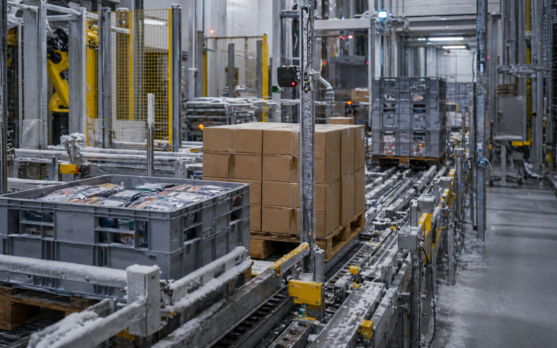
A modern automated freezer can look beautifully logical from the observation deck. Pallets moving with little human contact. Robots, shuttles or cranes doing work that used to punish labour in minus temperatures. More product in less space. Fewer people exposed to cold. Better inventory discipline. A tighter promise to the frozen food customer who wants stock ready for retail promotion, foodservice demand or export dispatch.
That is the good side, and it is real. Cold storage needs automation. Labour is difficult, energy is expensive, land is not getting cheaper near good logistics corridors, and frozen food customers are asking for more speed and more precision from the same network.
But density changes the risk picture. A conventional cold store with pallet aisles and human access already carries fire and recovery risk. Add high-density automation, plastic containers, charging systems, tighter voids, harder access routes and a frozen environment where water, ice, smoke and contamination create their own problems, and the economics start to look different.
The question is not whether automation is good or bad. That is too crude. The sharper question is whether the density being sold can still be protected, insured and restarted after the day nobody wants to model honestly.
Cold does not cancel fire risk
There is a stubborn misconception in parts of the food sector that a frozen warehouse is naturally safer because it is cold. Anyone who has walked a real cold store knows how thin that comfort is. Frozen goods sit inside cartons, film, trays, pallets, labels and secondary packaging. The building itself may include insulated panels and materials that demand careful specification. Around the freezer sit charging zones, plant rooms, electrical systems, docks, offices and staging areas where the cold-room logic ends and ordinary industrial risk returns.
Fire in refrigerated storage can be awkward in ways that dry logistics people sometimes underestimate. Access is more difficult. Visibility can disappear. Water can freeze, collect on racking or complicate the structure. Product that survives the flame may be lost through smoke, heat, water, temperature abuse or contamination concerns. In frozen food, a near miss can still become a stock write-off.
NFPA’s recent warehouse fire data gives the broader warning. In the United States, fire departments responded to an estimated 1,544 warehouse structure fires per year from 2020 to 2024, with direct property damage running into hundreds of millions of dollars annually. Storage areas accounted for a smaller share of fires than some other zones, but a much larger share of direct property damage. That is the part dense storage investors should read twice.
A freezer building can be compliant and still make an underwriter nervous. Compliance says the building meets a defined requirement. Protectability asks a more practical question: can a fire be detected early, reached, controlled and contained before the loss becomes a network problem?
Automation concentrates the loss scenario
ASRS systems, robotic grids and shuttle-based storage change more than throughput. They change the geometry of a loss. Product is closer together. Access can be narrower or partly blocked by the system itself. Firefighters may not be able to move through the risk in a familiar way. A small ignition source can become a complex incident if it sits inside a dense array that was designed for movement, not manual intervention.
Risk engineers have been paying closer attention to this. Guidance around automated storage now talks about robot holding areas, charging controls, detection, sprinkler design, container type, storage height and the differences between system architectures. That language is not decorative. It is the cost of making density believable.
For frozen food, the material around the product matters as much as the product. A pallet of boxed pizzas, frozen meals, bakery items or coated potato products may not look dramatic, but the fire load is often in the packaging system. Carton, stretch wrap, plastic trays, labels and pallet material become part of the risk. Add automation and the insurer is no longer looking at a simple freezer warehouse. It is looking at a dense mechanical environment with cold-chain consequences.
The industry likes to talk about pallets per cubic metre. It should also talk about loss per cubic metre.
Ocado is not an anti-automation story
The Ocado fires are often used lazily. They should not be turned into a slogan against automation. Ocado also remains one of the most visible examples of how advanced warehouse technology can transform fulfilment. The useful lesson is narrower and more serious: automated density makes recovery part of the operating model.
The 2019 Andover fire destroyed the automated customer fulfilment centre and forced a rebuild. The cost was reported at more than GBP 100 million, and the site had represented a meaningful part of Ocado’s UK delivery capacity. Two years later, the rebuilt facility was still being described as coming back into operation. That is the part that matters for cold storage. The recovery clock does not stop when the fire is extinguished.
Then came the 2021 Erith incident, where a collision of three robots was reported as the cause of a fire. Damage was limited to less than one percent of the grid, and operations were expected to resume quickly. A much smaller event, a very different outcome. Still, it showed how concentrated automation can become a corporate event within hours.
For a frozen food operator, the equivalent question is blunt. If a highly automated cold store goes offline, where do the pallets go? Which customer gets priority? Which retail promotion fails? Which foodservice contract starts making calls? Which products can be moved safely, and which become trapped in a claims discussion?
Recovery time is not a technical appendix. It is a commercial exposure.
Insurance will not price the fantasy layout
The insurance market does not look at an automated freezer the way a sales deck does. It looks at ignition sources, fire load, compartmentation, access, suppression, detection, maintenance, water supply, battery management, business interruption and rebuild complexity. It asks how many things have to go right for the operation to survive a bad day.
That is where many automation projects become more expensive than expected. The robot supplier may optimise the storage system. The developer may optimise the building footprint. The operator may optimise labour and throughput. The insurer has a different job. It has to decide whether the risk is acceptable, under what terms, with what deductibles, with what exclusions, and at what premium.
In a soft presentation, insurance is a line item. In a real project, it can influence layout, materials, charging strategy, fire protection design, maintenance procedures and the financing case. If those conversations happen late, the project team has already spent its flexibility.
Business interruption is the quieter number. A fire that damages a replaceable piece of equipment is one thing. A fire that stops a strategic frozen hub before peak season is another. Frozen food networks are not endlessly elastic. Spare capacity may be far away, already contracted, unsuitable for the product mix or too manual to absorb the load. The cost of a lost week can move through retail shelves, supplier penalties, wasted transport, emergency storage and damaged customer trust.
The next metric is insurable density
Cold storage automation will keep advancing. It has to. The economics of labour, land and service are pushing the sector that way. But the better projects will not chase maximum density as if every additional pallet position is automatically valuable.
The stronger concept is insurable density. Density that can be detected. Density that can be accessed. Density that can be separated. Density with charging areas treated as risk points, not afterthoughts. Density with fire protection designed around the actual commodity, container, height, temperature and system architecture. Density with a recovery plan customers can believe before they sign a long contract.
That will affect capital decisions. A cold store that is slightly less dense but easier to protect may be worth more than a beautiful cube that becomes difficult to insure. A facility with credible backup routing may win customers over a site with better headline automation but weaker resilience. A project that brings underwriters and fire engineers into design early may look slower at first and cheaper later.
By 2028, more frozen food companies will ask sharper questions of automated cold stores. Not just how many pallets fit. Not just how fast the system runs. They will ask what happens after a robot fault, an electrical incident, a battery issue, a panel fire, a sprinkler activation, a smoke event or a shutdown during a seasonal build.
The answers will separate engineered resilience from expensive optimism.
Frozen food cannot afford invisible fragility
Frozen food has a special problem with concentrated failure. A dry goods warehouse can often limp through disruption by moving stock, delaying orders or switching to manual work. Frozen stock is less forgiving. Temperature, shelf life, packaging integrity and customer timing all tighten the room for improvisation.
A retailer planning a freezer promotion does not care that the warehouse’s automation ROI looked convincing. A pizza manufacturer with finished goods in storage wants the product protected and available. A foodservice distributor wants the cases picked, loaded and delivered without a speech about recovery complexity.
Dense automation can serve those customers brilliantly. It can reduce labour exposure, tighten inventory, improve accuracy and handle flows that manual cold stores struggle to manage. But only when the hidden cost curve is admitted early. Fire protection, insurance, access and recovery planning are not obstacles to automation. They are part of automation’s real price.
The cold store of the future will not be judged only by how much it can hold. It will be judged by how much risk it can survive.