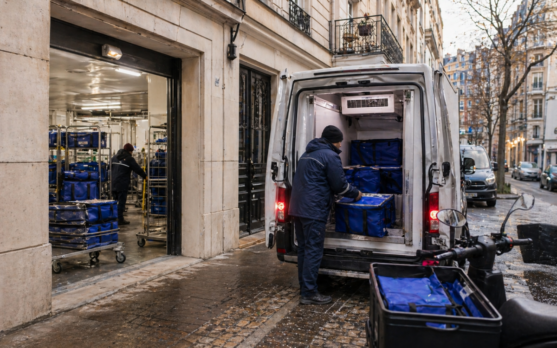
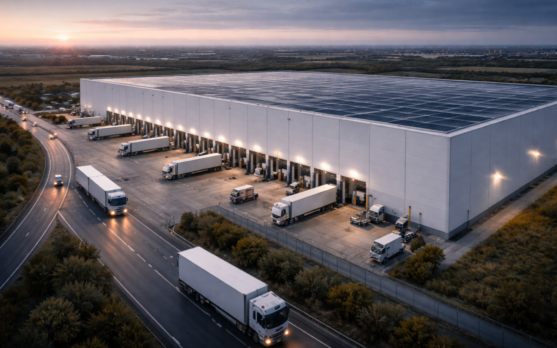
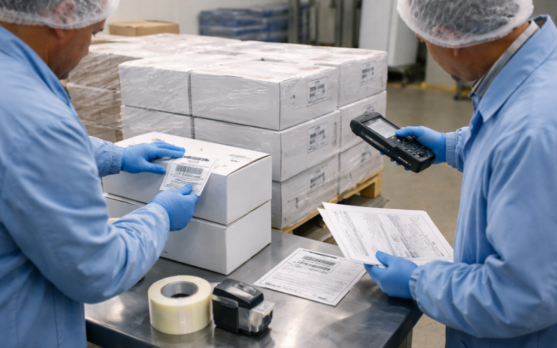
Everyone wants to talk about robots. The crane, the shuttle, the autonomous vehicle, the robotic depalletizer, the dark warehouse running at freezer temperature with barely a human in sight. It is an irresistible story. But inside the serious automation projects now reshaping frozen logistics, another story is becoming harder to ignore: the robot is not the real starting point. The pallet is. The tote is. The corrugated case is. In the automated frozen warehouse, performance is decided by the objects moving through the system, not only by the machines moving them.
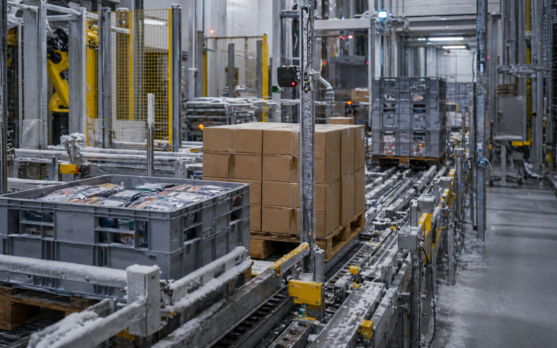
The robot gets the applause. The load carrier decides the uptime.
For years, warehouse automation has been sold through a familiar visual language: cranes rising in high bays, shuttles racing through dense storage grids, robots moving silently across polished floors, digital dashboards glowing in control rooms. It looks modern, expensive, and reassuring. It tells executives that the future has arrived.
But anyone who has spent time close to automated food logistics knows the uncomfortable truth. The warehouse does not fail only because the robot is weak. It fails because the box is slightly crushed. Because the pallet has inconsistent tolerances. Because the tote edge is warped. Because the label is in the wrong place. Because the corrugated case absorbs moisture, loses shape, and enters a machine that has no patience for improvisation.
A human picker can forgive a bad box. A forklift driver can compensate for an imperfect pallet. A warehouse worker can tilt, push, lift, rotate, read a damaged label, or simply make a judgement call. Automation does not work like that. It runs on repeatability. It needs objects that behave the same way thousands of times a day, at speed, in cold, humid, tightly controlled environments. That is why frozen warehouses are not really being rebuilt around robots. They are being rebuilt around the physical language that robots can understand.
Frozen logistics has a tolerance problem
The frozen sector is a particularly unforgiving place to discover this late. At ambient temperature, a slightly tired carton or a mixed pallet with small irregularities may still pass through a manual process. In deep-freeze operations, everything becomes harder. Materials stiffen, labels behave differently, moisture turns into a real operational factor, and human intervention is slower, more uncomfortable, and more expensive.
This is where the old warehouse logic breaks down. In a manual warehouse, the system often survives because people absorb the disorder. In an automated freezer, the disorder becomes visible. A poor pallet no longer means only a bit of extra handling. It can mean a blocked conveyor, a rejected load, a crane stoppage, a robotic picking failure, a case that cannot be squared properly, or a sequence that collapses because the physical object does not match the data model behind it.
That is the part many companies still underestimate. Automation does not simply speed up an existing warehouse. It exposes every weak assumption in the existing supply chain. Packaging quality, pallet quality, label placement, case dimensions, unit-load stability, moisture resistance, deflection, edge integrity, and code readability all move from the background into the center of the business case.
The pallet is no longer a cheap platform
In many boardrooms, pallets are still treated as low-value logistics hardware. They are something procurement negotiates, warehouses stack, and finance tries to keep cheap. That mindset is becoming dangerous. In an automated warehouse, the pallet is a moving mechanical component of a larger machine.
If pallet dimensions vary too much, if deck boards are damaged, if the underside does not interact cleanly with conveyors, if the load bends under weight, if frozen conditions make the material brittle, the pallet is no longer a neutral carrier. It becomes a source of risk. In high-bay automated storage, that risk is amplified because the system is dense, tall, fast, and tightly choreographed. There is very little room for “almost right”.
This is why pallet strategy is moving from procurement into engineering. A future-ready frozen warehouse needs to know not only how many pallet positions it has, but what kind of pallets can safely enter the system, how they are inspected, how they are rejected, how they are repaired, how suppliers are controlled, and how tolerance data is enforced before the load reaches the automated core.
The commercial implication is blunt: the cheapest pallet can become one of the most expensive decisions in the automation project.
Totes and trays are becoming the flexibility layer
Pallet automation is still the backbone of high-volume frozen storage. For bulk frozen food, manufacturing buffers, export flows, large retail distribution, and 3PL cold-storage hubs, high-bay pallet AS/RS remains one of the most powerful models available. It creates density, reduces manual freezer work, and can improve energy efficiency by keeping people and forklifts out of the coldest zones.
But the market is no longer shaped only by full pallets and predictable outbound flows. Grocery is becoming more fragmented. Orders are smaller. SKU mixes change faster. Store replenishment needs to be more precise. Retailers want product availability without overloading stores. Foodservice customers want more responsive supply. E-grocery and omnichannel models add another layer of complexity.
This is where totes, trays, mini-load systems, shuttle systems, and store-ready handling start to matter. They are not replacing pallets everywhere. They are creating a second automation language. Pallets give density and scale. Totes and trays give sequencing, flexibility, mixed-case handling, and finer-grained control.
The strategic warehouse of the next decade will not be a simple choice between pallet cranes and robots. It will be a layered system where pallets, trays, totes, cases, and roll cages each have a role. The winners will not be the companies that buy the flashiest equipment. They will be the companies that define the right unit of movement for each flow.
Corrugate is the quiet weak point
Corrugated packaging is one of the most underestimated pieces of the automation story. It is everywhere, relatively cheap, recyclable, familiar, and flexible. That is exactly why it gets ignored until it causes trouble.
In a manual process, corrugate can be forgiving. A person can handle a slightly bowed panel, a badly formed case, a soft corner, a weak score line, or a label that is not perfectly flat. Automated systems are less forgiving. Case erectors, conveyors, scanners, robotic grippers, depalletizers, and sortation systems all expect boxes to behave predictably.
The tension is becoming sharper because packaging is under pressure from two directions at once. Sustainability pushes companies toward lighter materials, more recycled content, lower material use, and less waste. Automation pushes toward rigidity, dimensional accuracy, clean surfaces, stable label areas, stronger edges, predictable folding, and better performance under stress.
That does not mean sustainable corrugate and automation are incompatible. It means they must be designed together. A case that looks acceptable in a manual packing line may not be good enough for a frozen automated warehouse. A box that saves material on paper may destroy value if it triggers jams, rejects, damaged product, or manual rework in a high-throughput freezer.
The automated freezer needs a grammar
The deeper issue is not packaging alone. It is grammar. Every automated system needs a set of rules that connects the physical world to the digital world. What is a valid pallet? What is a valid tote? What is a valid case? Where should the label sit? What deformation is acceptable? What load weight can the system handle? What happens when moisture changes the behavior of the material? How does the WMS know the physical object is still fit for automation?
In the old model, the warehouse could accept variation and hide it behind labor. In the new model, variation has to be engineered out, measured, or routed differently. That means companies need a load-carrier policy, not just a warehouse automation specification.
This policy should cover pallet type, pallet condition, supplier requirements, inbound quality checks, corrugate specifications, tote design, label placement, barcode and RFID standards, load stability, temperature performance, sanitation, rejection rules, and exception handling. It sounds dull. It is not. It is the difference between a system that runs at designed throughput and one that spends its life recovering from avoidable interruptions.
The data layer starts with the thing being moved
There is also a digital shift happening. Pallets, totes, trays, and cases are becoming data objects. They are not only physical carriers. They are identifiers, checkpoints, proof points, and risk signals.
In a mature automated frozen warehouse, the system should not simply know that product X is in location Y. It should know the unit load, the carrier type, the pallet ID, the case structure, the batch, the expiry logic, the temperature exposure, the movement history, the inspection status, and whether that carrier is approved for a specific automation zone.
This is where the next layer of cold-chain intelligence may emerge. Not from another dashboard showing robots moving around a facility, but from better understanding the condition and behavior of the physical carriers inside the network. A pallet with a digital identity. A tote with usage history. A case design linked to machine performance. A frozen supply chain where packaging and automation data finally talk to each other.
What changes for decision-makers
For executives, the lesson is practical. Do not start an automation project by asking only which robot, which crane, which shuttle, or which integrator. Start by asking what the system will be forced to handle every hour of every day.
Are inbound pallets consistent enough? Are suppliers aligned? Are the corrugated cases automation-ready? Can labels be scanned reliably after freezing, condensation, handling, and storage? Are totes designed for gripping, conveying, stacking, washing, and repeated cold exposure? Are packaging, operations, engineering, procurement, IT, and automation teams making decisions together, or is each function optimizing its own small corner?
The companies that answer these questions early will build more resilient automated warehouses. The companies that ignore them will discover the truth later, when a premium automation system is forced to run on messy physical inputs it was never designed to tolerate.
What comes next
In the short term, more automation projects will include serious load-carrier audits before final design. Pallet quality, corrugate performance, tote geometry, label readability, deflection, moisture behavior, and freezer compatibility will become part of the investment conversation, not a late-stage technical detail.
In the medium term, retailers, frozen food manufacturers, and 3PLs will push stricter packaging and pallet requirements upstream. Suppliers will be asked to deliver not only product, but automation-compatible product. That may create friction, especially for smaller producers, but it will also create a new competitive advantage for companies that can prove their packaging runs cleanly through automated systems.
In the long term, the frozen warehouse will become more modular and more data-driven. Pallet AS/RS will handle density. Shuttle and tote systems will handle flexibility. Robotic picking and palletizing will handle labor pressure. But the real intelligence will sit in the connection between physical carriers and digital control. The warehouse will not simply ask where the product is. It will ask whether the unit carrying that product is trustworthy enough to enter the automated flow.
That is the hidden language of frozen warehouse automation. It is not glamorous. It is not always visible in press releases. But it is what decides whether the robot creates value or just looks impressive in a video.