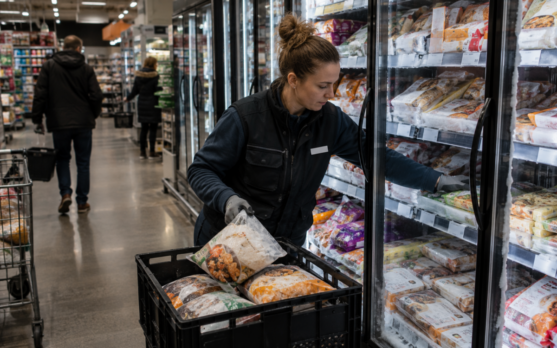
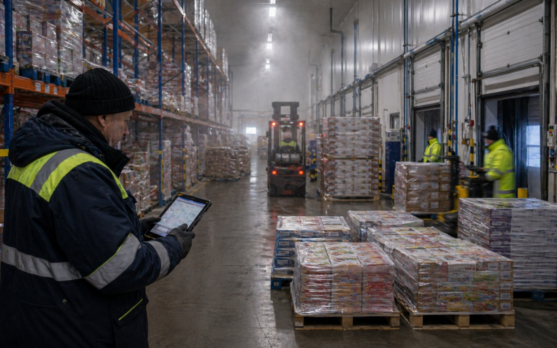
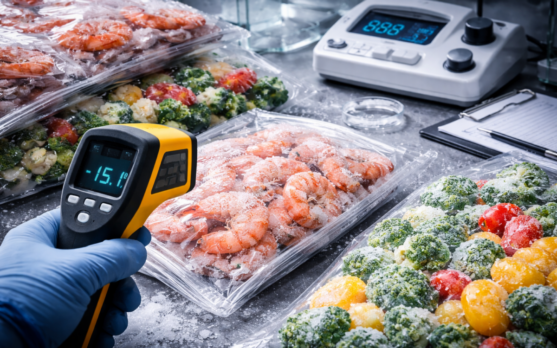
A compostable pack can sound persuasive in a buyer meeting until someone asks what happens at minus 18 degrees, after six weeks in a cold store, three pallet moves, a damp loading dock, a retailer’s backroom and a consumer freezer that opens ten times a day. Frozen food does not give packaging much room for sentiment. If the material cracks, sweats, weakens, leaks, lets the product dry out or confuses the waste stream, the compostable claim arrives too late to save it.
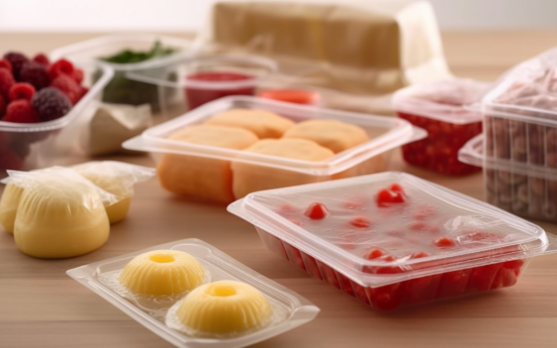
The freezer is a harsher judge than the compost bin
Compostable packaging has an attractive story. It promises a cleaner ending for a material that may otherwise become waste. In foodservice, in controlled collection systems, and in some food-contaminated packaging formats, the logic can be strong. Frozen food is less forgiving. The pack is not asked only to disappear at the end of its life. It has to protect the product first, sometimes for months, while moving through one of the most expensive and physically demanding parts of the food chain.
That distinction is often lost in packaging conversations. A frozen pack lives in cold, humidity, compression and rough handling. It may pass through an automated line at speed, then into a blast freezer, then into storage, then onto mixed pallets, then into a reefer truck, then into a retail freezer where presentation matters. A weaker seal is not an academic defect. It can mean freezer burn, dehydration, ice crystals, weight loss, a rejected case or a consumer complaint that lands back with the supplier.
The environmental accounting also changes once product loss enters the room. Throwing away a failed pack is one cost. Throwing away frozen food because the pack failed is a larger one, especially when the product has already consumed raw materials, processing energy, freezing capacity, labour, transport and shelf space. A compostable material that increases damage or reduces shelf life has not removed waste from the system. It has made the waste harder to see in the sustainability deck.
Compostable does not mean simple
Part of the trouble comes from language. Bio-based, biodegradable and compostable are still treated too loosely in commercial conversations. A bio-based material may come from renewable biological sources, but that does not automatically make it compostable. A biodegradable material may break down under certain conditions, but the phrase is almost meaningless without time, temperature, oxygen, moisture and environment. Compostable packaging is more specific, and usually tied to industrial composting conditions, certification and defined degradation performance.
That matters in frozen food because the end-of-life claim is only one part of the specification. A supplier may show a compostability certificate, and the buyer still has to ask whether the film seals consistently at line speed, whether the pack maintains oxygen and moisture barrier at frozen temperatures, whether it remains flexible after storage, whether it can withstand distribution, whether printing and adhesives complicate the claim, and whether the final market actually has access to an appropriate composting route.
In a supermarket freezer, those questions become commercial. A retailer does not want sustainability that creates mess. A category manager will not be impressed by a compostable pouch if it scuffs badly, looks tired on shelf, or increases complaints. A plant manager will be even less patient if the new material narrows the sealing window, slows output or raises rejects just before a seasonal promotional run.
The better suppliers know this. The more credible work around PHA, PLA blends and compostable flexible structures is not trying to win on claim alone. It is trying to improve flexibility, seal strength and cold-chain durability enough for real food applications. That is the useful signal in the market: not that compostable frozen packaging has been solved, but that material development is moving from brochure language toward performance testing.
Where the case is strongest
Compostable packaging is most convincing when the waste stream can be controlled. Foodservice is the obvious place to start. A frozen meal served in a university, hospital, workplace canteen, stadium or closed catering operation has a very different disposal profile from a retail pack taken home by a shopper. If packaging and food scraps can move together into a managed organic waste stream, compostability begins to make practical sense.
There are other plausible routes. Controlled frozen meal delivery, subscription meal services with collection models, events, institutional catering, airline catering and some quick-service environments may offer enough operational discipline to make compostable formats worth testing. Even there, the details matter. Who collects the packaging? Is the composter willing to accept it? Is contamination manageable? Does the packaging carry the right certification and labelling? Is the consumer or operator likely to separate it correctly?
Secondary and supporting components may offer another route with lower risk. Inserts, separators, sleeves, pads, outer elements and protective materials can sometimes be redesigned before the primary food-contact pack is touched. In frozen, that distinction is important. The primary pack must protect the food directly. A secondary component may have more room for substitution, especially where the performance burden is lower or where the component is part of a controlled distribution loop.
There is also a narrow but interesting field around compostable frozen pouches and films. The Pregis and CJ Biomaterials work around PHA and PLA structures, for example, is worth watching because it speaks directly to the cold-chain challenge rather than treating frozen food as just another packaged category. These are the kinds of developments that deserve attention: not because they prove a mass-market replacement is imminent, but because they point to the type of evidence the market will require.
Where the promise becomes fragile
Mass retail frozen food is the difficult arena. A consumer buys a pack, takes it home, opens it, and then what? If the municipality does not collect compostable packaging, the pack goes into residual waste. If the consumer puts it in the recycling bin, it can become a contaminant. If the composter rejects certified compostable packaging because its process, timing or contamination tolerance does not fit, the claim loses its practical value.
Frozen food also contains formats that place heavy demands on packaging. Seafood, meat, poultry, premium desserts, ready meals and long-shelf-life products cannot accept weak moisture performance or poor seal stability. If a compostable structure increases freezer burn, reduces shelf life or forces extra secondary packaging, the environmental case becomes less convincing. The material may still be compostable. The system around it may be worse.
Export makes the equation harder again. Long routes, reefer containers, temperature variation, port delays, mixed handling standards and multiple distribution partners expose packaging weaknesses that a short domestic route may hide. A compostable material that works in a pilot lane may not be ready for international frozen distribution. There is no shame in that. The damage begins when pilot success is presented as category-wide readiness.
Moisture is another quiet enemy. Compostable and bio-based materials can behave differently when exposed to condensation, cold surfaces and freezer humidity. The pack may leave the plant in good condition and still struggle after repeated temperature transitions. In frozen food, the test is rarely a clean laboratory moment. It is the messy sequence of packing, freezing, storing, loading, unloading, replenishing and home use.
Regulation will not rescue weak applications
Europe’s packaging regulation has made many companies more attentive to recyclability, minimisation, reuse and end-of-life claims. It has also created the temptation to assume that compostable packaging will receive a broad regulatory blessing. That would be a poor reading of the direction of travel.
The policy signal is more selective. Compostability is being recognised for specific formats where there is a clear environmental benefit and a fit with organic waste treatment. It is not a blank cheque for replacing difficult packaging decisions with a more attractive word. In many frozen food applications, recyclable mono-material structures, packaging reduction, stronger secondary design, reusable transport packaging or better pallet efficiency may remain more relevant than compostability.
That may frustrate brands looking for a simple sustainability message. It should reassure operators. Frozen food needs packaging that can be defended in the plant, in the cold store, in the retailer’s freezer and at disposal. A single claim cannot do all that work.
The buyer conversation has to change
A serious buyer meeting on compostable frozen packaging should feel less like a marketing pitch and more like an operational review. The first question cannot be only whether the material is compostable. It has to include where it will actually be composted, at what scale, under whose responsibility, and with what evidence that the target market can process it.
Then the cold-chain questions begin. Has the pack been tested at frozen temperatures, not just room temperature? What happens to seal strength after storage? What are the oxygen and moisture barrier results under the conditions the product will face? Does the material become brittle? Does it run on existing equipment? Does it affect line speed, rejects, shelf life or retail presentation? Can the supplier support volume, quality consistency and documentation?
These are not obstacles to progress. They are the conditions under which progress becomes commercially real. Compostable packaging may earn its place in frozen food, but it will do so application by application. Foodservice first in some cases. Controlled delivery in others. Selected films where performance is proven. Components where the product is not put at risk. The supermarket freezer will not be converted by enthusiasm alone.
The stronger commercial argument is not that every frozen pack should be compostable. It is that compostable packaging should be used where it solves a specific waste problem without creating a colder, more expensive one somewhere else in the chain.