Thermoelectric cooling has a seductive promise for the frozen food sector: no compressor, no conventional refrigerant, few moving parts, compact modules and tight temperature control. That is enough to make the technology sound like a clean break from old refrigeration. The freezer wall arrives quickly. Industrial frozen food is not a wine cooler or a sensor box. It is heat load, door traffic, product mass, ambient pressure, recovery time and cost per watt of cooling. Solid-state cooling has a future in food, but it will earn that future in narrow, useful places before it earns the right to challenge the main plant room.

The appeal is real, and so are the limits
Thermoelectric cooling is attractive because it removes several things operators dislike about refrigeration. There is no compressor in the usual sense. No conventional refrigerant loop. No vibration from moving mechanical parts. A Peltier module can be compact, quiet and precise. Send current through the module and one side becomes cold while the other rejects heat.
For small, controlled spaces, that is a compelling piece of engineering.
The trouble begins when the word “freezing” is used too broadly. A small thermoelectric compartment is one thing. A frozen warehouse, a blast freezer, a spiral freezer or a retail island under heavy traffic is another. Food freezing is not only about reaching a low temperature. It is about removing heat at volume, recovering after disturbance, handling moisture, protecting product texture and doing all of it at an energy cost the business can defend.
That is where thermoelectric systems still run into their old enemy: efficiency under load. Moving heat through a Peltier device is elegant, but not free. The hot side must be managed well. If heat is not rejected properly, the cold side weakens. In high ambient conditions, or where the temperature difference is large, performance becomes harder to justify against compressor-based systems.
So the useful question is not whether thermoelectric cooling is clever. It is where the cleverness pays.
Industrial freezing is an unforgiving benchmark
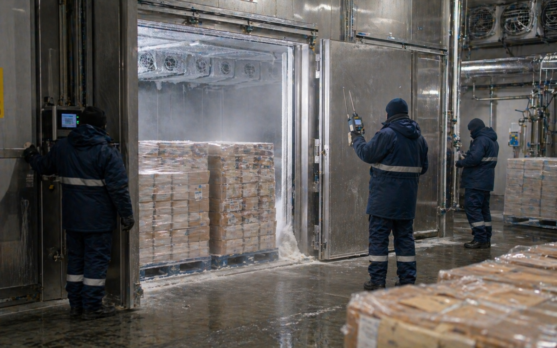
Frozen food plants are built around heavy thermal work. Product enters warm or partly processed. Packaging adds mass. Doors open. Air carries moisture. Evaporators frost. Forklifts move through docks. Production changes bring sudden loads. A compressor system is not elegant in the same way as a solid-state module, but it is very good at moving large amounts of heat.
That is why vapour-compression refrigeration still dominates the serious cold chain. Ammonia, CO2 and other industrial systems are not kept in place by habit alone. They offer scale, known service practice, high cooling capacity and economics that thermoelectric modules struggle to match in large freezing duties.
Solid-state cooling has no automatic right to replace that.
There is also a maintenance reality. A cold store manager does not buy a technology because it photographs well. He buys uptime, temperature records, service support and a predictable cost base. If a module fails in a point-of-use cooler, the problem is contained. If an industrial freezer cannot recover load, the problem can become a customer claim.
The more credible role for thermoelectric technology is therefore not bulk freezing. At least not yet. It is precision cooling, modular cooling and hybrid support in places where conventional refrigeration is awkward, oversized or too rigid.
The real opportunities are smaller and more interesting
Some of the best food applications will not look like classic refrigeration projects.
Online grocery staging is a good example. Stores picking chilled and frozen orders have a space problem. Orders need to be held safely between picking and pickup or delivery, but many stores were not designed as mini fulfilment centres. Phononic and ShopRite have already put active cooled freezer and refrigerator totes into grocery operations, with the system positioned around staging space, order handling and cold-chain compliance. That is not a frozen warehouse story. It is a back-of-store workflow story.
Thermoelectric cooling can be interesting in that kind of gap. A compact, HFC-free, actively cooled tote or cabinet can sit where a traditional refrigeration installation would be inconvenient. It can move with the process. It can serve a defined load. It can give data. For e-grocery, meal kits, pharmacy-food overlap, premium samples or last-yard cold chain, those details matter.
QA labs are another plausible route. Frozen food manufacturers need controlled sample storage, ingredient testing, shelf-life checks, micro-lot handling and temperature-sensitive materials. These are not always large loads. They often need precision, stability and clean installation more than raw cooling power.
Foodservice may also find uses in small modules: quiet point-of-use storage, controlled drawers, mobile stations, compact cold boxes for event catering, or speciality products that need separate temperature discipline. Again, the opportunity is not to cool the entire kitchen. It is to cool one problem better.
Hybrid systems are the more serious signal
The most telling sign from the appliance market is not pure thermoelectric refrigeration. It is hybrid cooling.
Samsung’s recent AI Hybrid Cooling approach uses a traditional compressor for the main work and a Peltier module for higher-load moments, such as after a large grocery load or during warmer operating conditions. That design choice is worth noticing. Even in a consumer refrigerator, the Peltier module is not asked to carry the whole system. It supports it.
That logic is more relevant to frozen food than a grand replacement story.
Hybrid cooling could, over time, appear in commercial systems where local temperature control matters: compartments with frequent access, small zones needing tighter stability, retail or back-room modules, automated fulfilment cells, mobile cold boxes, or high-value sample storage. The compressor handles the heavy load. Thermoelectric modules trim, stabilise or respond in places where a refrigerant circuit would be clumsy.
There is also the materials story. Samsung and Johns Hopkins APL have reported progress in nano-engineered thin-film thermoelectric devices, with large efficiency gains claimed against conventional Peltier designs. That matters because material performance has always been one of the barriers. Better thermoelectric materials could widen the field.
But progress in materials is not the same as a food industry retrofit plan. A lab result or appliance launch still has to pass through cost, durability, service, food safety, condensation control, cleaning practice and the unpleasant fact that food operations are rougher than product demonstrations.
Heat rejection is where the promise often gets tested
The cold side gets the attention. The hot side decides the result.
Every thermoelectric cooler moves heat from one side to another, and the hot side has to get rid of that heat efficiently. In a small box, that may be manageable. In a crowded retail back room, a delivery vehicle, a summer kitchen or a poorly ventilated enclosure, it becomes harder. Put a thermoelectric module in the wrong place and it can end up heating the space it is trying to serve, or running harder than the business expected.
This is where many simplified discussions about solid-state cooling fall short. They talk about no moving parts and no refrigerant, then treat heat rejection as a detail. It is not.
Food applications also carry moisture and hygiene questions. Condensation has to be managed. Surfaces must be cleanable. Temperature records must be credible. The system must survive staff use, not just controlled testing. A compact cooler that performs well in a specification sheet can disappoint if the operating environment is hot, wet, dusty or badly ventilated.
For frozen applications, the temperature gap is even more demanding. The lower the target temperature and the higher the ambient heat, the more difficult the case becomes. That does not make thermoelectric cooling irrelevant. It makes the use case narrow.
The buying test is application fit
Thermoelectric cooling should not be sold to frozen food operators as a revolution waiting around the corner. It should be sold, if at all, as a tool for defined jobs.
Does the application involve a small or moderate volume? Is temperature precision worth paying for? Is silence, compact design or refrigerant-free operation valuable? Is the load predictable? Can the hot side reject heat properly? Is the system easy to clean and maintain? Does it have credible temperature monitoring? Does the business need mobility or modularity more than maximum efficiency?
If the answer is yes, solid-state cooling deserves a serious look.
If the question is a frozen warehouse, a blast freezer or a high-throughput processing line, the answer is different. Compressors will keep doing the heavy lifting for the foreseeable future. The economics are too strong, the service base too deep, the cooling loads too large.
Over the next few years, the more interesting thermoelectric stories in food will probably come from the edges: e-grocery, last-mile staging, portable controlled storage, QA, lab work, premium product handling, automated retail modules and hybrid compartments. After 2030, better materials and smarter integration may open more doors.
Solid-state cooling does not need to conquer the freezer plant to matter. It only needs to solve problems that compressor systems handle badly.