The Asian frozen-food shelf used to be treated as a flavor shortcut: teriyaki here, sweet chili there, a few dumplings, a noodle bowl, maybe a spring roll pack pushed into the appetizer set. That reading is now too thin. The stronger products are not scaling because they carry an Asian label. They are scaling because they arrive in forms the freezer aisle can sell quickly: steamable dumplings, pan-crisp gyoza, bao-style bites, air-fryer rolls, noodle meals, rice formats and sauces that turn reheating into something closer to finishing.

The freezer has moved past the cuisine tour
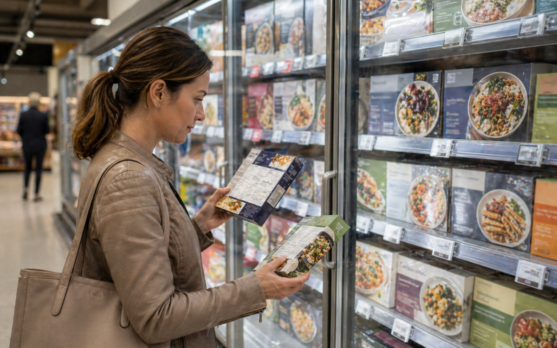
A retailer does not give space to "Asian food" in the abstract. The frozen buyer looks at the door count, the facings, the neighboring products, the household occasion and the likelihood that the shopper will understand the pack in three seconds. A vague cuisine claim is not enough there. The product needs a script.
Steam and dip. Pan crisp and sauce. Air fry and share. Microwave for lunch. Keep for a party. That is how Asian frozen food is moving into weekly shopping, not as a polite tour through regional cuisines, but as a set of repeatable formats.
The data now points in that direction. Conagra's 2026 frozen work places takeout-style frozen forms and flavors at USD 14.3 billion in annual sales, with global flavors, chicken formats and shareable snacks helping drive the activity. IFT has also pointed to strong growth in frozen street-food formats, with bao buns, dumplings and egg rolls all showing sharp unit gains. The interesting part is not that shoppers have discovered Asian taste. Many already had. The interesting part is that frozen retail has found formats that make those tastes easier to buy again.
That difference matters. A flavor can be tried once. A format can become a freezer habit.
Dumplings are the retail engine
Dumplings have become the most useful machine in Asian frozen food. They can be cheap or premium, family-size or single-serve, pan-fried or steamed, meat-filled or vegetable-led. They carry enough cultural signal to feel specific, but enough freezer familiarity to avoid a long explanation.
Look at the companies investing around them. CJ CheilJedang is building a European production base in Hungary for Bibigo dumplings, with production planned for the second half of 2026. The company has spoken about Europe's dumpling market growing at more than 30 percent annually. That is factory logic, not trend talk. A brand does not put that kind of money behind a product if it sees only a niche ethnic SKU.
Ajinomoto's hane-style gyoza tells the story from the texture side. The product is not being sold only as a Japanese dumpling. It is sold on the crisp lacy skirt that forms in the pan, the little restaurant cue that makes the freezer product feel more deliberate. A limited Costco run gave way to wider U.S. grocery distribution through names such as Walmart and Albertsons, with further chains expected or added in the rollout.
MìLà works from another angle. The company built attention around soup dumplings that are frozen raw and steamed at home, with Target, Costco, Sprouts and other retail appearances giving the format wider reach. Soup dumplings are not an easy product. The wrapper, broth, filling and steaming method all have to behave. That is precisely why they matter. They show how far frozen consumers can be taken when the product has a clear ritual and the quality holds.
In the old freezer logic, dumplings sat as an Asian side or appetizer. In the newer logic, they are a platform: wrapper, filling, sauce, method, occasion.
Bao, rolls and the shareable plate
Bao has a different personality. It is softer, rounder, more visual. It looks good in a club-store tray, on a party plate, in a foodservice menu photo, or inside a supermarket freezer next to other small bites. It can be savory or sweet, traditional or stretched into something closer to a filled snack.
The UK market has already shown how quickly bao can move once supermarkets and foodservice give it enough visibility. Tesco, M&S, Ocado, Sainsbury's, Waitrose and Aldi have all been part of a wider bao boom, with retailers expanding ranges and consumers using the product well beyond specialist Asian restaurants.
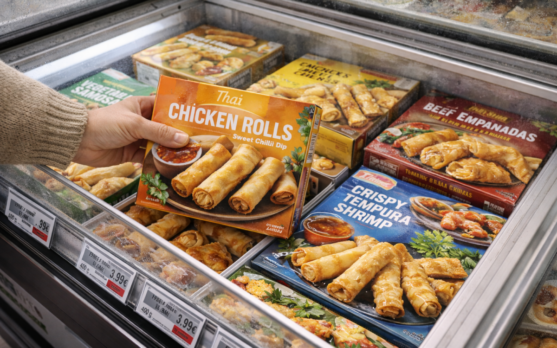
Spring rolls and egg rolls are older, but the air fryer has changed their value. The question is less whether the shopper likes them and more whether they crisp fast without leaking, cracking or drying out. A Thai-style roll with sweet chili sauce is not a complicated proposition. That is the point. The buyer can imagine the household use straight away: eight or ten minutes, small plate, dip, share.
The better products in this area do not simply add "air fryer" as a secondary instruction. They are built around hot-air cooking from the start. Wrapper thickness, oil pickup, filling moisture, sauce handling and piece size all matter. The consumer may only see a snack. The factory sees a sequence of failure points.
Noodles and rice still need sharper engineering
Noodles bring another set of challenges. Frozen ramen, udon and noodle bowls have a stronger claim to restaurant-at-home than ambient instant noodles, but only when texture survives the microwave or stovetop routine. Overcooked noodles destroy the promise quickly. Broth concentration, sauce separation, vegetable texture and topping quality all become part of the product's credibility.
Nissin's move into single-serve frozen meals with Kanzen Meal is a useful signal. A company built on instant noodles is not entering frozen meals by accident. The freezer offers a way to sell a more complete, more structured eating occasion, with nutrition, portioning and texture that ambient formats cannot always deliver.
Rice formats are also pushing into new territory. Trader Joe's frozen kimbap became a retail talking point because the product had a simple script: microwave from frozen for about two minutes, eat hot or chilled, use it as an entree, side or snack. It did not require the shopper to cook rice, season vegetables or understand every part of Korean convenience food. It translated the occasion.
Kimbap also exposes the risk. Rice texture is unforgiving after freezing. Seaweed can turn leathery. Fillings can taste dull if the product is engineered only for novelty. A viral product can bring shoppers to the freezer. It cannot protect repeat purchase by itself.
Sauce is where many products become premium, or fail
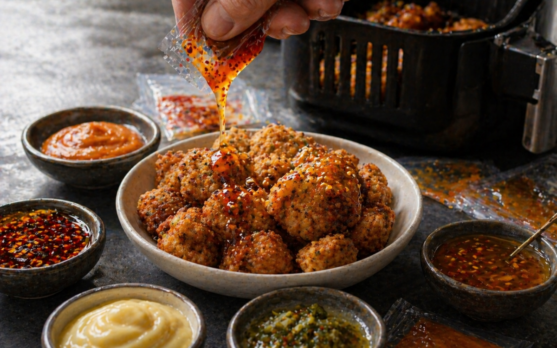
Asian frozen food depends heavily on the final component. Soy-ginger dip, chili crisp, sweet chili sauce, black vinegar, gochujang-style glaze, sesame dressing, bulgogi sauce, yuzu mayo, peanut satay, curry sauce. These are not decorative details. They often decide whether a product tastes finished.
The sauce also protects the base. Keep moisture away from the crisp shell until the last moment. Let the dumpling steam before it is dipped. Let the chicken or vegetable bite cook dry before the glaze goes on. The sequence is part of the value.
Private label will push hard here. A retailer can copy a spring roll, a dumpling, a bao or a noodle bowl more easily than it can build real food authority. The first place many copies weaken is the sauce. Too sweet. Too thin. Too little acid. A pouch that feels cheap. In a category where the consumer may already be comparing against takeout, that is dangerous.
There is a simple test. If the sauce feels like a costed accessory, the product stays ordinary. If it behaves like the final step of the dish, the product can justify more shelf space and a better price.
The word "Asian-inspired" is starting to wear out
The label helped the category open doors. It is now becoming too loose. A freezer set full of "Asian-inspired" products can hide big differences in quality, region, method and occasion. Korean mandu, Japanese gyoza, Chinese soup dumplings, Thai spring rolls, frozen ramen, kimbap, bao and teriyaki bowls should not all be flattened into one vague promise.
Retailers will need more precision. Not academic precision. Commercial precision. What is the product? How is it cooked? When is it eaten? What texture should the shopper expect? What sauce finishes it? Is it a snack, a side, a meal, a party item, a lunch shortcut, or a freezer staple?
Short term, the energy will stay with steamable dumplings, pan-crisp gyoza, air-fryer rolls, Korean chicken formats, bao multipacks, frozen kimbap, noodle meals and club-store appetizer assortments. Medium term, the stronger brands will move away from broad labels and toward format plus region plus occasion. Long term, the category will be judged less by how adventurous it looks and more by how reliably it eats.
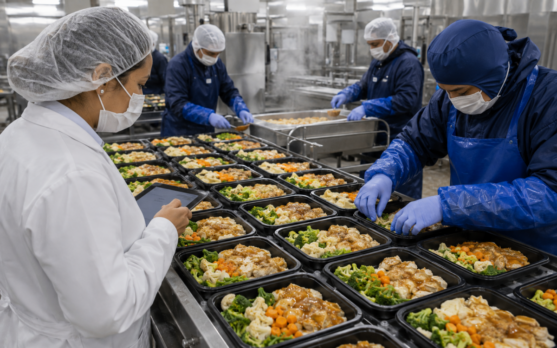
That is a healthier place for the market. It rewards engineering, not just naming. It rewards brands that understand wrappers, dough, rice, broth, sauce, reheating and cold-chain abuse. It also makes life harder for lazy products with a sweet sauce and a borrowed name.