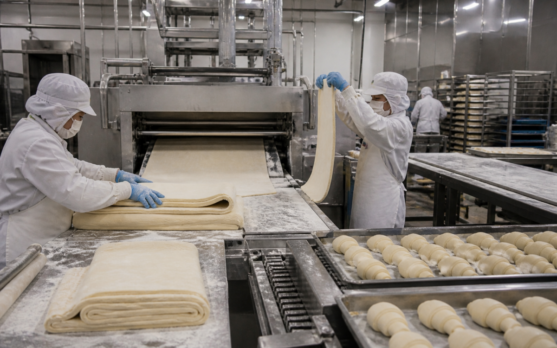
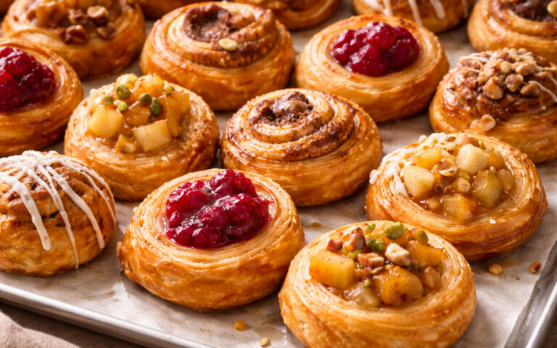
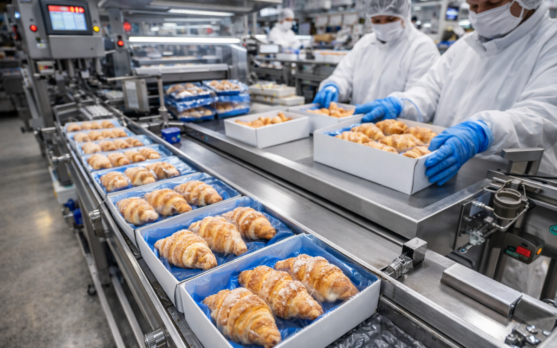
A vegan croissant can no longer hide behind the fact that it exists. The customer does not stand in front of a café counter, hotel buffet or freezer cabinet thinking about formulation work, plant-based lamination fat or egg-replacement systems. They see a pastry. It has to brown. It has to lift. It has to flake. It has to smell right after baking and feel right after the first bite. The freezer gives vegan bakery a route to scale, but it also gives every weakness more time to become obvious.


The freezer is where vegan pastry gets judged
Vegan frozen pastry used to be easy to explain and hard to execute. The explanation was neat: no dairy, no eggs, suitable for plant-based consumers, useful for inclusive menus. The execution was less forgiving. A croissant without butter still has to behave like a croissant. A waffle without eggs still has to come out of the toaster crisp at the edge and soft enough in the middle. A filled pastry still has to hold its fruit or cream without turning the base damp.
That is the shift now. The market is no longer asking whether vegan bakery can be made. It is asking whether it can be good enough to sit next to conventional pastry without apology.
Frozen bakery makes this more interesting because the product is not judged in the calm of a development kitchen. It is judged after manufacturing, freezing, transport, storage, thawing and final heating. A vegan pastry may pass a tasting warm from a trial oven and still fail in foodservice. It may look fine in a box and eat poorly after months in a freezer. The stronger products will be the ones designed for that chain from the start, not adapted to it at the end.
Removing butter removes more than butter
Butter is not just a flavour note in pastry. It is structure, aroma, plasticity, melt, colour and mouthfeel. In laminated products, it helps create separation between layers while carrying the sensory memory that consumers associate with classic Viennese pastry. Take it out and the product developer has to rebuild more than a label claim.
Plant-based lamination fats have improved. Some are built specifically for croissants, Danish pastry, puff pastry and cookies, with better handling than older margarine systems and cleaner positioning on palm oil or hydrogenation. That progress matters. It gives industrial bakeries tools that are closer to the way pastry lines actually work: sheeting, folding, resting, freezing, baking, cooling.
Still, the test is not the ingredient sheet. It is the bite. If the fat melts too early, the layers suffer. If it leaves a waxy finish, the pastry feels cheap even when the pack looks premium. If the aroma is flat, the product may be technically vegan but emotionally thin.
Bridor’s vegan croissant, for example, is positioned as a ready-to-bake 70 g product using plant-based agricultural ingredients and high-quality margarine. That is the kind of industrial signal buyers should watch. Vegan pastry is moving beyond niche bakery counters and into professional frozen formats that have to work for operators, not just for brand storytelling.
Egg replacement is a structure problem
Eggs are easy to remove on paper and difficult to replace in real bakery. They help with aeration, emulsification, binding, moisture, colour, richness and structure. In waffles and pancakes, they support lift and tenderness. In cakes and muffins, they help hold volume. In pastry applications, they influence finishing, browning and eating quality.
A weak egg replacement does not announce itself as a technical failure. It shows up as a pale surface, a flat muffin, a gummy centre, a dry crumb, a waffle that breaks wrong or a product that loses appeal as it cools. Consumers do not describe those things as emulsification problems. They simply do not buy again.
This is why ingredient systems such as Loryma’s Lory Stab are worth reading as category signals, even when they sound technical. The company has positioned the product for baked goods that traditionally rely on eggs, including muffins, pound cakes, waffles, pancakes and European desserts. That list is revealing. Vegan bakery is not only chasing croissants. It is moving through breakfast, snack cakes, frozen reheating formats and the kind of products that need volume and tolerance under ordinary handling.
Breakfast may carry the category further than patisserie
The romance sits with croissants and Danish pastries. The volume may come from breakfast.
Toaster waffles are not pastry in the strict French sense, but they are one of the clearest signals for vegan frozen bakery. They are familiar, already frozen, already reheated at home, already accepted as weekday convenience. Nature’s Path sells a frozen waffle range in which the collection is marked vegan across its products. Kashi’s Seven Grain Frozen Waffles are also positioned as vegan, built around grains and freezer convenience. These products do not ask the shopper to make a dramatic lifestyle decision. They live in the normal rhythm of breakfast.
That matters because the strongest plant-based growth may come from ordinary eating moments, not from shoppers looking for a moral statement. A dairy-free household may buy vegan waffles because they are useful. A flexitarian family may buy them because they are familiar. A hotel may choose a vegan breakfast item because it covers more guests with one SKU. A café may need one pastry that works for plant-based, dairy-free and broader inclusive-menu demand.
In those settings, vegan is a permission signal. Texture is the sales argument.
Foodservice wants one good inclusive option
Hotels, cafés, corporate catering and travel outlets do not want a weak vegan corner. They want one or two products that can carry the menu without requiring a separate operational burden. A vegan croissant that bakes well from frozen, holds its shape, looks credible on a tray and does not taste like a compromise can do useful work. It serves vegan customers, yes, but also lactose-avoidant customers, flexitarians and anyone who simply wants a lighter-looking option with coffee.
The operational reality is plain. Staff need simple instructions. The product has to tolerate imperfect thawing, changing service volumes and uneven attention during rush periods. A beautiful vegan pastry in a supplier tasting is only half the story. The other half is what happens when a hotel team is replenishing breakfast while clearing plates, or when a café employee is rotating trays between coffee orders.
Frozen formats can help because they reduce skilled labour pressure and improve availability. But they also expose weak formulation. A conventional butter croissant has its own difficulties, but it benefits from decades of process knowledge and consumer forgiveness. Vegan pastry has less room for error. If it costs more and eats worse, the claim will not protect it for long.
The category grows where the compromise disappears
Vegan pastry is still a small category compared with total frozen bakery, but it has the right kind of strategic pressure behind it. Plant-based food sales are no longer rising smoothly across every segment, and that may be healthy for bakery. The weaker novelty products will be pushed aside. Better products will have to compete on eating quality, not just ethics or avoidance.
The next phase will probably split into two routes. One will be mainstream and breakfast-led: waffles, pancakes, muffins, snackable bakery and private label frozen formats. These products will use vegan, dairy-free or plant-based cues as part of broader household convenience. The other will be premium and more technical: croissants, pain au chocolat, Danish pastries, filled puff pastry and bake-at-home patisserie. Here, the work is harder. The reward is higher if the product can stand beside butter pastry without sounding defensive.
The useful phrase may not be “vegan indulgence” anymore. It may be “plant-based pastry that behaves like pastry.” Less emotional, perhaps. More honest.
Because the freezer will not reward a product for being well-intentioned. It will reward the one that flakes, browns, fills, reheats and sells again.