Seaweed packaging has an easy story to sell: fast-growing marine biomass, no fossil plastic, a cleaner end of life and a visual identity that feels made for sustainability decks. Frozen food is less impressed. The freezer does not care where the material came from. It cares whether the pack can handle water, oxygen, seal stress, puncture, cold brittleness, shelf life, pallet pressure and a retail cabinet where shoppers treat every bag like it owes them money.

Seaweed is not one material
The phrase “seaweed packaging” sounds simpler than it is. It can mean a coating on fibre. It can mean a film. It can mean a pellet for conversion into flexible packaging. It can mean an edible layer, a dissolvable sachet, a capsule, a paper barrier, a compostable polybag or a component inside a wider packaging structure. For frozen food, that distinction matters more than the feedstock story.
Brown, red and green algae can provide useful compounds such as alginate, carrageenan and agar. These materials have film-forming ability and can be blended, coated, extruded or used in food-contact applications. That is why the category keeps attracting packaging developers. But a material platform is not the same as a finished frozen food pack. Between the seaweed harvest and the supermarket freezer sits a long industrial argument.
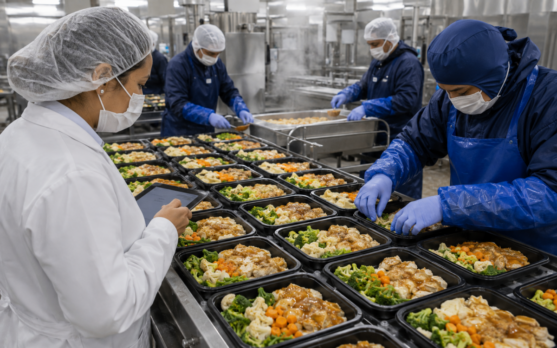
A frozen manufacturer does not buy a marine origin. It buys a specification. The film has to seal. The coating has to resist moisture. The pouch has to survive distribution. The tray has to preserve the product. The material has to behave predictably from batch to batch. A buyer may like the story, but a factory manager will ask whether it runs on the line at speed, whether it affects reject rates, and whether the supplier can deliver the same performance in November that it promised in a June trial.
That is the mature way to look at algae-based packaging. Not as a single alternative to plastic, but as a family of materials trying to find the right jobs.
The freezer starts with water
Frozen food is an uncomfortable place for materials that do not control moisture well. Water is everywhere in the category: inside the product, on the surface, in frost, in condensate, in the cold store, in the retail cabinet and in the consumer freezer. A packaging material that handles oxygen reasonably well but struggles with water vapour may still be a poor fit for long-life frozen products.
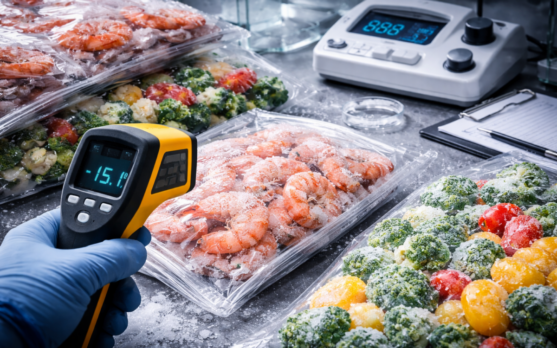
That is one of the harder truths for seaweed-based materials. Many marine polysaccharide films are interesting, but water sensitivity and moderate water vapour barrier performance remain recurring technical issues. In ambient foodservice, that may be manageable. In frozen, it can become a direct quality problem. Moisture migration is not just a line in a lab report. It is freezer burn on fish, dull surfaces on fruit, ice crystals in desserts, loss of texture in meat and complaints that never mention the packaging science behind the failure.
There is progress. Developers are working with blends, plasticisers, lipids, coatings, multilayer approaches and modified formulations to improve water resistance and mechanical performance. Kelpi’s work on seaweed-based barrier coatings for paper, card and fibre is relevant because it attacks one of the main obstacles: making fibre perform better against water, oxygen, grease and difficult product conditions. That route may matter more for frozen food than a dramatic claim about seaweed replacing every plastic bag.
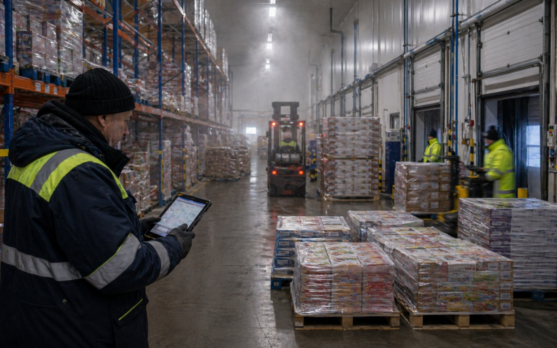
Still, the freezer is a brutal qualification test. A material that performs in a foodservice bowl or e-commerce mailer does not automatically belong around frozen seafood, vegetables, bakery or ready meals. Cold-chain packaging lives in a world of temperature abuse, compression and time.
The strongest entry point may be coatings, not bags
The seaweed companies getting closest to commercial relevance are not all trying to do the same thing. That is a good sign.
Notpla has built visibility around seaweed and plant-based materials for foodservice packaging, including coatings for takeaway formats, edible liquid capsules and dissolvable solutions. That is not the same as a mass-market frozen retail pouch, and it should not be treated as one. Its importance is different: it shows that seaweed-based materials can move beyond laboratory theatre when the use case is controlled and the format is specific.
Sway is working in another direction, with seaweed-based flexible films such as TPSea Flex, designed to run through existing plastic-bag infrastructure. That matters because packaging adoption is rarely only about material science. It is also about converters, machines, tolerances, line habits, supplier risk and the capital already sunk into existing systems. If a new material cannot enter the machinery of the industry, it remains a beautiful sample.
B’ZEOS is also pursuing a conversion-friendly route, using seaweed-based biopolymers processed into pellets for packaging applications. Again, the important point is not that pellets solve frozen packaging. They do not, at least not by themselves. The point is that serious algae packaging is moving toward industrial formats that converters understand.
For frozen food, coatings may be the first credible path. A seaweed-derived coating on fibre could help paperboard, cartons, trays or sleeves perform in applications where conventional fibre alone struggles. An alginate-based edible coating on a food surface may help protect seafood, fruit or other sensitive products from dehydration and quality loss. A dissolvable format may work in foodservice dosing. These are less theatrical than a seaweed bag in the freezer aisle. They are also more believable.
Retail frozen will be harder to convince
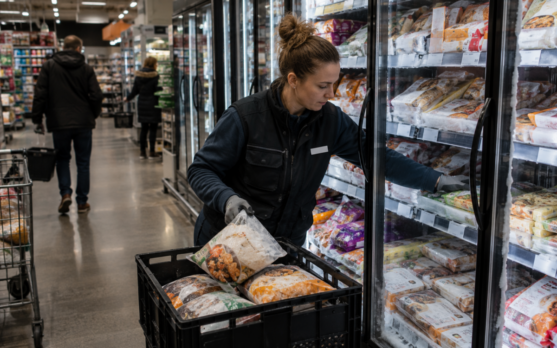
Walk through a freezer aisle and the commercial problem becomes obvious. Frozen packaging has to be cheap enough, tough enough, printable enough, sealable enough, stackable enough and familiar enough for high-volume retail. The category already fights for space, margin and trust. A material change that creates scuffing, weak seals, cloudy presentation, puncture risk, slower packing speeds or shelf-life uncertainty will meet resistance quickly.
Plastic flexible packaging is hard to displace because it does several jobs at once. It is light, strong, sealable, printable, efficient to ship and well understood by packing lines. It has environmental problems, but it has operational strengths. Seaweed-based films have to compete with those strengths, not with an abstract dislike of plastic.
The toughest categories will be those with long storage, long transport or high moisture sensitivity: seafood, meat, poultry, ready meals, frozen fruit, premium desserts and export products. A frozen bag of vegetables may look simple from the outside, but the packaging must protect against puncture, frost, moisture change, seal failure and rough handling. A tray for ready meals must manage multiple ingredients, temperature changes and sometimes cooking or reheating demands. A seafood pack may be judged by glaze loss, drip, odour, texture and buyer confidence.
Seaweed-based materials may find early retail opportunities in lower-risk formats, limited runs or premium products where the sustainability story adds value and the performance burden is manageable. Broad conversion across frozen retail is a different matter. No responsible buyer will accept a material because it sounds regenerative if it adds claims, damage, waste or operational friction.
Natural does not remove the need for proof
Seaweed carries a strong natural image, but food packaging cannot run on image. Biomass source, species, harvest location, seasonality and processing can all influence composition. Seaweed can also raise safety questions, including heavy metals and other marine contaminants, depending on origin and handling. For food-contact or edible applications, that makes sourcing discipline essential.
Frozen food companies are used to supplier audits and specifications. They will need the same discipline here: contaminant monitoring, food-contact compliance, migration evidence, batch consistency, odour control, allergen considerations where relevant, and clear end-of-life guidance. A sustainability team may enjoy the origin story. QA will ask for paperwork.
The same applies to end of life. Some seaweed-based materials are compostable, some dissolvable, some recyclable as part of coated fibre systems, some still dependent on industrial conditions. The consumer will not read a materials thesis in front of the bin. If the pack creates confusion, it can contaminate the wrong stream or lose the benefit that justified the switch.
European packaging regulation will make this harder to avoid. By 2030, packaging placed on the EU market faces much stricter expectations around recyclability, labelling and waste prevention. That does not automatically favour seaweed. It favours evidence. Materials that perform, document well and fit real collection systems will have a case. Materials that rely on a charming origin story will struggle.
The useful future is hybrid
The more realistic future for seaweed and algae packaging in frozen food is not heroic substitution. It is hybrid use.
Seaweed coatings may help fibre-based formats do more. Alginates may play a role in edible coatings for specific products. Seaweed-derived polymers may appear in films, blends or pellets where converters can work with them. Dissolvable formats may fit foodservice and manufacturing routines. Some materials may support premium or limited frozen products where the commercial story can carry extra cost. Others may stay outside frozen retail and still be valuable elsewhere in food packaging.
That is not a weak outcome. It is how most packaging change actually happens. A material enters the chain through the use case it can handle, then earns the right to move into harder applications. Frozen food will not be the easiest proving ground, but it may be one of the most meaningful. If a seaweed-based material can survive cold, water, seal stress, shelf life and industrial discipline, it deserves attention.
The mistake would be to ask seaweed packaging to behave like a miracle. The opportunity is to ask it to behave like a serious material.