A buyer asks for less plastic. A sustainability team wants a lighter pack. A brand manager likes the cleaner claim. Then, three months later, the frozen berries are clumped with ice, the fries have picked up freezer burn, the pastry has lost its edge, and half-open bags are sitting in household freezers like small monuments to good intentions. Frozen food has a strong sustainability story, but it depends on a piece of the system that is easy to attack and harder to replace: packaging that actually protects the food.
The easy target is not always the real waste
Packaging is visible. Food waste is often hidden. That is one reason packaging gets treated as the obvious villain. A tray, a pouch, a film, a resealable zipper, a sachet, a liner, a lid. The material is in the shopper’s hand. The waste bin sees it. The photograph is easy.
Food waste is messier. It happens later, after the marketing claim has done its job. A bag that will not close properly. Ice crystals around vegetables that were opened two weeks ago. A frozen fillet with dry white patches. A family-size pack that forces the consumer to wrestle out more portions than needed. A thin film that looks efficient on the spec sheet and weak in the freezer drawer.
The danger is not packaging reduction. The danger is packaging reduction treated as a trophy by itself.
A frozen food pack is not only a wrapper. It is part of the preservation system. It manages air, moisture, odor pickup, abrasion, portioning, handling, cooking instructions and the second life of the product after the first opening. If that system is weakened, the category can win a plastic saving and lose food value.
The wrong cut does not remove waste. It moves it.
The freezer gives time, but packaging makes that time useful
Frozen food is often described as naturally anti-waste because it extends shelf life and allows consumers to use only what they need. That is largely true. It is also incomplete.
The freezer gives time. Packaging decides how much of that time remains useful.
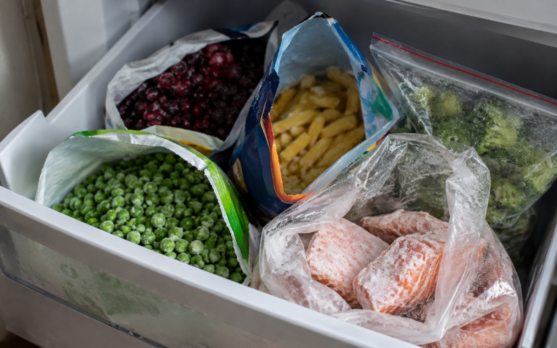
A bag of frozen vegetables is a good example. The shopper may use a handful tonight, another handful next week, then forget the rest until soup weather returns. If the bag closes well and the product stays separate, the freezer has done exactly what it should. If the pack tears, the seal fails, or the product turns into a frosted block, the same item becomes harder to use and easier to abandon.
Frozen bakery is even less forgiving. Croissants, laminated dough, par-baked breads and pastry pieces do not sell only calories. They sell structure. Crust, lift, flake, crumb, surface dryness. A packaging downgrade that allows more moisture movement or mechanical damage can ruin the very thing the product was bought for.
Meat, fish and seafood carry the most obvious visual penalty. Freezer burn does not necessarily make food unsafe, but safety is not the only question in a consumer’s kitchen. A dry edge, a faded surface, a leathery texture or a smell picked up from the freezer can turn edible food into rejected food. Nobody records that as a packaging failure on the shelf. The household bin does.
“Less” is too blunt a word
Frozen food needs a better packaging conversation than less versus more.
Some packaging is wasteful. Some formats are overbuilt. Some materials are hard to recycle for reasons that have more to do with legacy design than product need. Some packs exist to create shelf theatre rather than protect food. Those should be challenged hard.
But functional packaging deserves a different test. Does it prevent freezer burn? Does it protect texture after distribution? Does it keep portions separate? Does it close again after opening? Does it survive low temperature without cracking or weakening? Does it help the shopper cook correctly? Does it reduce the chance that a half-used pack disappears into the freezer until it is no longer appealing?
Those questions matter more than the headline weight of the pack.
A lighter bag that encourages waste is not a sustainability win. A slightly stronger, resealable pack that keeps a product usable across six or seven eating occasions may do more good, even if it uses a little more material. The useful measure is not packaging weight alone. It is protected food value per gram of packaging.
That phrase may sound technical, but the logic is simple. A gram of packaging has to earn its place. In frozen food, it earns that place by protecting the value already invested in farming, processing, freezing, transport, retail storage and household use.
The consumer is part of the package design
Packaging engineers often think about barrier, seal strength, puncture resistance, machinability, printability and cold-chain performance. They should. But a frozen pack also has to survive a less predictable environment: the consumer.
Home freezers are not ideal labs. They are crowded, opened often and badly organized. Packs are squeezed between ice cream tubs, half-used bags of fries, frozen herbs, meat portions, bread, pizza and leftovers. Products are opened in a hurry. Bags are folded badly. Clips disappear. Instructions are ignored. People pour, shake, tear, drop and forget.
The best anti-waste packaging understands that.
Resealability is not a premium extra for many frozen products. It is a waste prevention feature. Clear portion guidance is not decoration. It changes use. A pack that stands up, pours cleanly or lets a consumer remove one portion without thawing the rest can protect more food than a beautiful sustainability logo ever will.
There is a behavioral side to frozen packaging that the industry still underuses. The pack can tell the shopper how to store after opening, how to avoid clumping, how much to cook for two people, how to close the bag, how to spot quality changes, how to use the last portion. Small things, but frozen waste often comes from small frictions repeated over months.
Retail pressure will get tougher
Retailers are under pressure to cut packaging, simplify materials and move toward recyclable structures. Brands are under the same pressure. Policy is moving in that direction too. None of it is going away.
Frozen suppliers should not fight that movement with defensive language. They need better evidence.
If a pouch is downgauged, show that freezer burn does not increase. If a mono-material structure replaces a laminate, prove the barrier still protects the product. If a carton is reduced, test whether damage rises in distribution. If a reseal feature is removed, measure whether consumers waste more after first opening. If a portioned inner pack is eliminated, ask whether the household ends up thawing or cooking more than needed.
The next packaging claim should not be “30 percent less material” on its own. It should be “less material, same or lower food waste.” That second half is where credibility lives.
Buyers, packaging teams, R&D, quality, sustainability and category managers have to sit at the same table here. If one team cuts plastic and another team sees complaints rise, the company has not solved sustainability. It has rearranged the evidence.
The pack has to earn its place
The most serious frozen food companies will stop treating packaging as an apology and start treating it as a performance asset.
That does not mean defending every gram. It means defending the grams that work.
Frozen fruit may need a better reseal more than a lighter pouch. Frozen potatoes may need a pack that protects texture and limits moisture damage through distribution and home storage. Frozen bakery may need protection from crushing and humidity more than a cleaner-looking paper claim. Seafood may need barrier performance that preserves eating quality, not just food safety. Ready meals may need trays and films that make the cooking result reliable, because a badly cooked meal is another route to waste.
The public packaging debate often starts with the bin. Frozen food should push it back to the plate.
If the food is eaten, the pack has done part of its job. If the pack is lighter but the food is rejected, the system has failed with better optics.
The mature question is not how little packaging can be used. It is how intelligently packaging can protect food value while reducing material impact. That is a harder question. It is also the one frozen food is built to answer.