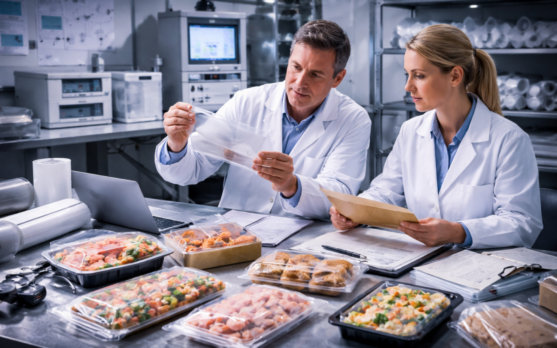
Food waste looks like the perfect raw material until it reaches the packaging line. On paper, the idea is almost irresistible: take discarded food streams, extract useful polymers, turn them into films, coatings or trays, then sell the result back into a food industry under pressure to cut both waste and plastic. The trouble begins in the middle. Packaging does not tolerate romance very well. Frozen food tolerates it even less. A waste-derived material has to become clean, consistent, food-contact safe, sealable, printable, scalable and cold-chain reliable before it deserves a place near a product that may spend months fighting moisture, oxygen and freezer burn.

The waste stream is not a material specification
The food industry generates enough waste to make the packaging idea feel obvious. UNEP has put global food waste at around 1.05 billion tonnes in 2022 across households, foodservice and retail. Europe alone reports tens of millions of tonnes a year. For companies looking at circularity, that volume is tempting. It suggests a material stream hiding in plain sight.
But volume is not the same as suitability. A mixed food waste stream can be wet, unstable, contaminated, seasonal and expensive to move. Even a cleaner industrial byproduct, such as brewery spent grain, fruit pomace, starch-rich residues or processing side streams, still has to be stabilised and converted into something predictable. Packaging converters do not buy moral value. They buy repeatable input.
That distinction matters. A frozen food plant running a high-speed line cannot build its packaging risk around variable material behaviour. A film roll that behaves differently from one batch to the next is not an innovation. It is downtime, waste, complaints and awkward calls with procurement.
Food waste may be cheap at the gate. Packaging-grade consistency is never cheap.
From residue to polymer, the hard part is control
The stronger part of the food-waste packaging story sits in biochemistry, not in simple reuse. Starch, cellulose, pectin, proteins, oils and other compounds can be extracted or converted. Microbial fermentation can turn organic carbon into PHA. Blends can combine starch, cellulose, proteins, PHA, PLA or other polymers to improve flexibility, barrier or processing behaviour.
That is the useful space. It is also where the work gets expensive.
Extraction needs clean enough feedstock. Fermentation needs controlled inputs. Purification has to remove what packaging, especially food-contact packaging, cannot tolerate. Drying, compounding and blending have to create material that a converter can run. Then come the duller tests that decide commercial reality: seal window, tensile strength, oxygen transmission, water vapour transmission, migration, odour, print performance and shelf-life impact.
PHA has become one of the more serious routes because it can be produced by bacteria using organic feedstocks and has biodegradable potential. Companies such as Genecis and VEnvirotech have built their positioning around turning organic waste into bioplastic materials. BioSupPack, working with brewery waste, is a more recent example of where the field is heading: PHA-based formulations, coatings and fibre-based packaging concepts aimed at circular packaging rather than lab curiosity.
That does not make the route simple. PHA remains tied to cost, scale, fermentation efficiency and downstream processing. A material that works beautifully in a prototype still has to meet the price and volume discipline of food packaging, where even small cost increases can become brutal across millions of units.
The freezer exposes weak formulations
Frozen food is a poor hiding place for material weakness. Starch-based films and protein films are attractive because they can be biodegradable and derived from familiar biological streams. They can also be sensitive to water. Cellulose-based films can offer useful barrier properties, but the final pack depends heavily on coatings, sealants and conversion structure. Pectin, chitosan and other biopolymer systems have promise in films and coatings, but the step from research sample to frozen retail pack is long.
In a freezer, water is everywhere even when everything looks dry. Ice crystals, condensation, product purge, sauce, fat, frost and temperature movement all test the pack. If a film softens, cracks, loses seal strength or allows too much moisture movement, the sustainability story collapses into a quality problem.
That is why waste-derived biopolymers may be more valuable first as coatings, layers and functional components than as full replacements for conventional flexible packs. A coating that helps a fibre tray resist moisture. A compostable sealant layer for a premium bakery pack. An active film that slows oxidation in a defined product. An edible or biodegradable coating that reduces moisture migration on a frozen product surface. These are credible pathways.
A large multi-serve bag of frozen vegetables is a different battlefield. So is seafood with purge, a family bag of fries, or a sauced ready meal that will be frozen, transported, thawed at the surface, heated and judged by consumers with no patience for technical excuses.
Food-contact credibility gets stricter when the source is waste
Food-contact packaging made from waste-derived material faces a particular trust problem. The circularity story sounds good, but the closer the material comes to food, the cleaner the story has to become.
A controlled industrial side stream is one thing. Mixed post-consumer food waste is another. Waste oils, brewery residues, fruit pomace, starch-rich process streams and seafood byproducts each carry different risks and different processing needs. The source affects odour, contaminants, allergens, microbial load, traceability and regulatory documentation.
No serious frozen food manufacturer will accept a packaging material because the origin sounds circular. QA will ask for composition, migration testing, declarations of compliance, allergen relevance, odour testing, shelf-life data and evidence that purification is consistent. Retail technical teams will ask the same questions, often with less patience.
There is a useful lesson in some experimental waste-derived films developed for non-food uses. They may be clever and environmentally interesting, but the origin of the feedstock can keep them away from food-contact applications. That is not failure. It is discipline. Not every waste stream belongs near food.
Frozen food will buy functions before narratives
In frozen food, the early commercial openings are likely to be selective. Premium frozen bakery is one. Some brands can justify compostable or bio-based films when the product value, pack story and shelf-life profile align. Ready meals and frozen bowls may use biopolymer coatings or layers inside fibre-based trays. Foodservice could adopt controlled packs or coatings where operators know the disposal route better than household consumers do.
Ingredient and process packaging may also matter. A waste-derived biopolymer does not need to carry the whole retail product to be useful. It might serve as a coating, release layer, inner film, edible barrier, sachet or component in a larger structure. That kind of application will rarely make a dramatic sustainability campaign, but it may solve practical problems without asking the material to do too much too soon.
The weakest route is the broad claim that food-waste biopolymers will replace plastic packaging across the frozen aisle. The category is too varied. A frozen pizza, a bag of peas, a seafood fillet, a plant-based burger, a sauce-heavy ready meal and a frozen croissant do not ask the same thing from packaging. The material portfolio will split by application, and some conventional plastics will remain difficult to displace.
Scale will decide how much of the promise survives
Europe’s PPWR puts more pressure on packaging claims. Recyclability, waste reduction, labelling and substances of concern will matter more than attractive origin stories. Food-waste-derived materials will have to explain where they go after use: recycling, industrial composting, home composting, biodegradation under defined conditions or some other managed route. A vague “biodegradable” claim will not carry much weight in a serious buyer meeting.
From 2026 to 2028, the most realistic progress will be in pilots, coatings, films for premium applications and partnerships between waste processors, biotech companies, converters and food brands. Frozen food adoption will stay careful. Nobody wants to be the brand that turned a circular packaging trial into a freezer burn issue.
By the early 2030s, the field should become more industrial. PHA from organic streams, brewery-waste formulations, cellulose and protein coatings, and blended compostable structures may move into more commercial trials. Better purification, better feedstock contracts and more standardised testing will separate serious suppliers from good storytellers.
Longer term, food waste may become one feedstock in the packaging toolbox. Not the answer to plastic. Not a universal frozen food solution. A source of carbon, starch, fibre, protein or polymer building blocks that can be turned into useful packaging where the chemistry, cost and application line up.
The circular economy has a habit of sounding clean from a distance. In packaging, it usually smells first of wet feedstock, hot processing, lab failure, trial runs and rejected samples. That is where useful materials are made. Food waste can become packaging. The part worth watching is not the idea. It is the discipline required to make the idea behave.