A frozen bag can look perfectly modern in a retailer’s freezer: sharp graphics, clear claims, a softer sustainability message on the back panel, maybe even a recycle-ready logo. Then the same pack reaches the recycling discussion and the conversation changes. The film may be PE or PP, the structure may have been simplified, the laminate may be lighter, but the print system sitting on the surface can still drag the whole claim into uncomfortable territory.

The frozen aisle still sells with colour
Walk along a frozen aisle and the first thing that hits you is not the polymer choice. It is colour. Steam rising from a plated meal. A bright vegetable mix. Ice cream tubs fighting for a second of attention. Private label pizza ranges laid out like mini billboards behind glass doors. Frozen food has always needed packaging to work harder than ambient categories because the product is hidden, the cabinet is cold, and the shopper rarely has time to study the detail.
That commercial pressure has created a habit. Big coverage. Deep colours. Heavy white layers. Gloss or matt finishes to make value ranges look sharper and premium ranges feel less industrial. On a conventional multilayer pack, that was mainly a question of print quality, food safety and cost. In a recyclable flexible structure, it becomes more sensitive. The print layer is no longer just the brand’s surface. It is part of the recycling story.
The awkward part for frozen food is that the selling job has not disappeared. Retailers still want shelf impact. Brand owners still want appetite appeal. Foodservice still wants packs that remain readable in cold rooms and back-of-house freezers. Packaging teams are being asked to simplify material structures while keeping the visual code that sells the product. That is where many recycle-ready projects become less clean than they look in a presentation.
Printing is now part of the recyclability test
Flexible packaging used to be discussed mainly through the film: PE, PP, PET, paper, aluminium, barrier layers, thickness, stiffness, puncture resistance. Printing sat around the edges of the conversation. That separation is breaking down.
In PE and PP flexible packaging, the ink, lacquer, primer and overprint varnish can affect how the pack behaves in sorting and recycling. Heavy ink coverage can change the classification of a film. Certain ink systems can influence odour, colour, emissions during extrusion, pellet quality or the ability to turn recyclate back into higher-value applications. A natural or transparent film stream is especially unforgiving because even small amounts of printed material can influence the colour of the recycled pellets.
That matters because a recycling claim is only as strong as the full pack. A buyer can approve a mono-material film and still inherit a weak packaging system if the artwork, white ink, coating or adhesive has not been assessed with the same discipline. The recycling line does not see the pack the way a brand team sees it. It sees material, colour, contamination risk and process behaviour.
Recent technical work from RecyClass has made this point harder to ignore. The discussion around inks on natural PE and PP flexible packaging has moved from a simple coverage debate to a more exacting look at ink weight, mandatory information and the effect of small printed fractions on recyclate quality. That is not a small editorial shift. It changes the way packaging specifications should be written.
NC-free is progress, but it is not a free pass
Nitrocellulose-based inks have served flexible packaging for good reasons. They can give strong mechanical fastness, good surface-print performance and reliable behaviour in demanding converting conditions. They are familiar to printers. They have been part of the machinery of flexible packaging for years.
The recyclability discussion is now pushing the market toward alternatives. PU-based and PVB-based ink systems have gained attention because technical testing has shown compatibility with PE and PP flexible packaging recycling streams. That is important progress. It gives converters and brand owners a more serious route than vague language about “greener inks”.
Still, frozen food buyers should be careful with easy labels. NC-free does not automatically mean low risk. Water-based does not automatically mean suitable for every film, speed, temperature or graphic requirement. Low-migration does not automatically mean recycling-compatible. Each term answers a different question.
A printed frozen pack has to survive more than a recycling protocol. It has to run on a line without creating drag, blocking, misregistration or sealing problems. It has to tolerate rubbing inside secondary packaging. It has to remain legible after condensation and freezer handling. It has to protect mandatory information, date codes and batch markings. If the ink performs well in recycling but fails in the factory, the pack will not survive commercial approval. If it runs well in the factory but damages recyclate quality, the sustainability claim becomes fragile.
Frozen food punishes weak print decisions
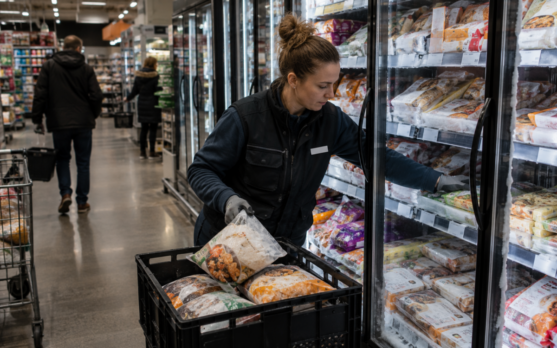
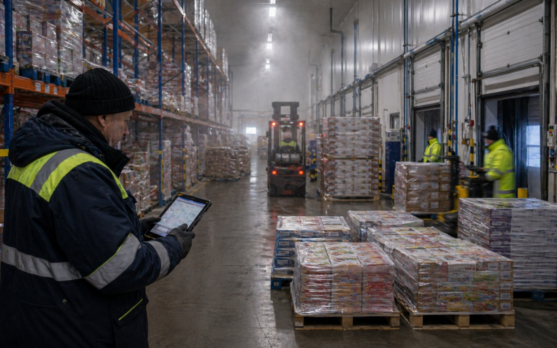
Frozen packaging is handled badly because the system around it is harsh. Bags are dropped into cases. Cases are stacked, cut open, moved, restacked and pushed into cabinets. Packs rub against each other while surfaces are cold and sometimes damp. A store employee rotating stock in a supermarket freezer is not handling a lab sample. Neither is a picker in a foodservice warehouse pulling mixed cases during a busy morning shift.
This is where print becomes operational, not decorative. A high-gloss surface may look good in artwork approval and still create problems with friction. A heavy white layer may help photography pop and still complicate recycling. A coating may improve scuff resistance and still need to be checked against the target recycling stream. A dark full-surface design may look premium, but it can make the natural-film recycling argument harder to defend.
The frozen category also carries a lot of functional print. Cooking instructions, safety information, allergens, storage guidance, nutritional panels, multilingual copy, recycling labels, QR codes, batch codes and expiry dates compete for space. In private label, that pressure is even higher because one artwork system often has to stretch across many SKUs, countries and pack sizes. Reducing ink is simple in theory. In a real range review, it means changing artwork discipline, not just asking the printer for a different formulation.
There is another tension. Frozen food uses packaging as evidence of quality. Frost, abrasion, dullness or damaged print can make a perfectly safe product look tired. Retailers dislike tired packs. Consumers read them as old stock, even when the cold chain is intact. That means converters cannot simply strip away print performance in the name of recyclability. They have to design a printed pack that can look acceptable after a hard journey.
The buyer meeting is where the claim should be tested
A serious buyer meeting on recyclable flexible packaging should no longer stop at film type and gauge. The printed sample needs to be treated as the commercial pack, not as a decoration added after the technical decision.
The first question is the target stream. Is the pack intended for PE recycling, PP recycling, coloured flexible film, natural film or a mixed flexible packaging stream? The answer changes the tolerance for colour, print coverage and additives. A supplier who cannot answer this clearly is not ready for a serious specification conversation.
The second question is whether the full structure has been tested: film, ink, primer, lacquer, adhesive, coating and sealant layer. Too many claims are built from partial evidence. A film supplier may have strong recyclability data. An ink supplier may have its own approval. A converter may have run a successful trial. The buyer still needs to know how the final printed pack behaves as one system.
The third question belongs to the factory. Has the pack run at real speed, with real product, on the intended line, under conditions close to production? Frozen food lines rarely forgive theoretical packaging. Seal windows narrow. Film handling changes. Scrap rises quietly before anyone wants to admit the new structure is causing trouble. Sustainability projects lose credibility inside factories when they arrive as claims rather than tested operating materials.
AI may help the brief, but it will not certify the pack
There is a useful place for AI and advanced design tools in this discussion, although the packaging sector should resist the easy theatre around it. Software can help teams compare more versions of an artwork and structure before they reach expensive trials. It can flag excessive ink coverage, simulate design choices, compare material scenarios, connect artwork changes with recycling thresholds and help packaging teams avoid obvious dead ends earlier.
That has real value in frozen food because the number of constraints is high. A packaging manager may need to balance a PE or PP route, seal integrity, puncture resistance, print coverage, low-migration requirements, cabinet appearance, retailer artwork rules and cost. A good decision tool can make that trade-off visible before the first full production run.
But no algorithm should be allowed to become a substitute for migration assessment, recyclability testing, line trials or cold-chain validation. The risk is not that AI will design a bad pack. The risk is that companies will use digital confidence to move too quickly past physical evidence. Frozen food has a way of exposing that mistake.
The commercial line is moving
By 2030, packaging teams in Europe will be working under a harder recyclability framework. Plastic packaging will face recycled-content pressure. Retailers will keep tightening their own specifications. Recyclability claims will need better documentation. Flexible packaging will remain commercially important because it is light, efficient and often essential for frozen products. It will also be asked to prove more.
The print layer will sit directly inside that pressure. Less ink where possible. Better ink chemistry where needed. More careful use of white layers, dark coverage, coatings and varnishes. More discipline between brand, procurement, converter and recycler. It sounds technical because it is technical. It is also commercial. A pack that cannot defend its recycling claim will become harder to sell to retailers, harder to explain to regulators and harder to justify inside a manufacturer’s own sustainability reporting.
The frozen aisle will not become plain. Nobody should expect that. But the best packaging briefs will start treating print as a material decision, not an artwork decision. That is a quiet change, and probably one of the most important ones now moving through flexible packaging.