In a potato plant, ambition arrives at the receiving bay before it reaches the fryer. Trucks come in dusty from the field, samples are cut, solids are checked, defects are counted, sugars are watched, and a buyer somewhere in Dubai, Singapore or Mumbai expects the same fry length, colour and bite next month as the one approved last quarter. Asia’s frozen potato market is no longer just a demand story. The factory is moving closer to the plate. India has the crop, the entrepreneurs and the export window. What it still has to prove is more demanding: that it can turn a volatile fresh-market potato system into an industrial supply chain built for repeat orders.

The factory is moving closer to demand
For years, the frozen potato trade was easy to map. Europe and North America processed. Many fast-growing markets imported. That map is still there, but it is becoming less tidy. China has built a larger domestic processing base. India is adding capacity at a pace that would have sounded ambitious a decade ago. Southeast Asia and the Gulf are no longer just distant demand points for European fries. They are buyers with more options.
That matters because frozen potato products are not ordinary food exports. A container of fries carries factory discipline, agronomy, storage history, oil behaviour, packaging strength and cold-chain execution. The product may look simple in a QSR basket, but the trade behind it is unforgiving. A buyer can forgive a late sample once. It will not build a regional menu around inconsistency.
India’s role in this new map is becoming harder to dismiss. The country produced about 58.6 million tonnes of potatoes in 2024-25. That is agricultural scale. On its own, it does not make India a frozen potato power. Fresh-market volume is not the same thing as processing-grade supply. A fry plant does not need any potato. It needs the right potato, in the right condition, arriving when the line needs it.
India’s advantage is real, but it is not automatic
The strongest argument for India is not just lower cost. It is proximity to the next demand layer. Gulf markets want competitive supply. Southeast Asia wants volume and price options. Indian QSR and foodservice are still expanding, even if retail frozen remains uneven outside the stronger urban pockets. A processor in Gujarat or Uttar Pradesh can sit closer to several growth markets than a factory in Western Europe.
That geography becomes more interesting when global buyers want diversification. European processors remain strong, but they have faced raw material pressure, energy cost, weather volatility and old-stock issues at different points. When buyers in the Gulf see an Indian supplier offering fresher production, competitive pricing and improving consistency, they test the lane. That is how market share begins to move, not with speeches about emerging markets, but with a buyer approving another container.
APEDA’s own potato market work has framed the issue neatly: India has gained in GCC frozen fries, but the task is to move from opportunistic gains to long-term supplier status. That line should be printed above the door of every new plant. Export growth is useful. Contract confidence is harder.
The new plants change the conversation
The investment wave is no longer theoretical. HyFun Foods has planned a major North Gujarat expansion of about INR 900 crore, with new capacity expected around late 2026 and production linked to the 2027 crop. The company’s stated plan would lift French fries capacity to 245,000 tonnes and potato specialties to 40,000 tonnes. McCain has announced a far larger Madhya Pradesh project, reported around INR 4,000 crore, with phased investment and a grower base running into the tens of thousands. Agristo’s Uttar Pradesh site adds another signal: international know-how, Indian potato acreage and a plant built with export markets in mind.
These projects are important because they push the industry beyond the old question of whether India can consume more fries. The sharper question now sits inside factory planning. Can the potato system feed these lines without losing discipline? Can farmers be contracted, trained and paid in a way that keeps processing varieties in the ground? Can storage hold quality instead of merely delaying a price collapse? Can the plant run at the consistency required by regional buyers who compare suppliers every shipment?
A new fryer is visible. The supply system behind it is harder to photograph. Seed, agronomy, irrigation, harvest timing, storage, transport, sampling and rejection protocols decide whether the factory becomes a serious supplier or a large piece of machinery chasing suitable raw material.
Buyer specs will decide more than acreage
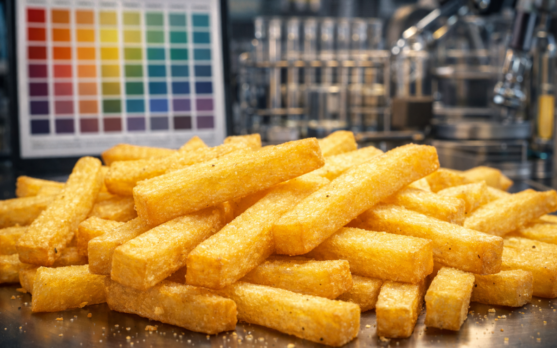
The most important room in this story may not be the boardroom. It may be the room where a QSR or foodservice buyer compares samples. Fry colour. Length. Defects. Crispness. Hold time. Oil uptake. Carton condition after transport. Performance after a slightly messy thaw-refreeze event that nobody wants to admit happened somewhere in the chain.
That is where India’s industrial test sits. A buyer in Saudi Arabia or the UAE is not buying the story of Gujarat agriculture. A buyer is buying predictability. If Indian fries are cheaper but less consistent, they stay as tactical supply. If they perform reliably, they become part of the planning cycle.
The same logic applies at home. Indian QSR chains and foodservice operators need supply they can build menus around. A fry that works in one city and struggles in another because of storage, transport or kitchen handling is not a stable platform. Domestic growth will reward processors that understand service as much as production.
Some Indian companies already know this. Their language has shifted from capacity to farmers, export markets, traceability and value-added products. That is the right direction. But the market will test the claim in the dullest possible way: repeat orders, claims rates, delivery windows and the number of times a buyer has to ask what changed.
Cold chain is not one problem
India has cold storage capacity, especially around potatoes. That can be misleading. Storing table potatoes in bulk is not the same as feeding a frozen processing platform. A fresh-market cold store, a processing-grade potato store and a frozen finished-goods chain serve different jobs.
For processing, temperature is only part of the issue. Potato storage affects sugars, fry colour and usable yield. Finished frozen goods need disciplined handling, reliable reefer availability, port execution and retail or foodservice distribution that does not damage the product after the factory has done its job. A processor can make a good fry and still lose value through weak cold-chain behaviour downstream.
Government support for food processing and cold-chain infrastructure helps, and India has active schemes for integrated cold chain and value addition. But incentives cannot replace operating discipline. The difficult parts are local and repetitive: the right store in the right district, the right transport at harvest, the right reefer slot, the right pallet handling at the port, the right data when a claim comes back from a customer.
The frozen potato sector will also have to avoid confusing volume with system maturity. A bumper crop can bring cheap raw material. It can also bring distress, storage pressure and quality spread. For a processor, the best year is not always the year with the most potatoes. It is the year with enough processable potatoes, kept well, priced sensibly and delivered without chaos.
Asia is not one market
Talking about Asia as one frozen potato story is lazy. China has built serious processing muscle and has become a net exporter of frozen fries. Its manufacturers are using scale, equipment and proximity to ASEAN to pressure regional supply. India is earlier in the curve, but it has a different advantage: a large crop base, a strong entrepreneurial processing layer and access toward the Gulf, Southeast Asia and domestic foodservice.
Southeast Asia will not simply wait for India. China is close. European suppliers are established. North American processors remain important in several channels. The Gulf is more open to diversification, but buyers there still expect consistency. India’s opportunity is real because it sits between supply scale and demand growth. Its risk is that too much capacity arrives before the agricultural and logistics system is fully ready to support it.
That risk should not be dismissed. If several plants chase the same processing-grade potatoes, contract farming will have to deepen quickly. If export buyers push harder on price, processors will need productivity rather than just cheap raw material. If domestic retail grows slowly, plants built around mixed demand will lean more heavily on export discipline.
The next race is reliability
From 2026 to 2028, India’s frozen potato story will be shaped by commissioning, grower expansion and buyer testing. New lines will need raw material. New contracts will need evidence. Export channels will reward suppliers that can ship on schedule without quality drama. The market will still celebrate capacity announcements, but capacity is only the visible part of the race.
From 2029 onward, the sector may become more selective. Standard fries will be crowded. Coated fries, wedges, hash browns, snacks, air-fryer formats and foodservice-specific products may offer better room for margin. Indian processors may also use local flavour knowledge and snack culture to build formats that are not just copies of Western potato products.
There is a bigger point here. India is not trying to become Belgium. It does not need to. Its best route is to build a potato processing system suited to its own farm base, its regional customers and its cost structure, while meeting the hard technical expectations of global buyers. That is a difficult combination. It is also the reason the market is worth watching.
The factory is coming closer to demand. The buyer is already at the table. The potato system now has to catch up.