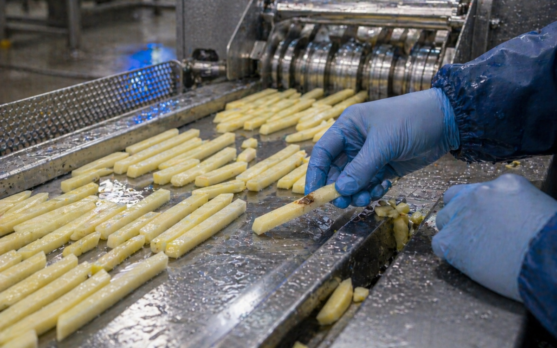
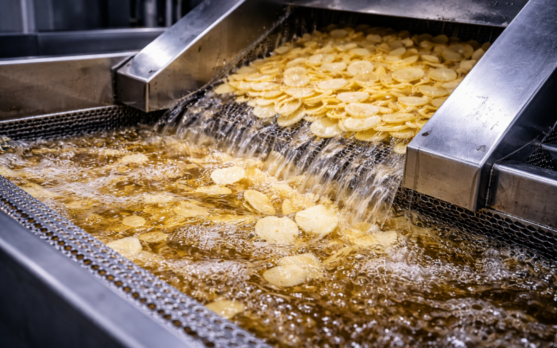
A processor does not need a potato that sounds impressive in a breeding presentation. He needs one that comes out of storage in February, cuts cleanly, does not bruise into waste, fries to the right colour and lets the factory run without arguing with every lot. That is where CRISPR becomes interesting for frozen potato. Not as a grand biotech promise, but as a possible way to make the raw material less moody when disease, storage, heat and sugar start pushing back.

The factory does not buy a breakthrough. It buys behaviour.
Gene editing is usually introduced with the language of science: target genes, edited lines, resistance traits, non-transgenic plants, breeding speed. In a potato processing plant, the questions are less elegant. Will this tuber store? Will it cut? Will it fry light enough? Will it hold quality after a difficult season? Will it give the plant more usable product, or only more paperwork?
That gap between lab language and factory language is where the commercial test sits. A variety can look promising in the field and still disappoint in processing. Good yield is useful, but not enough. A frozen fry or chip plant buys a whole performance profile: dry matter, sugars, fry colour, size, shape, dormancy, bruising resistance, disease history and storage behaviour.
CRISPR may help breeders reach some of those traits faster. It will not make processors less demanding. If anything, it may make them more precise. A buyer who hears “gene-edited potato” will still ask for the same evidence he asks from any new variety: samples, storage data, fry tests, field performance, defect levels and a believable supply plan.
Disease resistance is a supply-chain issue
Late blight does not stop at the field edge. It reaches the processor through lower usable volume, higher grower costs, more uncertainty in contracts and weaker storage outcomes. A factory with a full order book and poor incoming crop is not interested in the philosophical beauty of plant resistance. It wants enough sound potatoes to keep the line running.
CRISPR work on late blight resistance has become more serious in recent years. Research on genes linked to susceptibility, including Parakletos, has shown that editing can improve resistance under field conditions. The appeal is clear enough. Fewer disease losses, less pressure on chemical programs, more stable supply. For processors, that becomes relevant when it protects contracted volume and quality, not just when it produces an impressive research chart.
The cautious note matters. A resistant variety is not a free pass. Potato production still needs rotations, field monitoring, storage discipline and professional agronomy. Disease pressure changes. Pathogens adapt. Growers cannot farm a laboratory abstract.
Still, for frozen potato companies trying to secure long-term raw material, disease resistance belongs in the same conversation as price, water, storage and processing quality. It is part of keeping the factory fed.
Cold storage is the more interesting processing story
The most practical CRISPR story for fried potato may be hiding in cold stores, not in disease trials.
Processors need potatoes for months after harvest. Storage keeps supply available, but low temperatures can trigger cold-induced sweetening. The tuber accumulates reducing sugars. Later, in the fryer, those sugars darken colour and can raise acrylamide risk. A chip line sees it fast. A slice that should be pale gold comes out brown. A fry line sees dark ends, uneven colour and more anxious process control.
That is why work on vacuolar invertase matters. Researchers have used CRISPR/Cas9 to reduce or knock out activity linked to cold-induced sweetening, with edited potato lines showing better frying quality after cold storage. The line known as PIRU INTA, developed from Atlantic for chip production, is one of the clearer examples now being discussed in the trade.
For a factory, this is not a small technical curiosity. A potato that can tolerate colder storage without wrecking fry colour could change the handling of late-season supply. It could reduce the need for reconditioning. It could lower the number of difficult lots arriving in winter. It could give processors more room to manage sprouting and quality at the same time.
That does not mean every cold-storage problem disappears. Storage is still storage: temperature, humidity, ventilation, wound healing, dormancy, disease and time all matter. But a variety that fights sugar accumulation better gives the plant a better hand.
Bruising and browning are not cosmetic details
In fresh retail, a bruise may be a visual defect. In processing, it is trimming, sorting, waste, downtime and downgraded product. Bruising is money with a dark patch on it.
Potatoes are not handled gently on an industrial journey. They are harvested, loaded, stored, moved, washed, peeled, cut and inspected. Every weak point in the tuber becomes a possible cost. If gene editing can reduce enzymatic browning or improve tolerance to handling damage, the benefit is not just a cleaner-looking potato. It is less waste before the fryer and less pressure on optical sorting after cutting.
Work targeting PPO-related pathways is important for that reason. The industry should not oversell it. A potato that browns less still needs correct harvest and handling. Bad logistics can defeat good genetics. But reducing the sensitivity of the raw material could help plants keep more product in the saleable stream.
There is also a customer angle. Frozen fries, chips and specialty products live on visual trust. A dark piece in a premium bag draws the eye immediately. The consumer does not care whether the defect began in the field, in storage or on a belt. The brand gets the blame.
Climate resilience will enter the processor’s contract language
Weather is no longer a background risk. Heat, drought, uneven rainfall and disease pressure are already shaping potato quality. The issue is not only whether there are enough tonnes. A crop can be present and still be awkward: smaller tubers, weaker solids, more defects, storage instability, inconsistent fry colour.
CRISPR work on drought tolerance, including studies around CBP80 editing, points toward a future where breeders try to protect performance under stress, not just raise yield in normal conditions. For frozen processors, the important word is predictability. A plant can plan around a smaller crop if it understands the quality. It struggles when the crop looks acceptable on paper but behaves badly in production.
Processor contracts may become more technical as a result. Variety names and volumes will not be enough. Buyers will want evidence of storage behaviour, fry colour after stress seasons, reducing sugar profile, bruising performance and disease response. Gene-edited traits could become part of that evidence package.
The danger is the phrase “climate-proof potato.” It is lazy and it will not survive contact with agriculture. No edited variety can remove weather. The useful ambition is more modest and more valuable: potatoes that lose less performance when the season turns against them.
Regulation may move before the market is fully comfortable
The regulatory environment is changing. In April 2026, the Council of the European Union adopted new rules for plants developed with new genomic techniques, a major shift from the older, heavier GMO framing. The direction is clear enough: Europe wants more space for precision breeding in crops that can support resilience, sustainability and competitiveness.
Commercial acceptance will be slower and more uneven. Retailers, QSR groups, organic bodies, seed companies, growers and consumers will not all move at the same speed. Some markets will treat gene editing as a practical breeding tool. Others will handle it with caution, especially where food labels and public trust are sensitive.
That leaves processors in a delicate position. They may want the benefits, especially lower disease risk, better storage and more stable fry colour. They may not want a consumer-facing argument over biotech attached to a bag of fries.
The best route will be plain language and measurable value. Do not sell a miracle. Say what the trait does. Say what it does not do. Show the storage data, the fry colour, the field results, the handling performance. A gene-edited potato will earn its place the same way every processing variety does: by behaving well enough, often enough, at commercial scale.
That is the part of CRISPR that should interest the frozen industry. Not the glamour of editing genes. The possibility of making the potato less of a gamble between harvest and fryer.