The frozen food industry has heard plenty of clean-cooling promises. Some disappear after the conference slide. Some survive long enough to become a niche device. A few, much later, change equipment rooms. Thermogalvanic cooling belongs in the uncomfortable middle: technically interesting, genuinely relevant to the search for refrigerant-light refrigeration, but nowhere near ready to shoulder the work of a frozen warehouse, blast freezer or supermarket freezer bank. That makes it worth watching, not worth overselling.

The promise is cleaner than the current reality
Thermogalvanic cooling sounds attractive because it touches two weak points in conventional refrigeration: energy demand and refrigerants. Instead of using a compressor and a standard vapour-compression cycle, the technology relies on electrochemical reactions. In simple terms, a current is used to drive a reversible redox process that can create a cooling effect.
That is interesting. It is also a long way from a frozen food plant.
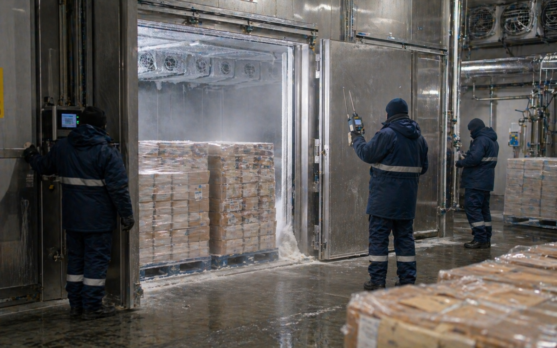
Industrial freezing is heavy work. Product brings heat into the system. Doors open. Moisture enters. Air moves badly in the wrong places. Evaporators frost. Pallets sit in front of airflow. Staff and forklifts do what real operations always do: disturb the tidy assumptions of equipment design.
A laboratory cell does not face that mess. A freezer room does.
So the useful discussion is not whether thermogalvanic cooling is clever. It is. The better question is whether it can become useful in food refrigeration without being pushed into claims the science has not earned yet.
The 70 percent figure needs to be handled carefully
The recent interest around thermogalvanic cooling comes partly from a 2025 Joule paper and related public reporting on a new electrolyte system. The headline number is tempting: more than 70 percent improvement in cooling power compared with previous thermogalvanic attempts.
That is not the same as a freezer using 70 percent less energy.
That distinction matters. A research system improving cooling power against earlier lab work is one thing. A commercial freezer cutting energy consumption by the same percentage is a completely different claim. The frozen food sector should be allergic to that kind of shortcut. It has seen enough technologies walk into the room with bold numbers and leave when the load test begins.
The reported cooling effect in the study was modest in absolute temperature terms, around 1.42 K of direct electrolyte cooling. The work is still valuable because it shows a path for improving electrochemical cooling performance. It does not prove that thermogalvanic refrigeration is ready for a cold store, a freezer cabinet or a foodservice freezer.
That is not criticism. It is the normal distance between a research result and a product that can be cleaned, serviced, insured, audited and left running on a Friday night.
Frozen food is a harder test than a cooling experiment
Frozen food is unforgiving because it asks cooling systems to do several jobs at once. Remove heat quickly. Hold temperature. Recover after disturbance. Protect texture. Prevent excessive ice crystal growth. Avoid warm spots. Produce records that customers and auditors will accept.
Thermogalvanic cooling still has to answer basic industrial questions before it enters that environment. How much heat can it move per square metre or per module? How does performance change over thousands of cycles? What happens if the electrolyte degrades? How is heat rejected from the other side of the system? Can it be cleaned? Can it be scaled? What does maintenance look like? What happens during a fault?
These are not unfriendly questions. They are the questions every food operator asks when a technology leaves the laboratory and approaches the loading bay.
A frozen warehouse does not care that a system is elegant. It cares whether product stays in specification, whether the energy bill makes sense, whether spare parts are available and whether the insurance file stays quiet.
At this stage, thermogalvanic cooling should not be presented as a replacement for ammonia, CO2, propane or established compressor systems. That would be premature. The real interest is smaller and more specific.
The first applications will not look like a freezer room
If thermogalvanic cooling reaches food applications, it will probably arrive at the edges first.
Think small controlled compartments, not distribution warehouses. QA sample storage. Laboratory refrigeration. Temperature-sensitive ingredients. Portable boxes. E-grocery staging modules. Retail micro-cooling. Foodservice drawers. Maybe cold-chain devices where silence, compact design or reduced refrigerant exposure is more valuable than raw cooling capacity.
That is how many cooling technologies earn their place. Not by replacing the main plant, but by solving an awkward problem that the main plant was never designed to solve.
Food factories have plenty of those awkward corners. Samples that need stable temperature but not a full cold room. Ingredients held near a line. R&D prototypes. Small batches for shelf-life tests. Speciality products that need tighter control than the general freezer. In these places, precision can matter more than scale.
Foodservice and retail have their own versions. A small module near a prep station. A pickup area for chilled and frozen online orders. A compact compartment for high-value frozen items. A controlled storage point in a dark store where conventional refrigeration would be bulky or expensive to install.
None of this makes thermogalvanic cooling a frozen food revolution. It makes it a technology with plausible first doors.
Hybrid may be the realistic route
The food industry should also pay attention to hybrid logic. New cooling technologies rarely replace entrenched systems in one move. They attach themselves to a problem.
A compressor handles the heavy load. An electrochemical or solid-state system may one day manage a smaller zone, a peak condition, a precision compartment or a local temperature correction. That kind of role is less glamorous than claiming the end of compressors. It is more believable.
The same pattern is visible in other alternative cooling discussions. Thermoelectric systems, for example, are finding more credible openings in portable, point-of-use and hybrid applications than in industrial-scale freezing. Thermogalvanic cooling could follow a similar path if the engineering matures.
The key will be heat rejection. Cooling is only half the story. The system still has to put heat somewhere. In a clean lab setup, that is manageable. In a food plant, supermarket back room or delivery module, heat rejection becomes a design issue, a space issue and sometimes a hygiene issue.
Then comes reliability. Food operators dislike technologies that require too much interpretation. A cooling module must either hold temperature or not. It must fail in a safe way. It must not create a maintenance routine that only one specialist can understand.
The technology to watch, not the equipment to buy
There is a useful place for thermogalvanic cooling coverage in the frozen food sector, but it should be labelled correctly. This is technology watch, not procurement advice.
Over the next few years, the important signals will be practical: larger prototypes, longer cycle testing, better materials, stable electrolytes, stronger heat exchangers, safety validation, cost data and demonstrations outside controlled laboratory conditions. If those arrive, the conversation changes.
Until then, operators should keep the categories clear. Energy-efficient freezing in real plants still depends on better compressor control, defrost management, door discipline, heat recovery, refrigerant transition, thermal buffering and maintenance. Thermogalvanic cooling is not ready to replace those tools.
Its value is different. It reminds the industry that refrigeration is not finished technology. Compressors dominate because they work, not because every alternative is irrelevant. The search for refrigerant-light, compact, precise cooling is real. It will matter more as cooling demand rises and climate pressure tightens around both energy use and refrigerants.
Thermogalvanic cooling is not a freezer yet. That may be the most honest reason to keep watching it.