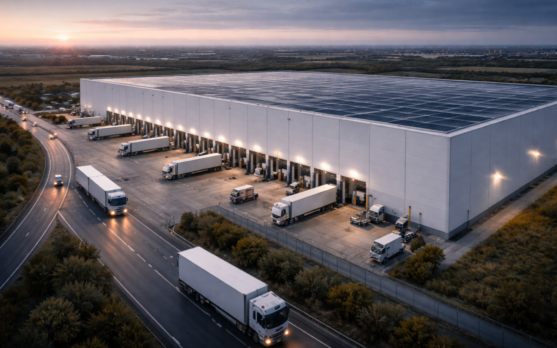
A large frozen warehouse in Indiana can look, from a distance, like a real estate story: a tall box, a heavy investment, more pallet positions on the map. Look closer and NewCold’s Lebanon campus says something sharper about the US frozen food business. Large processors are no longer building supply chains around spare freezer space. They are looking for controlled capacity that can absorb demand swings, handle mixed orders, reduce freezer-floor labor and keep chilled and frozen portfolios moving through the same industrial logic.
The Midwest freezer behind the national shelf
The frozen aisle does not tell the full story. A shopper sees pizza, vegetables, snacks, frozen poultry, ready meals, ice cream and potatoes. A retailer sees availability, empty doors, promotion compliance and category margin. A processor sees something more awkward: production runs, customer windows, late order changes, inventory aging, temperature discipline and the cost of holding product cold before it earns a dollar.
That is where Lebanon, Indiana becomes more than a dot on a logistics map. NewCold’s campus sits in the Midwest, close to the center of gravity for US food manufacturing and national distribution. The location matters because large frozen food processors do not only need cold. They need reach. They need a place where volume can move without forcing every pallet through a patchwork of older facilities, manual handling and emergency capacity.
NewCold’s Lebanon site was first announced in 2020 as a major automated cold storage project tied to an expanded relationship with Conagra Brands. At the time, the planned investment was about USD 150 million, with more than 100,000 pallet positions in a 141-foot high-bay warehouse. The original pitch was already clear: automated storage and retrieval, dark high-bay operation, advanced case picking and a distribution model built for large food processors rather than small, irregular overflow work.
That first version now looks almost modest compared with what the campus has become.
From anchor customer to campus logic
By 2025, NewCold had opened the second phase at Lebanon, adding another 100,000 pallet positions and taking the site beyond 200,000. The combined investment had reached about USD 300 million. In 2026, the company announced a further expansion of more than USD 500 million, taking total investment in Lebanon above USD 800 million since 2020. The third phase is planned as a new facility south of the existing operation, with three high-bay areas serving both frozen and chilled temperature zones.
That last detail changes the reading of the project. Frozen-only scale is one story. Frozen plus chilled is another. It suggests a campus designed around the way large food companies actually sell and ship product: not in neat category boxes, but across temperature regimes, channels and customer formats. A processor with a growing frozen portfolio may also carry chilled lines, bakery items, prepared foods or temperature-sensitive ingredients. The more those flows can be coordinated without multiplying handovers, the more valuable the site becomes.
Lebanon is not being built as a generic cold store waiting for whoever turns up. Conagra Brands has been identified as the anchor tenant, and Refrigerated & Frozen Foods has reported that FGF Brands, the Canadian bakery company with operations in Indiana, also stores product there. That mix is useful. It places the campus near the practical world of branded frozen food and bakery supply, where retailers want reliable replenishment, club and mass channels move large volumes, and foodservice customers can punish weak execution quickly.
There is a scene that matters here. It is not the glossy image of cranes moving in a dark warehouse. It is the planning call before a promotion goes live, when a processor, a retailer and a logistics partner are trying to decide whether the product will actually be available in the right places, in the right format, with enough recovery room if demand is wrong. That is where a high-bay automated campus earns its keep, or fails to.
Why large processors need more than pallet space
US frozen food has not drifted back to its pre-pandemic role. The category has held onto a larger place in household routines, helped by value seeking, meal planning and the simple fact that frozen products reduce waste at home. Recent reporting on the AFFI and FMI Power of Frozen work placed US frozen food sales at USD 87 billion for the 52 weeks ending in September 2025, more than 45% above 2019. That growth includes inflation, but it also includes a behavioral shift: shoppers use frozen more often, plan around it and increasingly combine frozen and fresh ingredients in the same meal.
That is good news for processors, but it is not comfortable news. A bigger frozen category can mean more SKUs, more channel-specific packs, more club-store volume, more mass-retail pressure, more online grocery complexity and more trouble when availability slips. The same research discussion pointed to a stubborn retail weakness: more than a quarter of shoppers saw availability of the frozen products they wanted as very inconsistent, and almost a fifth said they often struggled to find what they were looking for.
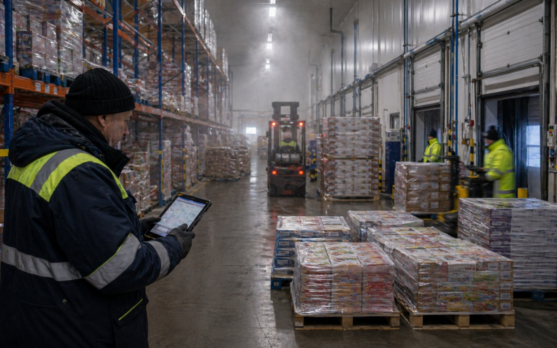
That problem does not begin at the freezer door. It begins upstream, where production, warehousing, order assembly and transport either line up or fight each other. For a large processor, a warehouse that simply holds pallets is no longer enough. The value is in throughput, accuracy, case picking, mixed orders, lot control, temperature reliability and the ability to react without throwing people into a freezing room to patch the system by hand.
NewCold’s Lebanon operation has been described as using nine double-stacked cranes in its first phase, automated layer picking and palletizing, and a nearly fully automated less-than-pallet assembly area. Those details matter because many food logistics failures happen below full-pallet level. A truckload may look clean on a spreadsheet. Store, club and foodservice orders rarely behave so politely.
The labor equation is being rewritten
Cold storage has always had a labor problem that the industry sometimes dresses up as an efficiency problem. Freezer work is hard. It is cold, physical, repetitive and unforgiving. Turnover is expensive. Training is slow. Mistakes are visible because frozen product gives operators little room for abuse, delay or improvisation.
Automation does not remove people from the building. It changes where the important work sits. At Lebanon, NewCold executives have described labor as concentrated more in operating, planning and maintenance than in conventional manual warehouse activity. Refrigerated & Frozen Foods reported that the case-picking area, where pallets are built manually, and truck loading and unloading are among the few areas where human labor remains prominent, while most product moves through automation.
That is a different kind of workforce. Less time spent driving through sub-zero aisles. More time spent managing systems, maintaining equipment, coordinating inbound and outbound flows, checking exceptions and keeping the automated process honest. It is not easier work in a simplistic sense. It is more technical, and probably less forgiving of sloppy data.
That last point is important for food processors. Automated cold storage exposes weak upstream habits. Poor item data, unstable forecasts, late changes, awkward pallet configurations and unclear order rules do not disappear inside a high-tech warehouse. They become more visible. The site can move quickly when the inputs are disciplined. It can also reveal exactly where a customer’s planning is not as clean as the customer thought.
The chilled signal inside a frozen story
The 2026 expansion is the part of the Lebanon story that deserves the most attention now. NewCold said the new facility will include frozen and chilled zones and will use a 2D shuttle system in North America for the first time in its network, moving product between temperature areas. That is a different commercial signal from another frozen high-bay alone.
Chilled adds complexity. It also adds relevance. Many major food companies no longer think of distribution in single-temperature silos. Retailers do not buy that way. Foodservice does not receive that way. A customer may want frozen entrees, chilled components, bakery items and temperature-controlled promotional stock connected by the same service discipline. A campus able to manage more than one temperature regime can become harder to replace.
There is also a regulatory and traceability undertone. FSMA 204 enforcement has been pushed to 2028, but the direction is still clear: large food supply chains will need better records, cleaner product movement and faster access to data when something goes wrong. A warehouse is no longer just a cost center in that environment. It is part of the evidence trail.
The caution is that multi-temperature automation is not a magic shortcut. It is capital-heavy, systems-heavy and customer-dependent. A USD 500 million expansion needs volume, utilization and discipline. If the right flows are there, the campus can become a powerful asset. If the flows are fragmented or unstable, automation can become an expensive way to discover that the network was never ready for automation in the first place.
A different benchmark for US frozen logistics
Lebanon sits inside a wider North American push by NewCold. The company lists automated frozen or temperature-controlled sites in Burley, Tacoma, Lebanon, McDonough, Coaldale and Hagerstown, with some facilities already operating and others moving through expansion or development. That network view is important. The Lebanon campus is not a one-off trophy project. It is part of a continental bet on large-scale, automated, customer-linked food logistics.
The market backdrop supports the bet, though not without risk. CBRE has described Midwest cold storage stock as largely inefficient and aging after years of underinvestment, with vacancy historically below 4% because these facilities are mission-critical for grocery, pharmaceuticals and other users. At the same time, newer national cold storage supply has created more caution in parts of the US market. That makes execution more important. Building cold space is not the same as building the right cold space.
For frozen food processors, the lesson is blunt. Logistics strategy can no longer be bolted onto the end of manufacturing. The cold store is becoming part of product economics, customer service and channel strategy. It affects what can be produced, where it can be held, how fast it can be released and how much stress the system can absorb when retail demand does not behave.
The Lebanon campus is a useful case because it is not merely bigger. It is more processor-facing. It is tied to anchor demand. It is expanding from frozen into chilled. It reduces certain types of manual freezer labor while raising the bar for technical labor and planning discipline. It sits in a geography where national reach matters. Those details make it a better story than another article about warehouse automation.