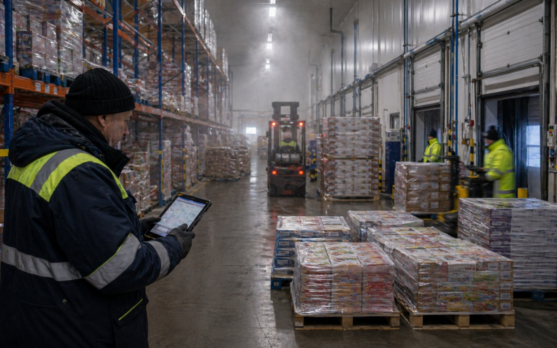
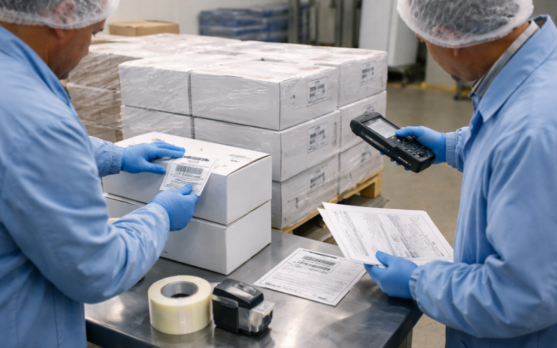
A pallet of frozen seafood can sit exactly where the warehouse system says it is, until someone opens the freezer and finds a different reality. A case is in the wrong lane. A lot has been split. A foodservice order is short. A retailer wants evidence, not reassurance. In frozen food, packaging has always carried product, protection and identity. Now it is being asked to carry something more valuable: operational truth. RFID will not make frozen packaging sustainable by itself, but it can make the cold chain less blind.

The cold chain still loses sight of itself
Frozen logistics looks disciplined from a distance. Pallets move through temperature-controlled docks, warehouse teams wear insulated clothing, scanners confirm orders, and systems record each movement. Then the day gets busy. A late truck arrives. A pallet is moved to make room. Cases are picked under time pressure. A customer changes an order. A promotion empties one line faster than expected. The warehouse management system remains calm. The freezer floor is less elegant.
This is where RFID becomes interesting. Not as a shiny packaging technology, and not as a consumer feature. Its value sits in the gap between what the system believes and what the supply chain is actually holding. In frozen food, that gap has a cost. It shows up as mispicks, missing cases, overstock, stockouts, excess safety stock, broader recalls and frozen inventory that spends too long in the wrong place.
The older article category, “RFID in eco-friendly packaging,” feels too soft for the subject. RFID does not reduce plastic. It does not improve a carton board grade. It does not make a pouch recyclable. Its environmental value is indirect and operational: fewer errors, less unnecessary handling, faster identification of affected product, cleaner stock rotation and less waste created by uncertainty. That is a more serious claim, and a more defensible one.
The case may matter more than the consumer pack
In frozen food, RFID does not need to start on every small retail unit. For many products, the economics would be weak. A tag on a low-margin bag of vegetables or a value pizza is a hard sell unless a retailer mandates it or the use case is unusually strong. The more practical entry point is often the case, carton, pallet, tote or reusable transport item.
That matters because frozen supply chains are built around movement at those levels. The consumer sees the retail pack. The warehouse sees cases. The transport operator sees pallets. The foodservice distributor sees cartons, totes and route drops. If RFID can make those units easier to identify without line-of-sight scanning, the gain is not cosmetic. A forklift passing a portal, a receiving area reading multiple cases at once, a foodservice location checking incoming goods faster, these are the places where the technology earns its keep.
Foodservice is a particularly strong candidate. Larger packs, repetitive flows, known destinations and tighter rotation needs create a better business case than many retail consumer packs. A frozen supplier serving restaurant chains, hotels, institutions or catering operators may gain more from case-level visibility than from another layer of front-of-pack communication. The customer may never see the tag. The buyer may feel its value when a lot can be located quickly.
RFID is not traceability by itself
The industry needs to be honest here. RFID is a capture layer. It identifies something and allows that identity to be read automatically. Traceability requires the event history behind that reading: what moved, where, when, why, in which business step, and under whose responsibility. Without clean master data, standard identifiers and systems that can share events, RFID produces faster fragments.
That is why GS1 standards matter in this conversation. The work around EPC, EPCIS and foodservice RFID is less glamorous than the tag itself, but more important. A reader can capture a case. EPCIS gives the event a language. Batch, date and lot logic make the information useful when something goes wrong. The tag is the visible technology cost. The larger investment is in data discipline.
The regulatory backdrop adds pressure. FSMA 204 in the United States is not an RFID rule, and it does not apply to every frozen product. But it is a clear signal that food traceability is moving toward more structured records, clearer critical tracking events and faster access to key data. Similar pressure comes from retailers, auditors and foodservice customers even where specific regulation is less prescriptive. No major buyer wants to discover during a problem that a supplier’s traceability depends on slow reconciliation and warehouse memory.
Frozen food has its own twist. Product can remain in circulation for a long time. A case may sit in a distributor freezer, move to foodservice, return through a complicated credit process, or remain in retail stock well after the production run is forgotten. Poor traceability ages badly in frozen.
Temperature needs a different conversation
There is a temptation to place every cold-chain problem under RFID. That would be lazy. A standard passive RFID tag can identify a case or pallet. It cannot, by itself, prove that the product stayed frozen. It cannot tell whether a door was left open too long, whether a pallet waited on a warm dock, or whether a case was thawed and refrozen.
Temperature visibility requires sensors, time-temperature indicators, data loggers or connected monitoring systems. RFID can be part of that architecture when combined with sensor capability or linked to condition data, but identity and condition are different types of evidence. Frozen food companies should keep that distinction clear when talking to buyers. Overclaiming turns a useful technology into another packaging promise that cannot survive scrutiny.
The strongest use case is a layered one. RFID identifies the unit and its movement. Sensors or TTIs record condition. WMS, ERP and traceability systems connect the reading to the commercial event. A retailer or foodservice operator then sees more than a code. It sees a chain of responsibility. That is where cold-chain confidence becomes more than a phrase.
Fresh food is giving frozen a warning
Recent RFID activity in fresh categories should not be copied blindly into frozen, but it should be watched closely. Walmart and Avery Dennison have worked on RFID for fresh categories such as meat, bakery and deli, with the stated aim of improving inventory accuracy, reducing food waste and supporting freshness. Avery Dennison has also introduced RFID inlays designed for difficult fresh environments, including cold, high-moisture and densely packed retail conditions.
Frozen is different. It is colder, often longer-life, and in many categories more case-driven than item-driven. Still, the fresh examples matter because they show where the technology is being forced to grow up. Food is harder than apparel. Moisture, density, temperature, packaging structure and handling all interfere with easy assumptions. If RFID can be made more reliable in difficult fresh environments, frozen operators will ask where it fits in their own chain.
Chipotle’s RFID case-label work is another useful signal. It sits closer to foodservice traceability than consumer-pack theatre. The point was to track ingredients from suppliers into restaurants, improve inventory and support food safety action. Frozen foodservice suppliers should recognize the shape of that problem. A restaurant chain does not want a romantic story about packaging intelligence. It wants the right case, the right lot, the right date and the ability to act when something is wrong.
The data ownership question will decide more than the tag
RFID in frozen food will not be slowed only by tag cost. It will be slowed by ownership, integration and trust. Who applies the tag, the supplier or the distributor? Who pays for it? Who owns the read data? Can a retailer require a specific encoding practice? Can a 3PL share enough event data without exposing commercial information? What happens when one buyer wants one tag format and another wants a different process?
These are commercial questions dressed as technical ones. A frozen supplier with several private-label customers could quickly face fragmented requirements unless standards hold the centre. The industry does not need five incompatible versions of “visibility.” It needs a common enough language for cases, pallets, lots, dates and events to travel through more than one company’s system.
The best near-term projects will probably be narrow. A high-value seafood flow. A foodservice distributor with repeated case movements. A retailer trying to reduce receiving errors. A frozen protein supplier exposed to recall risk. A warehouse operation where manual scanning is too slow and too often wrong. Broad promises will not convince operators who work in freezers. A hard, specific pain point might.
There is an editorial risk in calling all of this “smart packaging.” The phrase is too generous. RFID does not make a pack smart. It makes a unit readable. The intelligence comes later, if the data is clean, the events are captured, and the people using the system know what decision the reading is supposed to improve.