The frozen aisle will not feel PPWR first as a legal text. It will feel it in a buyer meeting, when a tray, pouch, sleeve or lidding film that looked acceptable last season suddenly needs proof: proof of recyclability, proof of recycled-content logic, proof that empty space is justified, proof that the pack can still protect food without becoming a compliance problem. From 12 August 2026, packaging stops being only a cost, a shelf tool or a sustainability promise. It becomes a pass-or-fail part of market access.

The law has moved closer to the freezer cabinet
For years, packaging regulation sat at a useful distance from day-to-day frozen food operations. It influenced targets, reports and corporate language, but it did not always reach the factory floor with the same force as a failed seal, a retailer complaint or a pallet rejected at intake. PPWR changes that distance.
Regulation (EU) 2025/40 entered into force on 11 February 2025 and will generally apply from 12 August 2026. That date matters because it turns the discussion from policy watching into preparation. The older language around a revised packaging directive no longer fits the moment. This is a regulation, with a more harmonised European framework and less comfort for companies hoping that fragmented national interpretation will buy them time.
Frozen food is exposed because its packaging is not decorative. It does heavy work. It has to handle low temperatures, moisture, grease, sharp product edges, long storage, retail freezers, food safety, cooking instructions, multilingual labelling and aggressive logistics. A weak pack creates waste. An over-engineered pack creates regulatory risk. PPWR is arriving right in the gap between those two failures.
The regulation does not ask a frozen pizza, seafood pouch or vegetable bag to become simple for the sake of appearances. It asks whether the complexity can still be defended. That is a more uncomfortable question.
2030 is no longer a distant packaging target
The first practical horizon is August 2026, but the date many packaging teams will feel in their bones is 2030. By then, packaging placed on the EU market is expected to be recyclable by design. The idea sounds tidy until it is applied to a frozen ready meal tray with a lidding film, a carton sleeve, a label, a barrier requirement and a microwave or ovenability claim.
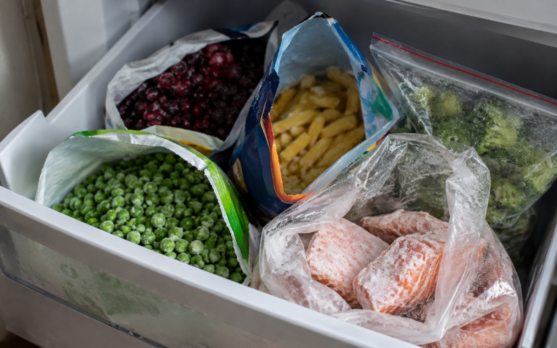
Some formats will move faster. Frozen vegetables, fries and certain potato products often have a clearer route toward mono-PE or mono-PP flexible structures, especially where barrier demands are modest. The work is still real: film stiffness, puncture resistance, sealing, print coverage and recycling stream compatibility all matter. But the direction is visible.
Other categories will sit in harder territory. Frozen seafood needs puncture resistance, seal integrity and sometimes stronger barrier protection. Meat and protein packs may need vacuum, MAP or robust lidding. Ready meals carry trays, lids, sleeves, labels and grease or moisture issues. Frozen bakery and ice cream can fall into fibre-based, coated-board or composite formats that look consumer-friendly but may ask difficult questions in recycling assessment.
By 2035, the pressure moves beyond design. The issue becomes whether packaging is recycled at scale, not only recyclable in a technical file. By the later stages of the framework, weaker recyclability grades will become increasingly difficult to defend. A pack that passes a narrow interpretation in 2026 may still be a redesign candidate before the decade is over.
The frozen aisle has more exposure than it thinks
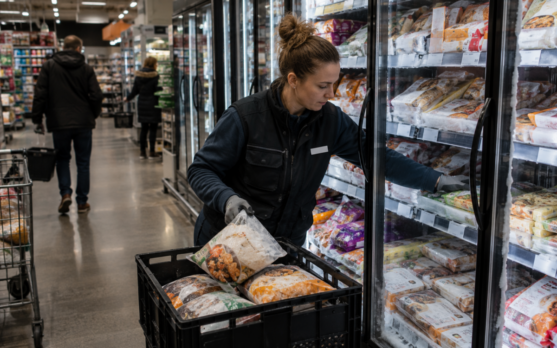
Stand in front of a freezer cabinet and count the interfaces. Plastic bag. Paper sleeve. Coated board. Window. Tray. Lid. Label. Ink. Adhesive. Shrink film. Multipack wrap. Transport carton. Pallet wrap. None of these pieces live alone anymore.
A premium frozen meal may use a black or coloured tray because it photographs well and signals quality. A paper sleeve may carry the brand story. The lidding film may need peelability, anti-fog behaviour and heat resistance. The outer case may be optimised for retail handling. From a commercial view, the pack makes sense. From a PPWR view, each layer and component starts asking for justification.
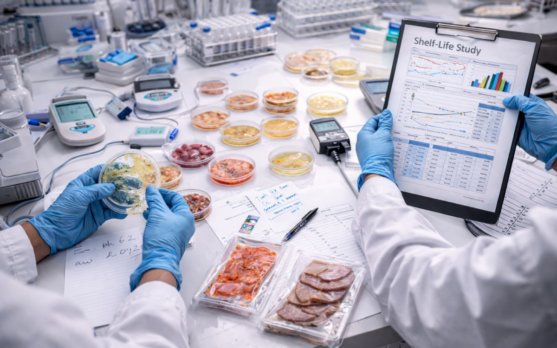
This is where frozen differs from simpler ambient categories. Food waste prevention is a genuine defence. A pack that protects a product through months of frozen storage has value. But that defence will need evidence. It will no longer be enough to say that a barrier layer, coating or mixed-material format is necessary because it has always been used. If complexity stays, it has to earn its place.
Retailers will accelerate that pressure. Private label teams do not want to discover late that a format carries higher EPR exposure, weak recyclability documentation or a looming redesign cost. Suppliers that arrive with vague claims will find themselves pushed back to converters. Converters will push back to resin producers, film suppliers and coating specialists. The chain will not break cleanly. It will become slower and more demanding.
Recyclability is becoming a cost structure
PPWR makes recyclability more than a design principle. It links packaging choices to economic signals, especially through EPR fees and recyclability performance. That changes the buyer conversation.
The cheapest pack on the purchase order may not stay cheap if it carries a weaker recyclability grade, heavier reporting requirements or redesign risk. A frozen food manufacturer comparing two films, two trays or two pouch structures will need to look past the immediate unit price. The new calculation includes documentation, eco-modulated fees, claim defensibility, retailer acceptance and the probability that the format will still be acceptable in 2030 and beyond.
Flexible packaging is a useful example. CEFLEX and RecyClass have already pushed the market toward more disciplined design-for-recycling choices: mono-PE, mono-PP, controlled coatings, better sortability, fewer incompatible layers, more careful use of inks and adhesives. That work now sits much closer to regulation. It is no longer only industry guidance for ambitious companies. It is becoming the language through which suppliers prove that a pack belongs in the market.
There is a harder background too. Europe’s plastics recycling sector is under pressure, with capacity growth falling short of what future targets require and polyolefin films among the affected areas. That makes poor design less acceptable. Recyclers do not need more technically recyclable material that produces weak yield, low-value output or too much operational pain.
Designed for recycling is a start. Useful to recyclers is a higher standard.
Recycled content is harder when the pack touches food
Recycled content sounds simple until it meets food-contact packaging. Frozen food companies cannot treat recycled plastic as a procurement swap. Safety, migration, contamination history, authorisation, supply and technical performance all sit in the same room.
From 2030, PPWR introduces minimum recycled-content requirements for plastic packaging, with higher targets by 2040. Food-contact and contact-sensitive packaging faces a different reality from non-food packaging. The material must be safe, legally acceptable and available in the right quality. A frozen seafood film, ready-meal tray or lidding structure cannot take recycled content only because a target exists. It has to protect the product and comply with food-contact rules.
This will create uneven progress across frozen categories. PET trays may find clearer paths where approved recycled PET streams and food-contact routes exist. Non-PET contact-sensitive plastics, including PP and PE applications, may move more slowly depending on supply, technology and regulatory confidence. Some components may be exempt or treated differently, but that should not be read as permanent comfort. The direction of travel is clear enough: virgin plastic dependence will become harder to defend.
Packaging teams will need better conversations with suppliers. Where does the recycled content come from? Is it authorised for food contact? Is the percentage calculated correctly? Does it affect sealing, brittleness, colour, odour or freezer performance? Can the supplier support the declaration year after year, not only during a launch project?
A weak answer will not stay hidden in a technical appendix.
Minimisation will hit premium and secondary packaging
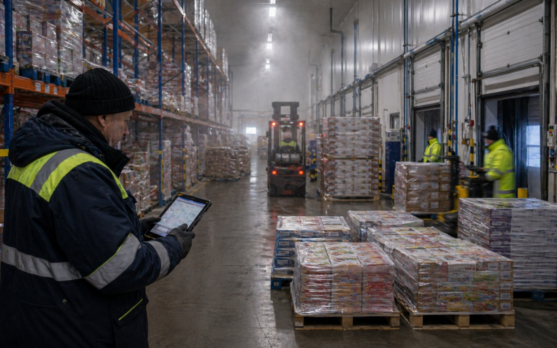
PPWR also brings packaging minimisation into sharper focus. Weight and volume must be limited to what is necessary for functionality: protection, safety, hygiene, information and handling. In frozen food, this will not only affect primary packs. It will reach sleeves, boxes, multipacks, transport packaging, e-commerce insulation and foodservice distribution formats.
That matters because frozen food has always used packaging space to manage perception. A larger box can make a product feel more generous. A sleeve can upgrade a tray. A premium carton can soften the hard reality of a frozen cabinet. Some of that will remain defensible where it protects the product, carries mandatory information or supports logistics. Some of it will start to look like empty space dressed as value.
E-commerce frozen formats deserve particular attention. Insulation, dry ice management, liners, outer boxes and void fill can be necessary, but the 50 percent empty-space logic for grouped, transport and e-commerce packaging will make sloppy design harder to justify. Direct-to-consumer frozen meal kits, specialty seafood, premium ice cream shipping and foodservice replenishment packs will all need more disciplined pack sizing and evidence.
There is a practical irony here. Cutting too much packaging can damage products and increase waste. Keeping too much packaging can create compliance and cost exposure. The better companies will not chase the lightest pack. They will define the minimum pack that still works.
The new packaging brief starts with risk
The old brief asked for price, shelf impact, machinability and perhaps a sustainability improvement. The new brief needs a different first page.
- Which parts of this pack are necessary for food safety, shelf life and cold-chain survival?
- Which components create recyclability, recycled-content or EPR exposure?
- Can the supplier prove performance for the full pack, not only the main material?
- Is the format defensible in 2026, 2030 and 2035?
- Does the pack create avoidable empty space, mixed materials or weak sorting signals?
- Would a retailer accept the documentation without sending it back for clarification?
These are not legal department questions. They belong in product development, packaging engineering, procurement, QA, sustainability and sales. A frozen food company that waits for final guidance before mapping exposure will lose time. The work can start now: SKU by SKU, format by format, supplier by supplier.
PPWR will not remove the need for tough packaging. Frozen food still needs packs that survive the line, the pallet, the truck, the freezer cabinet and the consumer’s kitchen. But it will punish lazy complexity. The formats most at risk are not always the most visible ones. They are the ones nobody can explain properly when the retailer asks for evidence.