A frozen processor does not discover the quality of a crop when the product reaches the freezer tunnel. By then, most of the important decisions have already been made in the field: when the crop was watered, how disease pressure was handled, whether the harvest window was missed, how the grower recorded inputs, how quickly the raw material moved from soil to factory gate and whether the lot can survive the kind of buyer audit that now sits behind more export contracts.

The factory problem begins before harvest
In a frozen vegetable plant, the receiving area can be more revealing than the production line. A truck arrives with peas, green beans, spinach or sweet corn. The clock starts immediately. The crop may still look acceptable, but a late harvest, a poor irrigation decision or a pest problem that was treated too slowly can already be written into the texture, colour and yield.
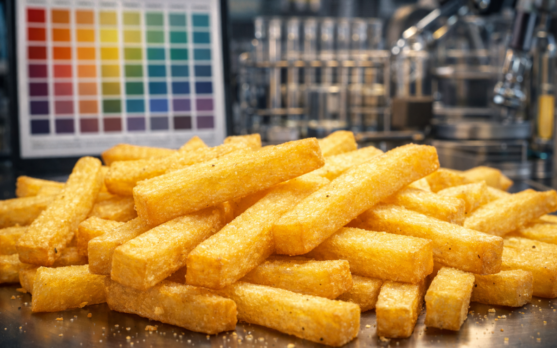
Potatoes are even less forgiving. A French fry processor is not buying bulk tonnage in any simple sense. It is buying dry matter, length, defect level, frying colour, storage behaviour and repeatability across contracts. If the tubers are too small, too wet, bruised, stressed or inconsistent, the factory pays for it in trimming, rejected product, oil uptake, line speed and customer complaints. The field has already sent the invoice.
That is the more serious meaning of smart farming for frozen food. It is not the drone photograph used in a conference presentation. It is earlier warning, tighter agronomy, cleaner records and a better chance that the crop entering the factory matches what the sales team has already promised.
Smart farming is becoming a sourcing discipline
In emerging markets, smart farming is often described as a way to raise yields. That is true, but incomplete. For frozen food, predictability may be just as valuable as extra output. A factory can cope with a modest crop if it knows what is coming. It struggles when volume, quality and harvest timing all move at once.
The tools are familiar now: satellite imagery, drone scouting, soil moisture sensors, irrigation scheduling, mobile advisory platforms, pest alerts, farm management software and digital field records. The difference lies in how they are used. A grower using a phone app for general advice is one story. A contract grower tied to a frozen processor, with field-level data feeding into procurement, harvest planning and compliance records, is another.
That second model is where the frozen sector should pay attention. It links the farm to the plant in a more practical way. If disease pressure is visible earlier, the agronomy team can act before the crop loses processing value. If yield forecasts improve, the factory can plan labour, packaging, cold storage and customer allocations with less guesswork. If input records are clean, export risk drops. None of this looks spectacular from outside. Inside the business, it changes the week.
Small farms remain central to the food system in many developing economies, and that makes the adoption curve uneven. A satellite image does not solve poor access to credit. A sensor is not useful if the grower cannot act on the data. A platform will not fix a weak contract. Smart farming becomes commercially useful when the buyer, agronomist, grower and processor are tied together by a crop that has a specification and a destination.
Potatoes show where the market is heading
Frozen potatoes make the upstream shift easier to see. The global French fry trade has long been dominated by highly developed production regions, but emerging suppliers are becoming harder to ignore. India, China and Egypt are all being watched more closely because processing demand, domestic scale and export ambition are beginning to overlap.
India is the clearest case. Its frozen fry exports have been rising, helped by new processing capacity, competitive pricing and stronger demand from markets that want alternatives to traditional European and North American supply. That does not mean India becomes a global leader overnight. It means the country is moving from raw crop potential toward industrial potato capability. That transition is impossible without better varieties, irrigation, storage, contract farming and tighter control of agronomy.
McCain’s work with growers in India shows the direction of travel. The company has described training growers in precision farming, data-led agriculture, pest management, storage and post-harvest handling, while promoting drip and sprinkler irrigation across its grower base. The commercial message is simple enough: a processor that wants consistent potatoes cannot leave the field to chance.
PepsiCo’s potato programmes point in the same direction. Drone scouting and AI-supported crop monitoring are being used to detect field problems earlier and help agronomists make faster decisions. In Latin America, the PepsiCo-Yara partnership around potato growers in Mexico, Colombia, Chile and Argentina adds another layer: crop nutrition, digital tools and lower-carbon fertiliser programmes connected to a large processed-food supply chain.
These examples matter because they show smart farming becoming part of procurement. The technology is not floating above the crop. It is being pulled into contracts, grower support, sustainability targets, factory supply and customer assurance.
IQF vegetables and frozen fruit need field-level discipline
Vegetables and fruit bring a different pressure. A pea crop can miss its ideal window quickly. Sweet corn loses quality fast after harvest. Spinach and herbs carry residue, soil and foreign-body risks. Mango, berries and tropical fruit depend on maturity, Brix, handling and short movement from harvest to processing. A frozen fruit buyer may be purchasing cubes, slices or pulp, but the commercial risk starts before cutting.
In export markets, the paperwork has become part of the product. European buyers, large retailers and foodservice customers want traceability, residue control and evidence that the supplier knows what happened before processing. For emerging-market exporters, this is where digital agriculture can move from “nice to have” to market access support.
A grower logbook written after the event is no longer enough for serious supply chains. The stronger suppliers will know which plot produced the lot, what was sprayed, when irrigation was applied, when harvest took place and how quickly the crop reached the plant. In high-risk categories, that data can decide whether a shipment is accepted, delayed or rejected.
There is a sharp commercial edge here. A low-cost crop that fails a residue check, arrives with inconsistent maturity or cannot be traced properly is not low cost. It is a liability with freight attached.
The adoption problem is commercial, not only technical
The smart-farming debate often spends too much time on tools and too little on incentives. Emerging markets do not lack technology vendors. They lack the conditions that make technology stick: stable buying relationships, agronomic support, grower finance, decent connectivity, trusted data rules and a price structure that rewards better practice.
Many smallholders will not invest in sensors, subscriptions or new irrigation systems simply because the technology exists. They adopt when the route to market improves. A processor can make that happen through contract farming. A retailer can help through private-label sourcing programmes. A development bank can help through credit. An exporter can help by turning compliance into a practical field system, rather than a panic before audit season.
There is also a data question that the food industry has not fully settled. Growers may be asked to share more information about their fields, inputs, water and yields. In return, they need more than pressure. They need better advice, fairer contracts and some share of the value created by that transparency. Otherwise, smart farming becomes another extraction layer placed on top of already thin farm margins.
The best models will probably look less like open-market adoption and more like organized sourcing clusters. Processing potatoes in India. Vegetable export zones in North Africa. Tropical fruit and IQF operations in Latin America and Asia. Potato and snack supply chains in Mexico, Colombia, Chile and Argentina. Places where the crop has a buyer, the buyer has a specification and the grower has a reason to change.
Export supply will be judged before the crop leaves the field
Over the next few seasons, smart farming in emerging markets will be most visible in crops where specifications are tight and the buyer has enough leverage to support adoption. Potatoes for fries, sweet corn, peas, green beans, spinach, berries, mango, pineapple and herbs all fit that pattern. They are not forgiving commodities once they enter frozen processing.
By the end of the decade, field-level data is likely to become a normal part of serious sourcing conversations. Buyers will ask about hectares under contract, irrigation control, disease monitoring, residue records, harvest forecasting and lot separation. Some suppliers will find this intrusive. Others will turn it into a sales advantage.
There is no need to pretend that smart farming removes agricultural risk. Weather will still disrupt crops. Water scarcity will still limit expansion. Pests will still move. Smallholders will still face credit and infrastructure barriers. But the suppliers that can see problems earlier and document their response will be treated differently from those who simply offer a lower price and hope the crop holds.
Frozen food has always depended on agriculture. What is changing is how close the frozen buyer may need to stand to the field.