At a frozen tuna facility, the old grading ritual has always carried a cost: a skilled worker cuts the tail, studies the flesh, judges fat by eye and leaves behind a product that is no longer quite whole. Sonofai’s 12-second ultrasound scan does not make that expertise irrelevant. It tries to capture part of it before the knife touches the fish, while the tuna is still frozen, opaque and commercially undecided.

The old cut is expensive
Frozen tuna grading is not a romantic craft once it reaches industrial scale. It is cold, repetitive, physical work, often done under pressure, with a product that can carry a large price difference depending on fat, appearance, intended market and buyer confidence.
The traditional tail-cut inspection has survived because it is practical. A trained grader can look at the cut surface and read signs that matter for sashimi, sushi chains, retail counters, foodservice and processing. But it is also destructive. The cut reduces value. It relies on scarce experience. It varies by person, site and working conditions. When hundreds or thousands of frozen fish need to move through a port or processing operation, artisanal judgement becomes a bottleneck.
That is the commercial space Sonofai is entering. The SONOFAI T-01, developed through the collaboration of Sonofai, Fujitsu, Ishida Tec and Tokai University, is built to assess fat content in frozen albacore tuna without cutting the fish. It uses ultrasound and Fujitsu’s AI analysis technology to classify the fish by fat level in around 12 seconds.
The claim is not that a machine now understands tuna in the way an expert does. That would be too neat. The more useful claim is narrower: one of the most valuable internal quality signals can be measured faster, with less damage and less dependence on a small group of highly skilled inspectors.
What the machine actually measures
Sonofai is not a general seafood oracle. Public information about the T-01 points specifically to frozen albacore tuna and fat assessment. That distinction matters. Fat content is commercially important, especially where albacore can move from a lower-value processing route into higher-value sushi or sashimi use. But fat is not the whole quality story.
The technical difficulty is also worth taking seriously. Sending ultrasound through frozen fish is not the same as scanning a fresh fillet. Ice crystals scatter and weaken the signal. Frozen muscle is dense, irregular and noisy. Fujitsu has described work on frozen tuna samples to train AI models that filter the noise and read the ultrasound reflections in a way that can support fat grading.
In plain factory language, the machine is trying to see inside a frozen product that does not want to be seen. That is why the story matters beyond one device. Seafood processors have long had to make expensive decisions with partial information. They can cut, thaw, sample, trust experience or accept uncertainty. Non-destructive grading offers another route, but only if the measurement proves stable under real operating conditions.
The FOOMA Japan listing for SONOFAI T-01 added a useful operational detail: the system can be configured for manual or fully automatic operation, with a stated processing capacity of about 30 tonnes per day under the assumptions given there. That moves the discussion away from a clever demonstration and closer to plant-floor relevance.
Frozen seafood needs quality data before thawing
The frozen seafood trade has a particular problem. Much of the value is locked inside a product that cannot be fully judged without disturbing it. Tuna is a clean example, but the logic reaches further into frozen seafood: internal quality, texture, fat, freshness history and handling damage are not always visible from the surface.
For tuna, grading affects where the product goes. A fish judged suitable for a higher-value sashimi or sushi application may be routed differently from one destined for canning, loins, processing or lower-value uses. The better the grading, the better the allocation. Poor allocation cuts both ways: premium material can be undervalued, while weaker fish can be pushed into a channel where it disappoints the buyer.
That is where non-destructive inspection becomes attractive. The fish stays intact. More units can be assessed. The result can be recorded. The grading process becomes less dependent on memory, confidence and the availability of a master inspector on a particular shift.
There is also a labour argument, but it should not be oversold. Machines do not remove the need for seafood expertise. They change where that expertise is used. A grader may move from cutting every fish to supervising thresholds, checking exceptions, reviewing scan results and making commercial decisions with better evidence.
The value is in allocation, not only speed
The 12-second figure is easy to quote. It is not the most important part of the story.
The more interesting value sits in allocation. If a processor can identify higher-fat albacore without cutting, it can protect product value before selling, storing or routing. If a cooperative can sort more consistently, it can reduce disputes. If a buyer can receive scan-backed grading data, it can make pricing and specification conversations less dependent on trust alone.
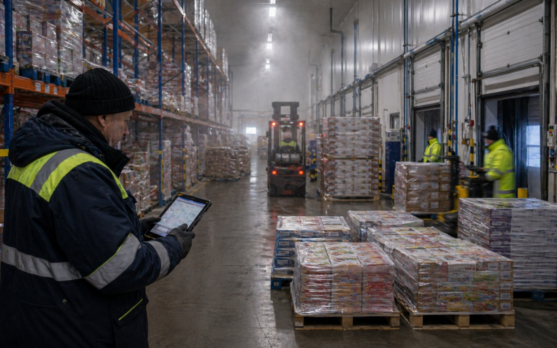
There is a warehouse reality behind that. Frozen seafood does not move as an abstract commodity. It sits in ultra-low-temperature storage, moves through ports, crosses borders, enters auctions or private contracts, and may be held until market conditions justify release. A grading decision made at the beginning of that chain can follow the fish all the way to the buyer meeting.
Albacore is a useful test case because it has more than one commercial identity. It has long been associated with canned products, yet higher-fat material can carry value in sushi and sashimi channels. A tool that helps separate those outcomes earlier may give processors a more disciplined way to extract value from the same catch.
That matters in a tuna market that is not always comfortable. International trade in fresh and frozen tuna has shown volatility, with pressure on high-value demand and changes in frozen raw-material trade. When price, demand and catches move, grading accuracy becomes a margin tool. It helps companies avoid selling the wrong fish into the wrong channel at the wrong price.
What still has to be proven
Sonofai deserves attention, but it should not be treated as a finished answer for the entire seafood sector. The public case is frozen albacore tuna fat grading. Freshness, firmness, texture and other species are future possibilities, not proven universal use cases.
The cost also puts the system in an industrial category. Public reporting has placed the price around 30 million yen, making it a tool for processors, fishing organizations, cooperatives and larger seafood operators rather than individual sushi chefs or small buyers. That is not a weakness. It simply defines the market.
The next questions are practical. How does the system perform across different fish sizes, freezing histories, handling conditions and fishing origins? How often does it need calibration? What happens when product temperature varies? How are disputed grades handled? Can the data be accepted by buyers outside Japan? Will the scan result become part of a broader traceability file, or remain an internal sorting aid?
There is also a human question. Expert graders have knowledge that machines do not automatically inherit. Some of it is visual, some tactile, some commercial. A good machine can reduce variation, increase speed and capture one measurable quality parameter. It cannot replace the broader judgement of people who understand markets, customers and product use.
A small sign of a larger shift
Sonofai is important because it points to where frozen seafood quality control is heading. Less cutting. More measurement. Less dependence on one person’s eye. More data attached to the product before it moves into storage, export or processing.
That does not mean every frozen seafood category will soon be scanned by ultrasound and AI. The economics will vary. The species will vary. The quality marker will vary. A high-value tuna is a much stronger case than a low-margin frozen block. But the direction is hard to ignore.
Frozen food has always promised time. The weak point is that time can hide mistakes. Non-destructive inspection helps bring some of those mistakes forward, before the product is cut, thawed, downgraded or sold too cheaply. In tuna, that may begin with fat. In other seafood, it may later involve texture, internal damage, freshness indicators or temperature-abuse signals.
The technology still has to earn its place in daily operation. If it does, the most interesting change may not be the speed of the scan. It may be the quiet shift from grading as a cut surface to grading as a data record.