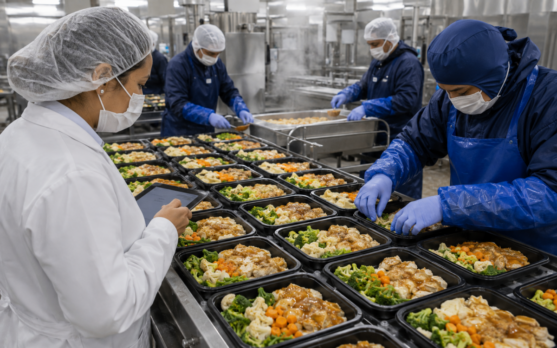
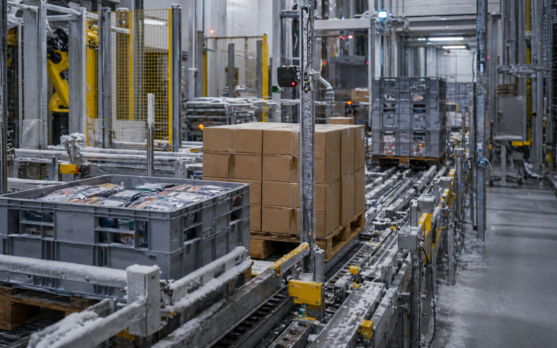
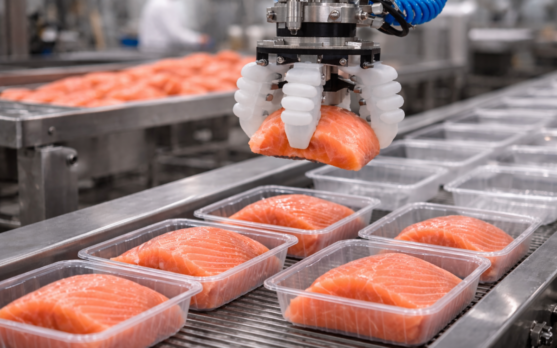
In a chilled assembly room, the slowest operation is often the least dramatic one: a worker placing chicken pieces into trays, another dropping sauce cups into the right compartment, someone else fixing a pouch that landed badly before the sealer gets to it. The line may already have depositors, checkweighers, conveyors, sealers and inspection systems, yet the awkward items still pass through human hands because they bend, slip, stick, overlap or refuse to arrive in the same shape twice. Robotic piece picking matters because it is starting to attack that stubborn middle of frozen food automation, where scooping was useful but never enough.
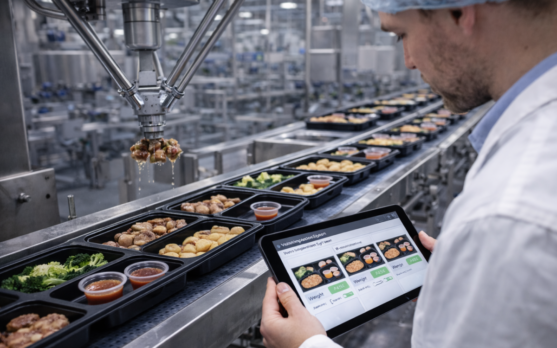
The line was automated, except for the part that mattered
Many frozen meal factories already look automated at first glance. Sauces are deposited. Rice and pasta are portioned. Vegetables move through weighers. Trays index under filling heads. A lidding or sealing system waits downstream with no patience for hesitation. Then the line reaches the part where one specific item has to be placed in one specific location, and the factory quietly becomes manual again.
That item may be a chicken breast, a burger patty, a vegetarian schnitzel, a sauce cup, a sachet, a topping pouch or a small protein component. It may be frozen, chilled, wet, rigid, sticky, shiny, fragile or slightly misshapen. It may arrive from a tote in no useful order at all. A worker can look at it and adjust in a fraction of a second. Traditional equipment has usually had a harder time.
Piece picking is interesting because it enters that space. It is not another version of bulk dosing. It asks the robot to see an individual food item, decide how to lift it, avoid damaging it, orient it if needed and place it where the package design requires. In frozen and chilled prepared foods, that is a much bigger step than it sounds.
Chef Robotics made that shift explicit in 2026, when it announced piece-picking capability for individual food items such as chicken breasts, burger patties and sauce cups from unstructured totes. The same direction later appeared in its meatpacking work, where the company said its robots could assemble raw, frozen and precooked proteins including pork loin filets, chicken breasts, lamb chops, steaks and sausage links onto trays before packaging. Those are not polite products from an automation perspective. They are physical arguments.
Scooping solved the easy part
Scooping and depositing have carried a large part of ready-meal automation for years. If the product behaves like a portionable mass, the factory has options. Rice, pasta, grains, diced vegetables, sauces, curries and some prepared components can be filled by weight, volume or recipe logic. The system may need tuning, but the basic problem is known.
Piece picking has a different character. The robot cannot simply ask how many grams are needed. It has to deal with object identity. One patty, one cutlet, one cup, one sachet. The placement may affect not just appearance, but sealing, heating performance, label accuracy, allergen separation or the consumer’s first impression when the tray is opened.
In a high-volume frozen meal plant, a sauce cup placed at a slight angle can become more than a cosmetic defect. It can interfere with sealing. A protein portion dropped across a compartment edge can create rework. A sachet trapped under film can become a complaint. These are small errors, but they accumulate in the dullest and most expensive way: stops, rejects, giveaways, manual correction and nervous supervisors watching the line speed fall.
That is why the move beyond scooping matters. It opens the part of the line that fixed automation often avoided: variable individual items in high-mix production.
Proteins are the hard test
Proteins make robots prove themselves. A frozen chicken breast does not behave like a fresh pork loin. A precooked patty does not behave like a raw steak. A sausage link may roll. A lamb chop may sit at an awkward angle. Surface moisture, fat, temperature, stiffness and shape all affect the pick.
Vision systems also have to work with food that rarely presents itself like a CAD model. Edges are unclear. Pieces overlap. Reflections can confuse cameras. Frozen surfaces can be bright, dull, frosted or uneven in the same tote. A human operator adjusts without naming the problem. A robot needs sensing, trained models, a suitable gripper and a process that gives it enough time to make the right decision.
There is a reason many food plants tolerated manual protein placement long after they automated other operations. The manual station was not there because managers enjoyed headcount. It was there because the product was difficult, the changeovers were frequent and the consequences of bad placement were immediate.
The best robotic systems in this area will not win only on speed. They will win on the ratio between speed, product damage, orientation accuracy, cleaning time and SKU flexibility. A fast robot that tears soft protein, loses grip on frozen portions or needs too much intervention becomes another bottleneck with better marketing.
Components make the business case sharper
Proteins get the attention, but components may prove just as important. Sauce sachets, seasoning packets, garnish toppers, dried protein packs, foil pouches, cutlery kits and small inserts are everywhere in modern prepared food and CPG assembly. They help brands build convenience, premium cues and format variety. They also make factories more complicated.
These pieces are irritatingly simple. A person can place them easily, at least for a while. Across a full shift, in a cold room, at line speed, across many SKUs, the simplicity disappears. Lightweight packets slide. Foil pouches crinkle. Small cups need upright placement. Inserts arrive in inconsistent stacks or loose containers. The sealer downstream does not care that the item was awkward.
Chef’s 2026 move into component assembly for CPG lines is worth reading in that context. The company is not just chasing frozen meals. It is following a wider manufacturing problem: products are becoming more modular, more varied and more dependent on small additions that make manual assembly hard to remove.
For frozen food, this is especially relevant in premium trays, meal kits, side-dish combinations, foodservice packs and private label products where retailers want differentiation without turning every new SKU into a bespoke engineering project. The factory wants flexibility. The commercial team wants range. The production manager wants the line to run without rebuilding the room every Tuesday.
High-mix factories need adaptive automation
The old automation bargain worked best when products were stable. Build a line around a known format, tune it, protect the speed, avoid disruption. That logic still makes sense for many high-volume products. A dedicated system can beat a flexible robot when the product barely changes and the volume justifies the steel.
High-mix frozen and chilled operations live in a less comfortable place. A contract manufacturer may run many SKUs for several customers. A private label supplier may deal with retailer-specific trays, grammages, toppings and pack instructions. A branded manufacturer may need seasonal items, limited runs and reformulations. The food is not always hard to make. The change is hard to absorb.
That is where robotic piece picking begins to look less like a labour replacement story and more like a range-management tool. If a system can learn new items faster, tolerate unstructured presentation and shift from one component to another with less mechanical rebuilding, the commercial team gets more room to develop products without punishing the factory.
DERO Groep’s work on robotic bin picking for fragile and frozen products, including vegetarian schnitzels, points in the same direction. Oxipital AI’s frozen food case study, where vision-guided robotics improved pick rates in a frozen vegetable application, also underlines the role of vision in making robots useful in food environments that are variable rather than perfectly staged.
None of this removes the need for good product presentation. A robot can handle more variation than fixed equipment, but it cannot turn chaos into profit by itself. Totes, infeed, spacing, lighting, reject handling, changeover rules and maintenance all still matter. The demo is the easy part. The third shift after sanitation is where the truth comes out.
The sanitation test will decide what survives
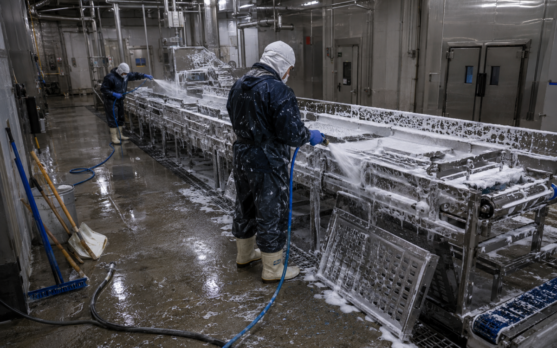
Food robotics has a habit of looking better in videos than in washdown. In a real plant, a gripper is not only a picking tool. If it touches food, it becomes a direct food-contact surface. It has to be cleanable, inspectable and designed so residues do not hide in joints, suction cups, fasteners or narrow gaps.
This is where some attractive ideas struggle. Suction can work well for certain items, but vacuum paths and cup surfaces need careful hygienic design. Soft grippers can protect delicate food, but they must survive cleaning and avoid trapping residues. End effectors for raw proteins face a harsher test than end effectors for dry sachets. A line that handles allergens adds another layer of discipline.
Plants do not buy a robot that can pick once. They buy a system that can pick after cleaning, after changeover, after a rushed production schedule, after a maintenance intervention and after the product arrives slightly different from the last batch. That is the standard piece-picking suppliers will have to meet if they want to move from trials into core frozen food production.
The likely result is not one winning gripper for everything. It will be a toolbox: suction for some cups and smooth items, soft or compliant grippers for delicate products, mechanical support for certain proteins, non-contact or low-contact approaches where product integrity demands it, and vision systems that can decide when not to pick. Refusing a bad pick may be as valuable as making a fast one.
The manual gap is getting smaller, not disappearing
Piece picking will not remove people from frozen assembly rooms overnight. Nor should it be sold that way. People will still be needed for setup, QA, sanitation, exception handling, replenishment, maintenance, supervision and judgment. Some products will remain too irregular, too low-volume or too commercially fragile to justify automation.
But the direction is clear enough. The manual gap is narrowing. Robots are moving from simple repeatable handling toward the messy work that kept people on the line: proteins, cups, sachets, components and awkward tray placements. The economics will be strongest where labour is scarce, product mix is wide, claims are costly and line stops hurt.
For frozen food manufacturers, the question is no longer whether robots can place food in a tray. In the right applications, they can. The sharper issue is whether the whole operation is ready for them: recipes, trays, product specs, sanitation, data, maintenance and the commercial habit of launching variety without asking what it does to the factory floor.