A frozen pallet can lose value long before anyone calls it waste. It waits in the wrong staging lane, misses a loading window, sits behind a slower-moving SKU, gets held by QA without a clear release route, or arrives at a retailer after the promotion has already started to fail. The data was probably there somewhere. A forecast, a warehouse scan, a temperature alert, a carrier update, a sales order change. The cold chain does not suffer from a shortage of signals. It suffers when nobody turns them into the next move fast enough.
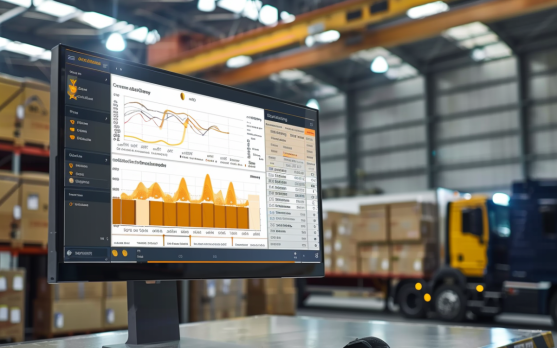
AI has to work before the truck leaves
Most of the public conversation around AI in cold logistics still begins too late. It starts with route optimisation, ETA prediction or temperature alerts. Useful, yes. But by the time the truck is moving, many of the decisions that shape waste, cost and service have already been made.
Frozen food needs AI further upstream. In the forecast. In allocation. In slotting. In dock schedules. In production release. In how a warehouse decides which pallets should sit near the door and which should disappear into high-bay storage. In whether a product should be shipped to a retailer, held for foodservice, moved to another DC, or pushed into a secondary channel before the clock turns unfriendly.
A forecast in frozen food is not just a sales number. It is a cold-storage reservation, a labour plan, a transport commitment and, in bad weeks, a waste risk. A promotion that overperforms can drain stock from the wrong location. A slow SKU can occupy expensive freezer space long after the buyer has moved on. A weather change can lift demand for one category and flatten another. A foodservice customer can change volume with little patience for the warehouse that has to absorb the shock.
AI earns its place when it sees these collisions earlier than a planner working through yesterday's reports.
The warehouse is where AI becomes physical
Cold stores are often presented as digital environments now. Dashboards, WMS screens, scanners, sensors, automated cranes, machine learning, predictive maintenance. The language is clean. The building is not.
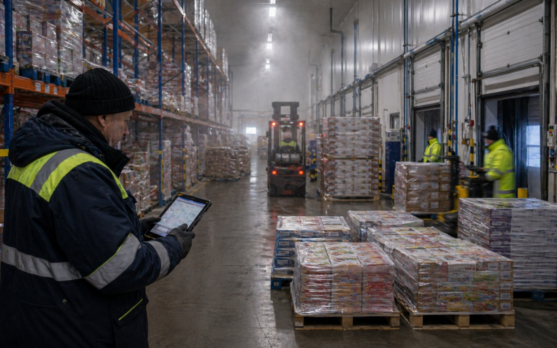
Inside a frozen warehouse, the work is physical and stubborn. Pallets have dimensions, damage, ice, film tears and awkward handling histories. Doors open. Forklifts queue. Workers change shifts. A pick sequence that looked efficient in the system can create congestion at the cold room entrance. A slotting decision can save travel time or quietly punish the refrigeration plant all day.
This is where AI becomes useful, or decorative.
Useful AI does not only say what stock exists. It helps decide where stock should sit. Fast-moving foodservice items closer to dispatch. Ageing product visible before it becomes a late panic. Sensitive frozen desserts protected from rougher movement. Coated products and frozen bakery managed with enough care that handling does not become quality loss. The warehouse stops being a frozen box full of inventory and starts behaving like a risk map.
Some of the biggest temperature-controlled logistics operators are already talking publicly about warehouse systems that combine automation, WMS logic and machine learning. That direction matters less as a technology story than as an operating signal. The value is not the algorithm itself. The value is whether the site can place, move and release product with fewer bad surprises.
Dwell time is the waste nobody wants to own
Waste in frozen food does not always begin with thawing. It often begins with waiting.
A pallet waits because the outbound door is not ready. It waits because the document check is slow. It waits because QA has put the lot on hold and nobody has defined the next review time. It waits because a customer delivery window changed and the planning team has not resequenced the work. It waits because the warehouse is full and the easiest decision is to leave the awkward product where it is.
Every cold-chain business recognises this, even if it does not always measure it well. Dwell time hides in staging areas, dock queues, blocked aisles, manual approvals, transport delays and handovers between systems. It can remain invisible because each delay looks small enough to tolerate.
AI can make dwell risk harder to ignore. It can flag the pallet that has spent too long outside its normal flow. It can show which SKUs repeatedly wait before dispatch. It can connect a late inbound truck to a likely outbound service failure. It can warn that a QA hold is moving from technical review into commercial damage. It can show when a warehouse is not short of space, but short of clean decisions.
That is a different kind of waste reduction. Less heroic. More useful.
Routes matter, but the route is only one piece
AI route optimisation has become the easy headline. Shorter routes, lower fuel, fewer delays, better ETA. All fair. In frozen food, route intelligence matters, especially when weather, port congestion, driver availability or border friction can turn a clean plan into a messy one.
Still, the route is not the whole cold chain.
A faster truck does not solve a warehouse that picked the order too late. A better ETA does not help if the receiving dock is not ready. A lower-risk route does not protect margin if the inventory was allocated to the wrong market in the first place. The stronger AI systems will connect route risk to product risk, not treat transport as a separate board game.
If a lane becomes unreliable, the system should help answer uncomfortable questions. Should inventory be moved closer to demand? Should a retailer receive partial volume earlier? Should a slower-moving product be protected for another channel? Should the warehouse change picking priority because a delivery window has narrowed? Should QA review a load because the thermal history and dwell pattern together look questionable?
Those are operating decisions. They are not solved by a prettier map.
Exception playbooks matter more than alerts
The cold chain already has alarms. Temperature alarms, late truck alerts, low-stock warnings, maintenance notifications, capacity warnings, forecast exceptions. Many businesses have more alerts than response discipline.
AI will make that worse unless the organisation is honest about who acts.
An exception playbook is the difference between information and control. If a frozen ready meal pallet is ageing in the wrong DC, what happens? If a retailer changes a delivery slot, who resequences the pick? If a route disruption threatens a load, who decides whether to reroute, hold or ship? If a refrigeration unit starts behaving abnormally, who sees the maintenance risk before the room becomes unstable? If a temperature event occurs, when does QA enter the conversation?
AI should not simply add another layer of advice. It should make the next responsible action clearer. Sometimes that action will be automatic. Often it should not be. Food safety, customer claims, product release and commercial substitution still need accountable people. The better system is not the one that removes judgement. It is the one that brings judgement into the room earlier.
There is a hard truth here: AI cannot optimise a cold chain that still hides its exceptions in emails, phone calls and spreadsheet notes. It can only expose the gaps faster.
Clean data will become the advantage
By the end of this decade, AI-based forecasting and supply-chain planning will be far more common in large organisations. That does not mean every cold chain will become intelligent. Some will simply become noisier.
The limit will be data quality. Product master data that does not match reality. Shelf-life rules handled differently by each site. Temperature data sitting in a separate platform. WMS events that do not talk to transport systems. QA holds invisible to sales until too late. Promotions entered late. Returns coded poorly. Customer complaints separated from logistics history. The old cold-chain mess, only with an AI layer on top.
Frozen food companies should be careful here. The promise of AI is seductive because the pain is real: labour pressure, energy costs, waste, service failures, capacity shortages and fragile demand signals. But weak data will push weak recommendations. If the system does not know what the product is, where it is, how old it is, what condition it has been kept in and what commitment it serves, the output will sound confident and still be wrong.
The more mature companies will start with operating questions rather than technology slogans. Which decisions are late today? Which products become waste because nobody acted early enough? Which routes repeatedly create exceptions? Which sites lose time at the dock? Which customers create volatility that the warehouse absorbs silently? Which quality holds need faster commercial routing?
AI is useful when it answers those questions in time to change the work.