The Frozen Middle Is Getting Crushed: Private Label Below, Premium Above
The frozen aisle is drifting into a harsher shape than many brands want to admit. It is no longer enough to be decent, familiar, and priced somewhere in the middle. That old formula used to survive on habit, a bit of promo support, and the quiet assumption that shoppers would keep a few national brands in the basket out of routine. That assumption is starting to break. In much of Europe, private label is no longer a cheap substitute waiting for shoppers to trade back up, and premium is no longer a niche reserved for a few indulgent lines. Both ends are getting stronger at the same time. Which leaves one awkward question sitting in the freezer: what exactly is the middle still for?
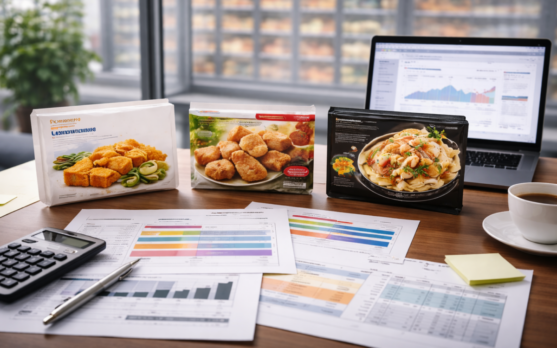
This is not really a price war. It is a relevance war.
The easiest way to misread the frozen market right now is to turn everything into a value story. Yes, value matters. Yes, households are still cautious. Yes, own label keeps taking ground because many shoppers are watching the bill closely. But that explanation, on its own, is now too thin.
What is actually happening feels more unsettling for branded frozen players, because the attack is coming from both directions. At the bottom, retailer labels have become stronger, more trusted, and more normal. At the top, premium frozen is no longer just about luxury. It is about better ingredients, cleaner design, stronger cues around health or indulgence, and products that feel like they are giving the shopper a reason to spend more. In the middle sits a growing number of brands that are neither cheap enough to win the value fight nor special enough to win the premium one.
That is the real squeeze. Not that the middle disappears overnight, but that it loses its natural excuse for being there.
Private label is no longer a temporary inflation habit
One of the most dangerous mistakes frozen brands can make is to assume that shoppers will eventually wander back to the old brand hierarchy once the pressure on household budgets eases. Europe is giving fewer reasons to believe that.
Private label has become normal, and not in the old slightly apologetic way. It has scale, visibility, quality progress, shelf confidence, and in many cases better retailer support than mid-tier brands can realistically expect. That matters because once private label stops feeling like a compromise, it stops needing a crisis to justify itself. It simply becomes one of the default ways people shop.
That change is especially painful for frozen because frozen was always a category where practicality already carried a lot of weight. People buy frozen for ease, portioning, lower waste, speed, and convenience. When a retailer can offer a product that looks good enough, tastes good enough, and costs less, a middle brand quickly discovers how fragile “good enough plus a little brand equity” really is.
The premium end is getting sharper too
If the story ended with private label trading shoppers down, the response for branded frozen players would at least be simple, even if unpleasant. Cut, fight, defend, promote. But that is not the whole story anymore.
The premium end is becoming more crowded and more credible. Retailers have figured out that own label can move upward, not just downward. They can build better-looking packaging, cleaner claims, more sophisticated recipes, and ranges that feel deliberately elevated rather than merely acceptable. Meanwhile, branded players that genuinely stand for something can still pull shoppers upward when they offer a clear reward: restaurant-style quality, stronger health logic, distinctive cuisine, cleaner ingredients, or a real emotional hook.
That leaves the frozen middle trapped in the least comfortable position in modern grocery. Too expensive to feel obviously safe. Too ordinary to feel worth stretching for. Too familiar to feel exciting. Too vague to feel protected.
Frozen is unusually exposed because it lives on repeat purchase logic
Some categories can survive in the middle for longer because the shopper is buying expertise, aspiration, status, or technical reassurance. Frozen is harder. A lot of frozen shopping is brutally practical. People come back because the product solved a weekday problem, fed the household reliably, and felt like a sensible purchase.
That repeat-purchase logic sounds stable, but it can turn cruel when private label improves. Once the retailer version becomes acceptable, the branded middle does not lose the shopper in one dramatic move. It loses the shopper quietly, one substitute at a time. A pizza here. A vegetable side there. A fish line replaced. A ready meal swapped. Eventually the household still buys frozen, but not the same brands.
This is why middle-tier frozen players should worry less about dramatic consumer rejection and more about gradual irrelevance. The freezer can look full while the brand is slowly being edited out of it.
Promotions are no longer a reliable rescue plan
For years, a lot of middle-tier packaged food lived off the same unspoken bargain: we may not be the cheapest and we may not be the best, but we can stay in the game through frequency, familiarity, and deals. That model looks less comfortable now.
Promotions still matter, of course. But more and more, they look like a support mechanism rather than a growth engine. When too much of the category is on deal, promotion stops feeling like a sharp weapon and starts feeling like background noise. The brand spends margin just to remind the shopper it exists. Worse, it trains the shopper to view the regular shelf price as negotiable or inflated.
That is a bad place for the frozen middle to live, because promotions work best when they are backing a product people already want. They work much less well when they are trying to create desire that was never very strong in the first place.
The middle is not dead. It just has to stop being generic.
This is where the analysis needs some discipline. Not every mid-priced frozen brand is doomed. Some will hold because they still carry emotional memory, stronger taste recognition, regional affection, or a specific format advantage that retailers have not matched well. Some have room to sharpen their proposition without jumping all the way into premium pricing. Some can simplify ranges, improve product quality, and become more focused rather than more expensive.
But the lazy middle is in real danger. The range that exists because it has always existed. The product that says little beyond basic competence. The brand that lives in the space between “not too expensive” and “not too bad.” That version of the frozen middle is exactly what modern retail systems are learning to punish.
Retailers do not need it as much as they once did. Shoppers do not need it as much as they once did. And if growth stays weak, shelf space becomes less forgiving toward anything that cannot explain itself quickly.
What the next phase likely looks like
In the near term, the pressure is likely to show up first in assortment choices and portfolio pruning. Retailers will become less patient with lines that neither anchor value nor clearly upgrade the category. Brands will respond by trying to sharpen one side of the proposition. Some will push into better ingredients, premium convenience, or health-led differentiation. Others will strip back, simplify, and fight harder on value.
Over the next two to three years, expect more barbell behavior in frozen. More strength at the opening-price and strong-mainstream private-label end. More energy at the premium and premium-private-label end. Less room for fuzzy mid-tier propositions that depend on broad but shallow loyalty.
Longer term, the biggest winners are likely to be the players that make one hard decision early. Pick a side and mean it. Either become unmistakably stronger on value or become unmistakably stronger on reason-to-pay. The middle can still exist, but only if it stops acting like a parking space between two clearer worlds.
The strategic question for frozen brands is brutally simple
When a shopper stands in front of the freezer, what is the exact sentence that protects your product? Not the ten-slide brand deck. Not the heritage story in a board presentation. The one sentence.
Is it “this is the smart value choice”? Fine. Then it needs to beat the retailer honestly enough to deserve that claim. Is it “this feels better than what the retailer offers”? Fine. Then the product, packaging, and eating experience need to prove it fast. But if the answer is some softer version of “we are a known brand and people kind of trust us,” that may no longer be enough.
That is why the frozen middle is not under pressure merely because shoppers are trading down. It is under pressure because the aisle is becoming more explicit. Value is getting clearer. Premium is getting clearer. The middle is the part still mumbling.
Conclusion
The uncomfortable truth for frozen brands is that the squeeze is no longer hypothetical. Private label has become too strong to dismiss as a cyclical budget choice, and premium has become too attractive to dismiss as a fringe indulgence. That leaves the middle facing the hardest commercial test of all: proving that it still deserves space, spend, and attention when both edges of the market are improving faster.
The brands that survive this phase will probably not be the ones that defend the middle as a comfortable place to stay. They will be the ones that redefine it, sharpen it, or leave it. In frozen, “somewhere in between” is starting to sound less like a strategy and more like a warning.
Essential Insights
The frozen aisle is moving toward a barbell shape. Private label is stronger than many brands hoped, premium is broader than many expected, and the brands caught in the middle are now the ones most likely to be questioned, squeezed, and quietly replaced.


