Romania’s Cold Automation Moment: Why Bucharest Could Become the CEE Warehouse Everyone Ends Up Studying
For years, Romania’s cold chain story has mostly been told in a familiar language: capacity, proximity, labor, rent, and who can still find room when volumes spike. That story may be about to get old. What is taking shape near Bucharest is not just another cold warehouse and not just another investment headline. It is potentially the moment when one market in Central and Eastern Europe stops competing mainly on available cold space and starts competing on something more uncomfortable for everyone else: precision, visibility, consistency, and energy discipline at scale. If that happens, Bucharest will not simply gain a large automated site. It will become a reference point, maybe even the reference point, for how the next generation of cold logistics gets judged across the region.
The real story is bigger than the building
It is tempting to treat this as a straightforward piece of industrial news. A major automated cold storage operator enters Romania. Banks finance it. The warehouse is large, modern, efficient, and scheduled to go live in late 2026. That version is fine as a news brief. It is not enough as an industry read.
The more interesting question is what changes once a market like Romania gets a site designed to run on a completely different operating logic. Not a prettier warehouse. Not a slightly newer warehouse. A warehouse built around automation, digital integration, dense storage, tighter process control, and far less tolerance for the small frictions that traditional cold chains learn to live with every day.
That is why Bucharest matters here. This is not the first time NewCold has built serious automation in Central and Eastern Europe. Poland already gave the group proof that the model can work at scale. The Romanian project matters because it drops that model into a market where the local reference point has been different. That is when things start moving. Not overnight, and not evenly, but decisively.
When a new standard arrives, the old market does not disappear. It gets sorted.
That is the part many people miss when they look at automation projects. They imagine a simple before-and-after. Old warehouses on one side, robotic warehouses on the other. Reality is messier. What usually happens first is market sorting.
One group of customers starts realizing that “cold storage” is not one thing anymore. There is cold capacity, and then there is cold capacity with discipline. There is frozen handling, and then there is frozen handling with better visibility, cleaner data, steadier service windows, fewer avoidable touches, tighter control of exceptions, and a stronger ability to explain where the product is and what just happened to it.
That distinction matters a lot more than the industry often admits. Because once a serious automated node opens in a market, the comparison stops being theoretical. Buyers, brand owners, and retailers no longer have to imagine what better might look like. They can visit it. Measure against it. Ask awkward questions because of it.
And that is usually when the pressure begins. Not necessarily on price first, but on credibility.
Romania is well placed for this shift, which is exactly why the pressure could spread beyond Romania
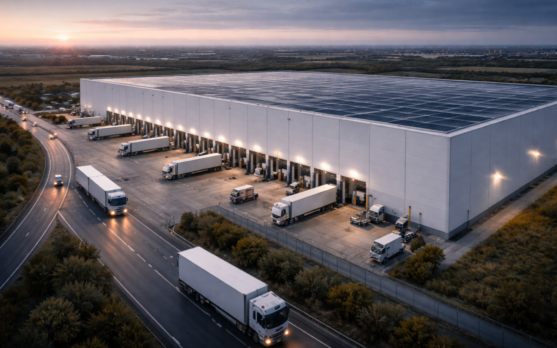
Bucharest is not just a big consumer market. It is also a directional logistics point. Put a high-performance cold asset in the north of the capital, close to the ring-road logic and major corridors, and it stops being a local warehouse story. It becomes part of a wider map.
That geography matters because CEE does not move as a single unified cold-chain market. It moves through nodes. Whoever controls the strongest nodes, or defines the most attractive ones for food flows, starts shaping expectations well beyond city limits. If the Bucharest site performs the way its backers and operator clearly want it to, it could influence how manufacturers think about Romania, how retailers think about service reliability, and how regional logistics planners compare routes, buffers, and inventory positioning.
In other words, Bucharest does not need to replace Warsaw, Prague, or Budapest as a logistics reference point to become influential. It only needs to become the place where the region starts seeing that advanced cold automation is not confined to the usual shortlist of more mature markets.
The biggest early shift may be in service expectations, not tariff levels
There is always a lazy version of this discussion that reduces automation to one question: will it make storage cheaper? That is too small a frame, and in the short term it is probably the wrong one.
Large automated cold infrastructure is expensive to build, expensive to ramp, and selective in the kinds of flows it rewards most. So the first visible effect is less likely to be a dramatic fall in market prices and more likely to be a quiet rise in service expectations.
Once a serious customer starts working with a facility built for dense automation and digital integration, certain old tolerances begin to feel harder to defend. Inventory mismatches look uglier. Slow exception handling feels slower. Unclear slotting logic becomes more irritating. Broad, vague service promises start sounding weak. What used to be accepted as cold-chain normal starts reading as avoidable noise.
That is where the real disruption sits. Not in one spectacular pricing move, but in a gradual change in what counts as acceptable performance.
Retailers and food producers are likely to ask better questions
This is where the project gets especially interesting for decision-makers. The old warehouse sales pitch was often simple: we have space, location, labor, and enough operational reliability to get the job done. The next pitch looks different. How visible is my stock? How quickly can exceptions be identified? How clean is the interface between my systems and yours? What happens at peaks? How much variability am I paying for without seeing it clearly? How much energy waste is quietly embedded in this model?
Those are better questions. Harder, but better. And once buyers start asking them, the competitive field changes fast.
Some operators will remain strong because they are flexible, close to demand, clever with mixed handling, or very good in specific niches. Automation does not erase that. But it does raise the bar for larger, repeatable, retailer-facing and manufacturing-facing flows where consistency matters more than improvisation. A market that once rewarded “good enough cold capacity” can start rewarding “measurable cold performance.” That is a very different game.
The operator pressure across CEE may be more psychological than physical at first, but that still counts
Not every cold warehouse in the region needs to start pouring concrete tomorrow. That is not how these shifts happen. The first response is usually strategic discomfort.
Competitors start revisiting their own positioning. Suddenly everyone wants to talk about visibility. About WMS upgrades. About better dashboards. About traceability. About more intelligent slotting. About energy efficiency that is no longer a CSR footnote but a commercial point. Nobody wants to be the operator that looks decent until a benchmark walks into the neighborhood and makes “decent” feel old.
That is why this could become a CEE test case. Not because the whole region will copy one facility in eighteen months, but because the facility may force the rest of the region to show its hand. Who is truly modernizing? Who is polishing the sales deck? Who can support the standards that larger food customers will increasingly want? And who is still quietly monetizing a market that has tolerated too much opacity for too long?
Why the energy angle should not be treated as background detail
Cold logistics people know this already, but it still does not get enough executive-level attention: energy is not just a cost line in cold infrastructure. It is a design philosophy. It shapes how resilient a warehouse can be, how stable its economics look over time, and how persuasive its long-term offer becomes when customers are trying to make sense of their own margins.
That is one reason the Romanian project deserves to be read carefully. If the promised efficiency gains are even broadly delivered, the message to the market is bigger than “green warehouse.” The message is that cold automation can tighten the relationship between service quality and energy discipline instead of forcing a trade-off between them.
That matters in CEE because plenty of operators have been able to delay hard modernization choices as long as customers still bought capacity first. A more efficient, more digital node in Bucharest makes that delay harder to defend.
What shifts first, what shifts later
Between now and launch, the strongest immediate effect is likely to be commercial repositioning. Expect more talk about automation, traceability, digital service, and energy performance from operators that do not want to look second-tier in customer conversations.
In the first year after go-live, if execution is solid, the real signal will probably come from who moves volume there and why. If major food producers or retail-linked flows lean in, the market will read the message quickly. Not all pallets are equal. Some pallets are votes.
Over the medium term, the more meaningful change could be in procurement behavior. Romania may start being considered not just as a lower-cost location with strategic demand access, but as a place capable of hosting higher-standard cold-chain architecture that supports regional service ambitions. That is where the CEE test-case argument becomes serious.
Longer term, the most important consequence may be cultural. Once a market sees what high-automation cold logistics looks like up close, it becomes much harder to go back to talking about warehouse quality in purely traditional terms. The vocabulary changes. So do the expectations. And once that happens, even operators that never plan to build a robotic tower still have to respond to the new language of the market.
The deeper implication is uncomfortable, which is why it is worth writing
Romania has often been discussed as a promising logistics market. Promise is easy. The more difficult question is whether it can become a market that resets standards rather than simply absorbs capacity. This project gives it a chance to do exactly that.
If Bucharest becomes the place where advanced cold automation proves it can reshape customer expectations, supplier behavior, and regional comparisons, then the story is no longer about one warehouse. It becomes about a new line being drawn across CEE. On one side sit operators selling cold space. On the other sit operators selling controlled performance.
That line will not be absolute. Markets never work that neatly. But once it appears, even faintly, everyone can see it. And once everyone can see it, the old middle starts shrinking.
Conclusion
The most interesting thing about Romania’s cold automation moment is not that a major operator is building a modern site near Bucharest. It is that the project arrives at exactly the point when food logistics across the region is becoming less forgiving of vagueness. Customers want cleaner visibility. Better service logic. Stronger traceability. More resilient cost structures. Less hand-waving.
If the Bucharest facility delivers even reasonably close to its stated ambition, Romania will not just gain a flagship cold asset. It will gain influence. It will become the place people reference when asking what the next cold-chain standard in CEE is supposed to look like. And once that starts happening, the real pressure lands on everyone else.
Essential Insights
Bucharest does not need to become the biggest cold node in CEE to become the most instructive one. If this project works, it could change what retailers, food producers, and logistics buyers expect from cold storage across the region.