The Next Big Food Cyberattack Will Look Like a Frozen Operations Failure
The next major cyberattack in food will probably not feel like a cyberattack at first. It will feel like a frozen operation losing its grip. Orders will stall. Labels will stop making sense. A load will miss its slot. Someone in QA will start asking whether the temperature history is still trustworthy. Someone in the warehouse will say the system shows one thing, but the floor says another. And for a few hours, maybe longer, the business will not be arguing about hackers. It will be arguing about whether product can still move, whether records can still be defended, and whether anyone really knows what is in tolerance, what is on hold, and what can still be shipped without regret.
It will not look dramatic at the beginning. That is what makes it dangerous.
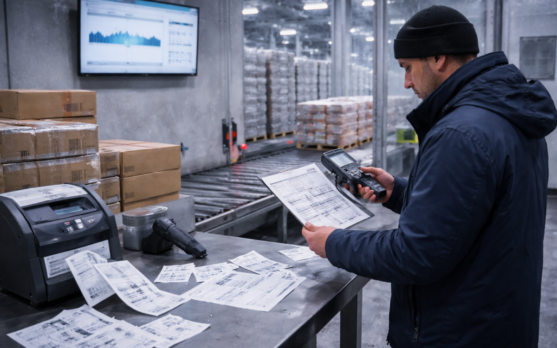
People still imagine cyber incidents in the old visual language: black screens, ransom notes, locked files, panic in the IT room. That still happens. But in frozen, the nastier version is often quieter. It starts with friction. A printer behaves strangely. A barcode does not scan. A shipment status looks wrong. Inventory appears to be there, but not where it should be. A customer portal goes down. A warehouse team reaches for paper because the system is technically alive, yet no longer reliable enough to trust under pressure.
That is the moment the story changes. It stops being about whether servers are encrypted and starts being about whether the operation still has a shared version of the truth. In frozen, that question gets expensive very fast.
The freezer does not need to go down for the business to be in trouble
This is where too many boardrooms still get the risk wrong. They assume the real nightmare is a direct hit on refrigeration or plant controls. That would be serious, of course. But a major loss can happen long before anything that dramatic. The attacker does not need to shut down compressors to create a commercial mess. It may be enough to hit the coordination layer around the product.
If the warehouse management system becomes unreliable, if labeling goes uncertain, if transport workflows stop syncing, if lot lineage turns blurry, if temperature records are present but no longer fully believable, the product may still be frozen physically and yet become harder to release commercially. That is the point. The operation can still be standing while confidence inside it starts to collapse.
Frozen is less forgiving than many other categories
In some sectors, manual workarounds buy time. In frozen, they buy stress. Timing is tighter. The chain of custody matters more. Product status matters more. Shelf-life assumptions matter more. A delay is not just a delay. A delay can become a documentation problem, a retailer problem, a load-planning problem, or a QA problem. Once that stack begins to form, the issue is no longer "Can we keep working?" It becomes "Can we still prove what happened?"
That is why frozen is so exposed to data-trust incidents. Not merely data loss. Data trust. Those are two different things. A missing record is a problem. A record that exists but may be wrong is often worse, because it tempts the business to keep moving while doubt spreads underneath the workflow.
The real attack surface is everything in between
The weakest point in a frozen network may not be the cold store itself. It may be the file-transfer layer. The supplier connection. The logistics API. The customer ordering portal. The label-generation workflow. The cloud tool nobody thinks about until it breaks. The third party everyone depends on but nobody fully sees.
That is why the next major incident is likely to feel messy rather than theatrical. Not one clean explosion of failure, but a chain of smaller distortions that start connecting. Orders are delayed. Picks are adjusted manually. Labels are reissued. Exceptions pile up. Someone notices a gap in the lot trail. Someone else notices a timestamp discrepancy. By the time the company uses the word "cyber" with confidence, operations has already been bleeding credibility for hours.
This is where cyber stops being an IT issue and becomes a QA issue
That transition is the part too few executives price correctly. Once digital trust breaks, QA gets pulled into the center of the incident. Product may need to be held not because it is known to be unsafe, but because the evidence required to defend it has become shaky. Temperature history might exist, but can it be trusted? Lot mapping may be visible, but is it complete? Label records may be available, but do they match what actually moved?
Those questions are brutal because they do not produce neat answers. They create hesitation. And hesitation in frozen is expensive. Loads wait. Customers push back. Internal teams argue. The commercial side wants continuity. QA wants proof. Operations wants clarity. Cybersecurity wants containment. Nobody is wrong, and that is exactly why these incidents become so difficult to manage.
Manual fallback sounds comforting until you try it at freezer speed
Every business continuity slide deck contains some version of the same reassurance: if the system fails, we can revert to manual mode. That sounds sensible in a meeting room. On a real frozen floor, under real volume, with real retailer windows, it starts looking less heroic.
Manual processes are slower. They create more reconciliation work. They depend heavily on local judgment. They produce more room for misreads, relabeling errors, duplicate actions, and missed handoffs. In a cold environment, where everything is already paced around throughput and precision, manual mode is not a neutral backup. It is a stress multiplier.
And the longer it lasts, the more the business risks drifting into another problem entirely: products that are probably fine, but no longer easy to defend at the speed the market expects.
The next wave will be uglier because it will be less obvious
Ransomware still dominates headlines because it is visible. But the more unsettling direction is integrity failure. Not systems that are obviously dead, but systems that appear to function while feeding the operation partial, delayed, altered, or quietly inconsistent information.
For frozen operators, that is the nightmare worth taking seriously. A threshold changes. A lot code is mismatched. A shipment event does not post correctly. A sensor value looks plausible, but the chain behind it cannot be verified cleanly. Nothing looks catastrophic in isolation. Together, those cracks can turn ordinary dispatch into a release-risk discussion.
That kind of incident is harder to spot, harder to explain, and often harder to contain because the operation keeps moving while confidence erodes. Full shutdowns are painful. Invisible distortion is worse.
What happens next
Over the next year or two, the most disruptive frozen incidents are likely to land first in coordination-heavy zones: distributors, WMS layers, labeling systems, managed file-transfer tools, transport interfaces, third-party connections, and customer-facing portals. The first visible symptoms will often look operational, not criminal. Expect more delayed loads, more manual picking, more lot mismatches, more hold decisions driven by uncertainty, and more arguments over whether the data can still support release.
Over the following few years, the center of gravity is likely to move from availability to credibility. That is the bigger shift. Businesses will worry less about whether the data exists and more about whether it can still be defended under pressure. That pulls cybersecurity into the same room as food safety, QA, traceability, legal exposure, and customer trust.
Longer term, the operators that come out ahead will be the ones that stop treating cyber resilience as a specialist program run off to the side. In frozen, it is becoming part of the operating model itself. The serious question will not be "How fast can we restore systems?" It will be "How fast can we restore trust in product identity, product history, and temperature evidence?"
The companies that handle this well will think differently now
They will not ask only whether backups work. They will ask which systems could turn a digital incident into a product-hold event by lunchtime. They will not assume traceability is strong because data is digital. They will test whether it remains trustworthy under stress. They will not keep QA, operations, and cybersecurity on separate tracks and hope a crisis magically knits them together.
Most of all, they will understand one uncomfortable truth early: in frozen, the next big cyberattack may not be remembered as a hack. It may be remembered as the day the operation stopped being able to prove itself.
Conclusion
The most expensive future cyber incident in food may not be the one that crashes the most systems. It may be the one that makes a frozen business doubt its own records just long enough to jam picking, blur traceability, delay release, and turn ordinary product into contested product. That is why this topic belongs in the boardroom. The real damage is no longer measured only in encrypted files or offline hours. It is measured in broken operational trust.
Essential Insights
For frozen operators, cyber risk is no longer just about uptime. It is about whether the business can still prove lot integrity, label accuracy, shipment history, and temperature credibility when the digital layer starts lying, lagging, or going dark.