The Scan Before the Test: Why Non-Destructive Mycotoxin Screening Is Starting to Matter
Ask anyone who works with grains at scale what makes mycotoxin control so frustrating and the answer usually appears fast: timing. The laboratory result comes after the uncertainty has already started doing damage. A lot has been received, moved, blended, stored, priced, or mentally filed under “probably fine,” and only then does the slow certainty of analytical chemistry arrive to clarify whether that optimism was justified. That is why the current interest in Vis-NIR, Raman, and hyperspectral imaging feels more substantial than the usual cycle of shiny-tech enthusiasm. These methods are not being refined because the sector wants prettier instruments in the intake lab. They are being refined because grain businesses need a way to look earlier, screen faster, and decide sooner where the real risk may be hiding. Fungal contamination and toxin load do not distribute themselves politely across a lot. A few bad kernels can distort the whole commercial picture. Some damaged grains look suspicious but turn out manageable. Others look almost ordinary and carry the real problem. The promise of vibrational spectroscopy and imaging sits right there, in that gap between what the eye sees, what sampling catches, and what conventional testing confirms too late to be painless.
Quality control is shifting from confirmation to triage
For a long time, mycotoxin control followed a familiar sequence. Take the sample, run the test, wait for the answer, then decide whether the lot is acceptable, restricted, blended under policy, or rejected. That sequence still matters. Nobody serious in the industry is pretending a fast optical scan should replace reference chemistry where legal compliance, customer claims, or high-risk decisions are involved.
What is changing is the role of the first look. Plants and grain handlers increasingly want a screening layer that sits before the confirmatory layer. Not to declare final truth, but to sort the obvious from the questionable and the questionable from the urgent. That sounds modest, yet in practice it can change a great deal. A rapid screen at intake can influence where a lot is parked, how aggressively it is sampled, whether it should be held from blending, or whether it deserves immediate escalation instead of routine handling.
That is why these technologies are becoming more interesting now. The practical value is not just analytical. It is operational. A method that helps quality teams see risk earlier, even imperfectly, can still save time, reduce blind mixing, and improve the odds that confirmatory testing is focused where it matters most.
Why visible and near-infrared methods are gaining ground
Vis-NIR and related NIR systems are attractive because they can read a lot very quickly and without destroying the sample. In grain applications, that matters. You are often dealing with heterogeneous material, pressure to move product, and the uncomfortable fact that contamination is rarely spread evenly enough to reward casual sampling habits.
These methods are useful because they do not need to “see” the toxin directly in some dramatic science-fiction sense to add value. Often they are picking up the consequences of fungal activity, subtle changes in chemistry, moisture relationships, color, surface character, or internal composition that travel with elevated risk. That distinction is important. The signal is sometimes direct, sometimes indirect, often mixed. But from a quality-control standpoint, the question is simpler: does it help identify suspect material sooner than the current workflow?
Increasingly, the answer looks like yes, at least as a screening tool. Especially when the system moves from bulk measurement toward single-kernel or localized analysis, the value becomes easier to see. Instead of flattening an uneven problem into one average number, the instrument can help expose where the trouble is clustering.
Hyperspectral imaging changes the geometry of the problem
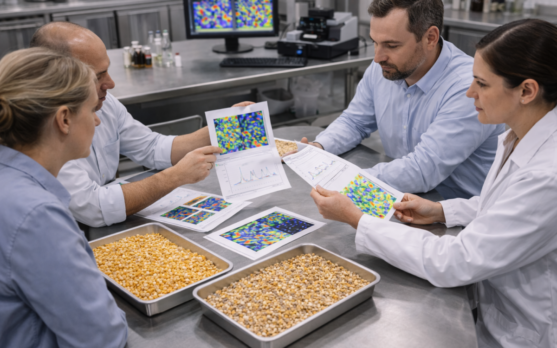
Hyperspectral imaging has drawn so much attention because it does something ordinary spectroscopy cannot do as easily. It combines spectral information with spatial information. That sounds technical, but the practical implication is straightforward. You are no longer treating the sample as one blended signal. You are mapping variation across the grain or across a field of grains.
That matters because mycotoxin risk is messy. It is patchy. It concentrates. It behaves less like a neat percentage and more like a distribution problem. In real lots, a minority of kernels can carry a disproportionate share of the risk. Traditional methods can absolutely detect that risk, but only if the right material enters the sample stream in the first place. Hyperspectral systems offer another angle: they can help reveal suspicious fractions before everything is averaged into submission.
This is where the technology starts to feel commercially relevant rather than academically elegant. If a sorter, inspector, or intake station can distinguish material that deserves closer scrutiny, that is already useful. No grand revolution required. Just a better front end to a familiar decision process.
Raman is appealing because it can be more chemically specific
Raman approaches sit slightly differently in the conversation. Where Vis-NIR often works through broader compositional and structural changes, Raman is attractive because it can capture more chemically distinct spectral fingerprints. That gives it a sharper edge in some contamination problems, particularly where molecular-level differences matter and the signal can be extracted cleanly enough from the sample.
The catch, naturally, is that real food systems are rude to elegant theory. Fluorescence interference, signal weakness, sample variability, throughput constraints, and instrument complexity all have a habit of reminding researchers that a promising method is not the same as a settled industrial tool. Still, Raman keeps advancing because the payoff could be significant. If it can improve confidence at kernel level or sharpen the separation between contaminated and non-contaminated material early in the chain, processors will pay attention.
That is the pattern across this entire field, really. Nobody needs perfection on day one. They need methods good enough to improve decisions upstream.
The real bottleneck is no longer just hardware
There was a time when the instrument itself felt like the center of the story. Now the harder part is often what happens after the scan. Spectral data are rich, noisy, and annoyingly sensitive to real-world variation. Crop year changes. Moisture shifts. Instruments differ. Suppliers differ. Kernel orientation differs. One site scans wheat after one storage profile, another scans maize after another, and suddenly the nice clean model from the development stage starts behaving like a gifted intern under pressure.
This is why chemometrics and machine learning have become inseparable from the conversation. They are not decorative add-ons. They are what turn huge spectral datasets into something a quality manager can actually use. Feature selection, calibration, classification, transfer learning, and model adaptation are now central because the industry does not just need accuracy in one study. It needs robustness across instruments, commodities, seasons, and operating conditions.
That point gets missed surprisingly often. In pilot work, a model can look excellent. On the plant floor, the world adds humidity, dust, inconsistent sample presentation, and a thousand forms of agricultural untidiness. The next stage of progress will come from making these models less fragile, not just more impressive in a paper.
Earlier screening matters because mixing mistakes are expensive
One reason this topic deserves more attention in commercial food and feed chains is that early screening changes downstream economics. A suspect lot identified early can be held, sampled more intelligently, separated, or routed with more care. A suspect lot missed early may already be combined, diluted, committed, or moved somewhere much harder to unwind. At that point, the issue is no longer only analytical. It becomes logistical, contractual, and occasionally political inside the business.
Seen from that angle, non-destructive screening is less about replacing the lab and more about protecting the lab from being asked the wrong question too late. That is a much more grounded way to understand where Vis-NIR, Raman, and hyperspectral systems fit. They help companies ask better questions sooner.
And that may be the real threshold this category is crossing. The old model treated mycotoxin control mainly as a test. The newer model is beginning to treat it as a sensing architecture, where rapid optical tools, smarter sampling, sorting decisions, and confirmatory chemistry work as a sequence rather than as isolated acts. Once that logic takes hold, adoption becomes much easier to justify.
The technology is becoming believable because the ambition is maturing
What makes the field feel more credible now is not that someone has finally built a magic scanner that sees every toxin instantly in every grain. That would be a charming fantasy, but still a fantasy. What feels credible is the more disciplined ambition emerging around these tools. Researchers and technology developers are increasingly positioning them as screening systems, early-warning layers, and decision-support instruments. In other words, as part of quality control rather than as a theatrical replacement for it.
That is a healthier framing, and also a more adoptable one. Grain processors, millers, ingredient buyers, and feed operators do not need perfect optical omniscience. They need faster visibility, more informed segregation, and better odds of catching the ugly surprises before those surprises have been distributed across a larger volume of product.
In that sense, the direction is clear. Non-destructive mycotoxin screening is moving from research curiosity toward practical pre-screening infrastructure. Not finished. Not universal. But no longer theoretical either.
Conclusion
The most useful way to read the current progress in vibrational spectroscopy and imaging is this: the industry is getting better at seeing where to look before it commits to slower, more definitive testing. Vis-NIR offers speed and practical scalability. Hyperspectral imaging adds spatial intelligence that bulk methods simply do not have. Raman brings a more chemically focused perspective that could become increasingly valuable as deployment improves. None of that eliminates the need for confirmatory analysis. It does something more realistic and, for many operations, more immediately valuable. It helps quality control move earlier in time. In grain handling, that is often where the real money and the real risk sit.
Essential Insights
Non-destructive spectroscopy is becoming valuable not because it replaces reference mycotoxin testing, but because it helps grain businesses identify suspect material earlier, sample smarter, sort better, and make fewer expensive decisions in the dark.