FSMA 204 After the Delay: The Frozen Supply Chains That Relax Now Will Pay for It Later
The most expensive sentence in frozen food right now is probably this one: “We still have time.” Technically, yes. Operationally, that sentence may age very badly. FSMA 204 did not fade out when the date moved. It became something more dangerous: a rule many companies now feel they can postpone without consequence. That is the trap. Because the hard part was never the calendar. The hard part was always the chain itself: whether product identity survives cold storage, repacking, relabeling, importer handoffs, system gaps, and human shortcuts well enough to be reconstructed fast when someone important asks questions. In frozen ingredient chains, especially those touching seafood, the delay is not a free pass. It is a stress test disguised as breathing room.
The deadline moved. The exposure did not.
There is a very human tendency in business to confuse postponed enforcement with reduced danger. It happens all the time. A deadline slips, the room relaxes, budgets drift, software decisions get pushed to the next planning cycle, and everybody quietly agrees to be responsible later. That logic works fine for repainting a warehouse wall. It works terribly for traceability architecture.
FSMA 204 is awkward precisely because it is not a cosmetic regulation. It reaches into the messy middle of real operations, where product moves, gets received, stored, split, relabeled, repacked, shipped again, and sometimes thawed, handled, or commercially reconfigured in ways teams do not always treat as strategically important. On paper, many businesses look organized enough. In practice, they are often running on tribal knowledge, disconnected files, and a level of internal confidence that feels solid only because nobody has forced a clean reconstruction lately.
That is why the delay changes the psychology more than the substance. The rule is still there. The scope questions are still there. The demand for quick, coherent records is still there. What changed is that weaker operators now have more room to fool themselves.
The frozen sector keeps underestimating one simple point: frozen does not mean outside the frame.
This matters because parts of the frozen world still talk as if time in the freezer somehow softens the regulatory picture. In several seafood categories, it does not. Frozen finfish, frozen crustaceans, and frozen molluscan shellfish remain very much part of the conversation. That alone should be enough to keep seafood importers, processors, and cold-chain operators from treating this as a distant compliance memo.
The more subtle issue is ingredients. Multi-ingredient foods can still be pulled into scope when a listed ingredient remains in the same form. That is where a lot of companies are likely to misread their own portfolios. Not because they are careless, necessarily, but because the real world is full of edge cases that look commercially ordinary and regulatory bland until somebody maps them properly. Two frozen SKUs can sit side by side in the same plant, move through the same freezer, share the same paperwork habits, and still carry very different traceability exposure because one contains a listed ingredient in the relevant form and the other does not.
That is not a small detail. That is the kind of detail that turns a calm audit conversation into a bad internal meeting.
Cold storage is not the quiet middle anymore.
For years, many operators treated cold storage as if it were the neutral zone of the chain. Product comes in, product stays cold, product goes out. Clean, useful, necessary, but somehow not where the interesting risk lives. That view is getting older by the minute.
Under the logic of the rule, holding is not a dead space. It is part of the story. And once you accept that, the uncomfortable questions start coming quickly. Can the warehouse actually link what arrived with what left? Can it preserve lot identity cleanly across pallet changes, label swaps, storage moves, or cross-dock pressure? If a customer, regulator, or importer asks for the trail, does the answer live in one coherent chain or in a scavenger hunt across emails, WMS screens, receiving notes, and someone’s memory of “how we usually do it”?
This is where the frozen sector needs to be brutally honest with itself. A facility can be operationally competent and still be traceability-fragile. Those are not the same thing. Plenty of sites run efficiently every day while carrying invisible administrative weakness underneath. They look strong until the product history has to be rebuilt at speed. Then the cracks show.
The expensive moment often arrives during repacking, not production.
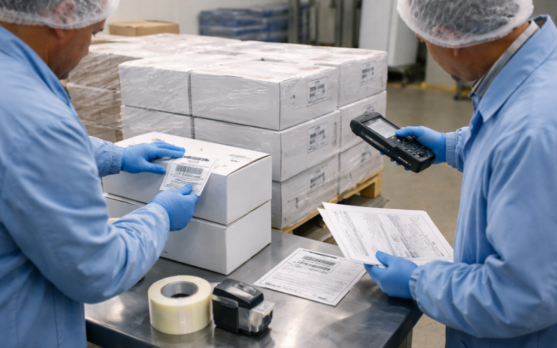
If there is one place where executives should stop using the word “minor,” it is repacking. In too many businesses, repacking and relabeling are still treated like commercial housekeeping. Necessary, routine, unglamorous. But this is exactly the kind of step where lot clarity can either survive or quietly fall apart.
Not dramatically, usually. That is what makes it dangerous. Nobody sounds an alarm. Cases get reconfigured. Labels get replaced. Pallets are split for customer needs. A shipment is redirected. A warehouse team does what the day requires. A co-packer makes a sensible adjustment. Each step feels manageable on its own. Then one day the business needs a clean, defensible narrative of what happened to a specific lot, and the answer turns out to be trapped inside five partial records and two assumptions.
The industry likes talking about digital traceability as if the problem lives in software selection. Often it does not. Often the problem is that the business has never fully decided which operational moments are serious enough to deserve disciplined identity control. Repacking is one of those moments. So is relabeling. So is cross-border receiving. So is any point where product form, packaging context, custody, or lot relationship becomes easier to blur than to explain.
The market will probably sort suppliers before FDA does.
This is the part that should make decision-makers pay attention. The commercial consequences are unlikely to wait politely for the enforcement consequences. Big buyers are not famous for enjoying preventable uncertainty, and import-facing supply chains are not built on trust alone. The more this rule settles into customer conversations, the more likely it becomes that supplier preference starts shifting early.
The divide will not be philosophical. It will be practical. Which supplier can explain its lot logic without a long preamble? Which cold-chain partner can show clean handoffs? Which importer can defend product history without calling three other companies first? Which processor has already mapped the awkward corners of its own operation instead of hoping nobody asks? Those businesses will start looking easier to keep. Easier to approve. Easier to defend internally.
The others will still say they are “working on it.” That phrase is not going to age well either.
What the next phase is likely to look like
Between now and the end of 2026, the strongest frozen operators will probably do something unromantic but powerful: they will stop talking about FSMA 204 as a future event and start treating it as a portfolio-mapping exercise. They will ask where the true exposure sits, SKU by SKU, ingredient by ingredient, handoff by handoff. Not because that sounds visionary in a board slide, but because it is the only way to discover where the chain is bluffing.
During 2027, the more serious businesses are likely to move from mapping to pressure-testing. Can the records really be pulled fast? Does the lot identity survive everyday operational messiness? Are supplier data habits strong enough, or merely familiar? Can the warehouse, the processor, the importer, and the commercial team all describe the same product journey in the same language? Those questions matter more than whichever vendor gave the slickest traceability demo last quarter.
By the time mid-2028 arrives, the most prepared operators will not experience the rule as a dramatic compliance cliff. They will experience it as confirmation that they already run a more disciplined chain. The less prepared ones will discover something harsher: the delay did not reduce the cost. It simply moved the bill.
The real story here is not regulation. It is self-knowledge.
That is the angle I would not let go of if the goal is industry impact. The article is not really about whether FDA still cares. It clearly does. It is about whether frozen ingredient chains know themselves well enough to prove control under pressure. That is a much sharper question, and frankly a more modern one.
A company that cannot reconstruct where a lot entered, what happened during storage, whether it was transformed, how it moved onward, and how fast the record can be assembled is not simply “a bit behind.” It is operating with a blind spot. And blind spots are expensive in frozen food because product travels far, margins are not generous, and trust can erode faster than most boardrooms like to admit.
That is why the delay is not comforting. It is revealing. It tells you who is going to use the extra runway to build a sturdier chain and who is going to waste it pretending the runway itself is the strategy.
Conclusion
The lazy reading of FSMA 204 is that frozen ingredient chains were handed more time. The smarter reading is that they were handed a mirror. The deadline moved, and now the sector gets to see which businesses were building real traceability discipline and which were just hoping deadline pressure would eventually force it into existence.
For frozen seafood and other complex ingredient chains, that difference will matter long before July 2028. It will show up in supplier confidence, importer comfort, audit tone, customer preference, and the speed with which a business can answer difficult questions without sounding nervous. The operators that move now will not just look compliant later. They will look credible. In this market, that is worth more.
Essential Insights
FSMA 204 is no longer mainly a countdown story. It is a credibility story. The frozen chains that treat the delay as permission to slow down may discover that the market starts judging their traceability discipline well before regulators do.