Soft Grippers Make Delicate Food Handling Scalable
Soft grippers are finally crossing an important line in food automation. For years, they looked promising in demos but harder to trust on a real production floor, where product variability, sanitation routines, speed targets and downtime costs have a nasty habit of exposing weak ideas. That is starting to change. A new generation of soft gripping tools, backed by better sensing, cleaner hygienic design and smarter motion control, is making it possible to handle fragile, wet, irregular and easily damaged food items with far more confidence than before. Not perfectly, and not everywhere, but convincingly enough that processors are beginning to treat delicate food handling as a realistic automation target rather than a problem that must stay manual forever.
Why delicate food has always been such a stubborn automation problem
There is a reason food factories automate boxes faster than products. Boxes behave. Food does not.
A pastry can collapse at the edge. A chicken portion can slide the moment a belt accelerates. A chocolate shell can mark if the pressure is slightly off. A soft fruit may look fine at first contact, then reveal bruising later, once it has already moved downstream and become someone else’s headache. That is the sort of industrial comedy food manufacturers know very well.
Traditional rigid grippers were never built for this kind of chaos. They work well when dimensions are stable, surfaces are predictable and the object does not mind being grabbed with mechanical certainty. Delicate food products are almost the opposite. They vary in shape, texture, moisture, weight distribution and surface friction, sometimes from one piece to the next. On a line running at commercial speed, those small differences stop being small.
That is where soft grippers began to attract serious interest. Instead of forcing a product into the logic of a rigid tool, they allow the contact area to adapt. The grip becomes more forgiving. Force can be distributed more gently. The tool can wrap, cradle or stabilize rather than pinch and hope for the best.
The technology is maturing because the whole system is improving
The important shift is not that the fingers are softer. It is that the whole handling package is getting smarter.
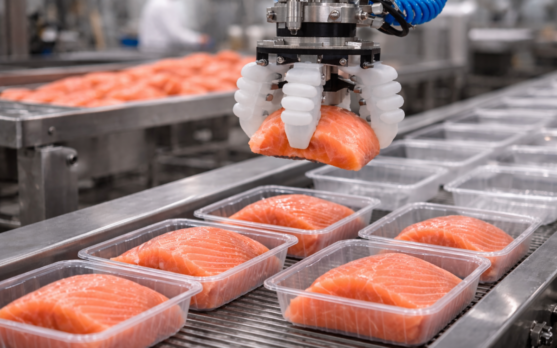
Newer soft gripping systems are being designed with food plants in mind, not just robotics labs. That means hygienic materials, washdown suitability, sealed or easier-to-clean structures, and geometries that make sense for actual products like bakery items, poultry portions, confectionery or fresh produce. It also means tighter integration with vision systems, conveyor tracking and motion control, so the robot is not merely touching gently. It is approaching, gripping, moving and releasing with more discipline.
That distinction matters. A soft finger by itself is not a miracle. In fact, a badly controlled soft gripper can still crush a product, smear a coating or drop an item at the worst possible moment. The real gains appear when compliant contact is paired with better timing and better feedback. Recent research has pushed hard in that direction, especially around tactile sensing and slip detection. That work is starting to make robots less clumsy in the split second that matters most: the instant when a product begins to move inside the grip.
This is a subtle change, but it is a big one. Older systems often relied on fixed pressure settings and a bit of optimism. Newer approaches are much closer to controlled responsiveness. The robot senses more. It adjusts earlier. It overcompensates less. That is how delicate handling stops being a lab stunt and starts becoming process engineering.
Softness alone is not enough, and that is actually good news
One of the more useful lessons from recent studies is that “soft” does not automatically mean “safe.” Both soft and hard grippers can damage fragile products. Sometimes the damage is obvious. Sometimes it is not. A fruit may show bruising later. A premium seafood item may lose presentation quality. A bakery piece may hold its shape just enough to pass a quick glance, while still suffering micro-damage that affects consistency or shelf life.
That is not bad news for soft gripping. It is a reality check, and reality checks are healthy. They stop processors from buying fairy tales wrapped in silicone.
The better view is this: soft grippers widen the safe operating window, but they do not remove the need for careful validation. Grasp force still has to be tuned. Motion profiles still matter. Product orientation still matters. Sanitation still matters. Hidden damage still matters. The payoff comes when a processor treats the gripper as part of a measured handling strategy rather than as a magical accessory that fixes everything by being gentle-looking.
Where the strongest opportunities are emerging
The most promising applications tend to share a few traits. The product is hard to standardize. Manual handling is labor-intensive or inconsistent. Presentation quality matters. A dropped or damaged item carries a cost beyond raw material loss. And the step itself is repetitive enough that automation has clear value once the gripping problem is solved.
Raw protein is an obvious example. Poultry portions, seafood, marinated components and other wet products are difficult because they are soft, slippery and rarely uniform. Bakery is another strong candidate, especially for products that are airy, topped, coated or easily deformed. Confectionery sits in a similar zone. It can be lightweight, fragile and visually unforgiving. Fresh produce, especially softer categories, also remains a prime field for gentler gripping strategies.
Frozen food lines may benefit in a slightly different but equally important way. In mixed-product environments, processors often need to protect coatings, shapes and piece integrity during transfer to trays, flow-wraps or secondary packaging. Even when the product is firmer because of temperature, surface behavior can still be tricky, especially when frost, crumbs, glaze or irregular geometry complicate contact. A well-designed soft gripper can help stabilize those transfer points, which are often exactly where manual intervention lingers the longest.
The quiet heroes are hygiene and repeatability
There is a temptation, especially in robotics marketing, to make everything sound futuristic. The truth is more grounded. In food plants, two of the biggest adoption drivers are boring in the best possible way: hygiene and repeatability.
A soft gripper that performs beautifully but is awkward to clean is not a breakthrough. It is a maintenance problem in costume. The newer commercial systems that look most credible are the ones that clearly address food-contact materials, washdown conditions and contamination risk. That does not make for flashy headlines, but it is exactly what moves technology from pilot cell to production line.
Repeatability matters just as much. Processors do not need a robot that succeeds on a good day with a cooperative product. They need one that survives variation. They need it to grip piece number three the same way it grips piece number three thousand, even when the upstream feed is messy, the line is fast and the room is not feeling sentimental.
This is why recent progress around tactile sensing is so interesting. It points toward grippers that do not merely contact gently but understand that contact while it happens. A system that can detect early slip, adjust force or compensate for a slight change in orientation is far more valuable than one that is simply soft and passive. In industrial terms, intelligence at the point of contact is where the next real gains will come from.
What processors should actually ask before investing
There is a simple way to cut through the noise around soft gripping. Ask ugly practical questions.
Can the tool be cleaned without fuss? Does performance stay stable after repeated sanitation cycles? How much product variation can it handle before success rates drop? What happens at full target speed, not reduced demo speed? Can it manage wet surfaces, odd shapes and different weights without constant retuning? Has the processor measured hidden damage, not just visible damage? How hard is it to switch formats? How much of the system relies on sensing, and how much still depends on guesswork?
Those questions matter more than glossy animations ever will. The processors that get the best results from soft gripping will be the ones that evaluate it as part of line design, QA discipline and operational economics, not as a fashionable gadget from the automation carnival.
This is the phase where soft grippers become normal
That may be the real story. Soft grippers are becoming less exotic.
They are no longer interesting only because they look clever or mimic the human hand. They are becoming interesting because they are useful. Recent tools and research are moving the conversation away from “look what the robot can do” and toward “can this run in production without wrecking yield, hygiene or uptime?” That is a much tougher question, and a much better one.
The answer is increasingly yes, but with conditions. Soft gripping works best when paired with good sensing, disciplined motion, hygienic engineering and realistic expectations. In other words, it succeeds when treated like industrial technology rather than theatrical robotics.
That may sound less glamorous. It is also exactly why the category is getting stronger.
Conclusion
Soft grippers are making delicate food handling scalable because they address a problem the industry has wrestled with for years: how to automate products that refuse to behave like identical parts. The recent progress is real, but it is not about softness in isolation. It comes from the combination of compliant contact, smarter sensing, more hygienic design and tighter process control. For processors, that means delicate handling is no longer stuck in the realm of impressive prototypes. It is becoming a serious industrial option, especially in applications where product damage, labor pressure and presentation quality all collide. The processors that benefit most will not be the ones chasing novelty. They will be the ones choosing systems that stay gentle, clean and repeatable when the line is running at full speed and the products start doing what food always does: acting like food.
Essential Insights
Soft grippers are becoming truly scalable in food processing when gentle contact is combined with sensing, hygiene and reliable motion control, not when softness is treated as the solution by itself.