Piece-Picking Breakthroughs for Proteins and Components: How Robots Are Moving Beyond Scooping in High-Mix Operations
Food automation has had a blind spot for a long time. Robots were great at uniform, rigid items and great at “bulk moves” like portioning, scooping, and dumping. The hard part sat in the middle: picking one wet, irregular chicken breast out of a messy tote, placing it flat in a tray, then switching to patties, then switching again to sauce cups that must land upright in tight compartments. High-mix operations live in that middle. In 2026, the breakthroughs are less about a single miracle robot and more about systems that finally combine perception, compliant gripping, orientation control, and washdown-ready hardware into something plants can run across SKUs without turning every changeover into a science project.
Why proteins and “small parts” were so resistant to automation
Proteins behave like the worst of all worlds. They deform, they reflect light, they stick to each other, they slide, and they rarely present a clean edge for a gripper. In a tote, pieces overlap and hide each other. Any approach that relies on neat presentation breaks down fast.
Components like sauce cups and inserts are the opposite problem. They are stable, but they demand accuracy. A cup placed slightly crooked can cause sealing failures, lid interference, or messy rework. And in high-mix assembly, cups are not the only small component. Think toppers, portion packs, garnishes, and inclusions. The tolerance stack is tight, and the tray design is not forgiving.
That is why “scooping” stuck around. It is fast, it is simple, and it works when the downstream process can tolerate variation. But it is also blunt. It cannot reliably control orientation, it cannot respect compartments, and it forces QA and checkweigh to catch what the process should never have created in the first place.
What’s new in 2026 is not just picking, it is controlled placement
The shift is from moving food to assembling food. That sounds subtle, but it changes everything. Assembly requires each item to arrive in the right place, in the right pose, at a speed that keeps the line honest.
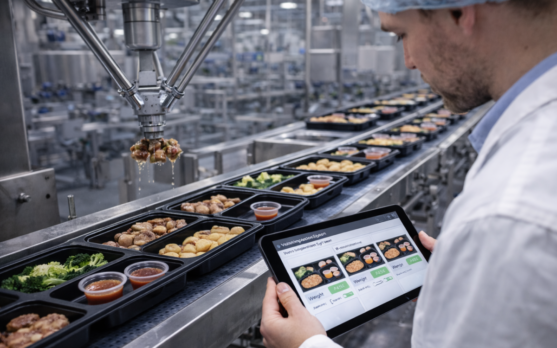
A clear example of this “assembly mindset” is the recent push around piece-picking in prepared meals and high-mix lines: robots segment, lift, and place individual items like chicken breasts, burger patties, and sauce cups, with explicit emphasis on orientation during deposition, such as laying a chicken breast flat or placing a sauce cup upright. This is the exact boundary between “we automated filling” and “we automated the tray.”
Breakthrough 1: Vision that deals with clutter, not staged product
Traditional machine vision liked clean spacing. Modern systems are getting better at messy reality: segmenting individual pieces in a pile, estimating pose, and deciding whether a pick is feasible without tearing or dragging another piece along.
The practical win is that the robot no longer needs perfect upstream presentation. You can feed from unstructured totes or bulk containers and still get a reliable pick plan. That matters in plants because perfect staging is expensive. It adds conveyors, singulators, and headaches. The more intelligence you push into perception, the simpler your mechanical feed can be.
It also matters for high-mix. If the “same” product changes shape slightly batch to batch, the system needs to adapt without constant re-teaching. Better segmentation and pose estimation reduces that friction.
Breakthrough 2: Grippers that match the physics of food
For proteins, the gripper is the make-or-break component. The old playbook was vacuum only, which struggles with wet surfaces, leaks, and inconsistent sealing. The newer playbook is hybrid and compliant: multi-zone vacuum arrays, soft fingers, adaptive tooling, and approaches that can “settle” a piece rather than clamp it aggressively.
Soft gripping has moved from novelty to necessity because it spreads contact forces and reduces damage. For raw proteins, damage is not just cosmetic. It can change cooking performance, purge, and yield. A gripper that leaves marks or tears surfaces creates downstream quality risk.
On the component side, the gripper problem is different. Sauce cups need stable, upright handling. The tool must resist tipping during acceleration and deceleration, and it must release cleanly without bounce. In a tight tray, there is no space for a second attempt.
Breakthrough 3: Pick plus orient, not just pick plus drop
This is where the story gets interesting. Bin picking used to mean “grab something.” Now it increasingly means “grab and present it correctly.”
Public demos around poultry show the direction: picking drumsticks from bulk, orienting them, and tray packing at high rates. Similar claims exist for bulk patty handling, including orienting and recognizing surface features during packing. Whether your plant needs that exact throughput is less important than what the demo implies: orientation control is becoming normal, not exotic.
Why it matters: orientation is what makes robotics valuable in compartments, in portion-controlled trays, and in lines where the next step is sealing. If you cannot control pose, you are not automating the problem. You are relocating it.
Breakthrough 4: Cleanability and washdown are finally being treated as core requirements
Plants do not buy robots. Plants buy uptime that survives sanitation.
Open food environments punish equipment that has crevices, exposed fasteners, poor drainage, or surfaces that trap residue. Sanitation crews will find every weakness, quickly, and repeatedly. That is why washdown-rated robotics is an important part of the piece-picking story, especially as robots move closer to exposed product.
Delta robot suppliers have been pushing food-grade and washdown positioning for years, but it is increasingly relevant to high-mix picking because those cells tend to live near primary handling and tray loading. Stainless variants and IP69K-rated options exist specifically to tolerate aggressive cleaning regimes and hot, high-pressure washdowns in food environments.
High-mix is the real battlefield, not maximum speed
Many plants can automate a single SKU if they are willing to engineer the line around it. High-mix is different. The line changes product, portion, tray format, and component set. Sometimes multiple times per shift.
The winning systems treat changeovers like software, not mechanics. Vision models that recognize new items with minimal retraining. Recipe-driven placement patterns. Tooling that swaps quickly. Simulated validation so you can launch a new tray layout without weeks of trial and error.
This is also where “beyond scooping” becomes a business argument. Scooping is tolerant but wasteful: higher giveaway, inconsistent presentation, and more downstream rejects. Piece-picking is more disciplined: less chaos in the tray, fewer sealing issues, cleaner weight control, and more consistent customer experience. In frozen meal assembly and component-heavy trays, that discipline is often worth more than raw pick rate.
Where plants are seeing the earliest ROI
Piece-picking tends to land first where labor is scarce, variability is high, and precision has direct cost consequences.
Prepared meals are an obvious fit: proteins plus multiple components, tight compartments, and a strong need for repeatable presentation. Protein tray packing is another: consistent orientation helps both sealing and downstream cooking performance. Component placement (cups, sachets, inserts) becomes attractive when SKU variety is high and manual placement becomes a bottleneck or a quality risk.
In practice, many plants start with a hybrid goal. Automate the hardest repetitive placement tasks and let people handle the truly odd cases. Then expand once the system proves it can survive the ugly parts of production: wet product, inconsistent supply, sanitation cycles, and real shift-to-shift variation.
What “good” looks like in a piece-picking specification
Plants that succeed with piece-picking tend to specify outcomes, not just equipment. A good spec answers questions that operators and QA will ask on day one.
Pick reliability across product conditions: wetness, overlap, partial occlusion, temperature, and typical variation.
Placement definition: what “flat” means for a breast, what “upright” means for a cup, and the positional tolerance in the tray.
Changeover workflow: how many SKUs, how recipes are managed, and how long the real changeover takes.
Sanitation design: washdown rating, surfaces, access, and time to clean and requalify.
Fallback logic: what happens when the robot cannot find a safe pick, and how exceptions are handled without line stoppage.
The plants that treat these as first-class requirements avoid the classic trap of buying an impressive demo that collapses under real plant conditions.
Conclusion
Piece-picking is becoming the dividing line between “we automated a task” and “we automated the operation.” In 2026, robots are moving beyond scooping because the enabling stack is finally mature enough: vision that can interpret clutter, grippers that respect deformable proteins, orientation control that makes compartmented trays workable, and washdown-friendly hardware that does not turn sanitation into a constant argument. The most important breakthroughs are not theatrical. They are practical. They make high-mix assembly repeatable, and they move variability out of the tray and back into the system where it can be controlled.
Essential Insights
Robots are moving beyond scooping into true piece-picking because the full system has improved: AI vision for clutter, compliant grippers for proteins, controlled orientation for tray assembly, and hygienic, washdown-ready designs that can survive real high-mix plant conditions.