Frozen food has always carried an invisible bill. It sits in the compressor room, in the freezer tunnel, in the cold store door left open too long, in the evaporator that frosts too quickly, in the heat rejected outside while another part of the plant pays for hot water. Energy-efficient freezing is no longer a side project for engineers. It is becoming a margin issue, a carbon issue and, in some factories, a capacity issue. The companies that still treat refrigeration as background utility cost are leaving money in the cold.

The freezer is no longer just a utility cost
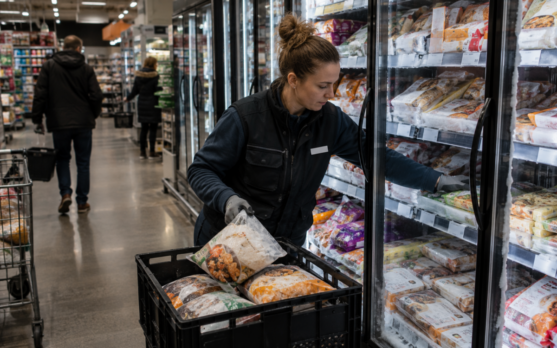
In frozen food, cold is not an accessory. It is the process, the protection and the promise. A frozen vegetable line, a seafood cold store, a bakery blast freezer, an ice cream distribution hub or a supermarket freezer aisle all depend on the same basic discipline: remove heat, keep it out, prove the product stayed where it should.
That discipline has become more expensive to ignore.
Electricity prices have made refrigeration visible to finance teams that used to see it as a fixed operating burden. Carbon reporting has made refrigerant leakage harder to hide inside technical maintenance. Retailers are asking more questions about supply-chain emissions. Manufacturers are under pressure to protect margin without weakening quality. Cold stores are being asked to do more with tighter power, tighter labour and less tolerance for waste.
The old answer was to buy better equipment when the plant was rebuilt. That is too slow. Most frozen food businesses need gains from systems already running: compressors, evaporators, defrost controls, doors, setpoints, heat recovery, refrigerant management and staff habits that never appeared on the original engineering drawings.
Boring controls may cut more carbon than headline technology
The most useful energy work in freezing is often disappointingly unglamorous. Raise suction pressure where the product and process allow it. Clean evaporators. Stop over-defrosting. Repair door seals. Add variable-speed control to motors that do not need to run flat out. Check whether fans, pumps and compressors are operating for the load that actually exists, not the load someone assumed years ago.
None of that sounds like a breakthrough. It is where many plants lose money.
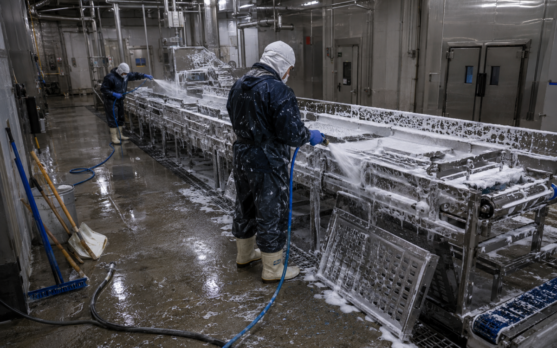
A freezer tunnel running with poor airflow does not announce itself as a carbon problem. It shows up as longer dwell time, uneven product temperature, higher fan energy or operators compensating with colder settings. A cold store with frequent door traffic may blame energy use on volume, when the real problem is dock discipline. A defrost cycle set too generously melts ice that did not need melting, then asks the refrigeration system to pull that heat back out again.
The smart freezer is not the one with the most sensors. It is the one that stops wasting energy on assumptions.
Digital controls, monitoring and analytics matter when they make those assumptions visible. Which evaporator actually needs defrost? Which door causes repeated temperature recovery? Which cold room runs colder than the product specification requires? Which compressor sequence makes sense on a mild night and makes no sense in summer? Those are plant questions before they are technology questions.
The -18°C convention is now a commercial argument
Few subjects in frozen food have more symbolic weight than the storage temperature. The industry has lived with -18°C for so long that it can feel less like a setting and more like a law of nature.
It is not.
The Move to Minus 15°C debate has pushed a serious question into the open: how much energy is being spent to defend a convention that may not be necessary for every product, every route and every market? Morrisons’ UK store trial, supported by industry work from Nomad Foods and Campden BRI, has made the issue harder to dismiss. The reported energy savings from moving from -18°C to -15°C are large enough to interest anyone who pays a frozen electricity bill.
But this is not a switch to be thrown casually.
Frozen food is not one product family. Ice cream, seafood, vegetables, bakery, meat, ready meals and high-fat prepared foods do not all respond in the same way to temperature history. Retail cabinets behave differently from distribution warehouses. A stable cold store is not a busy supermarket aisle. A controlled study is not the same as a fragmented end-to-end supply chain.
Still, the conversation matters. If the sector can prove that selected categories can tolerate a different standard without safety, texture, nutrition or shelf-life damage, the energy prize is too big to ignore. The work ahead is evidence, not slogans: product trials, transport monitoring, retailer alignment, insurance confidence and clear category rules.
Factories cannot keep throwing heat away
Freezing removes heat. Many food factories then pay separately to create heat somewhere else.
That gap is starting to look wasteful.
Refrigeration plants reject heat from compressors and condensers while the same site may need hot water for cleaning, process heating, space heating, CIP or other services. Heat recovery and industrial heat pumps are not new ideas, but the economics are changing as steam, gas and carbon all come under pressure.
The best examples are not theoretical. GEA’s work with Nestlé’s infant formula plant in Nunspeet, including heat pump technology supplying hot water at 85°C and cold water at 1.5°C, shows the direction. Food factories are beginning to look at heating and cooling together, rather than as separate engineering islands.
For frozen food plants, this matters. A factory that runs blast freezing, cold storage, hot water systems and cleaning cycles should not look at refrigeration only as a cold-making machine. It is also a heat-moving machine. The question is whether useful heat is captured, upgraded and reused, or simply pushed out to the atmosphere while another meter keeps running.
Refrigerants are moving from engineering detail to business risk
The refrigerant decision used to sit mostly with engineering. That is changing.
In Europe, the revised F-gas framework tightens the path away from HFCs and puts a long-term phase-out on the table. For frozen food operators, the issue is not only carbon accounting. It is service availability, future compliance, equipment lifetime, insurance, technician competence and the risk of being locked into a system that becomes harder or more expensive to maintain.
Natural refrigerants such as ammonia and CO2 already have strong roles in industrial refrigeration. Propane and other lower-GWP options are visible in commercial and smaller systems. None is a lazy choice. Ammonia demands safety competence. CO2 requires design skill, especially in warm climates. Hydrocarbons bring charge limits and service rules. Low-GWP does not mean low-complexity.
The better operators will not treat refrigerant transition as a forced replacement exercise. They will connect it to energy efficiency, heat recovery, maintenance strategy, leakage control and site investment plans. A refrigerant project done badly can become an expensive compliance story. Done well, it can modernise the cold system and reduce both direct and indirect emissions.
The future is a better-run cold system
Energy-efficient freezing will not be won by one technology. It will be won by tighter control of the whole cold system.
That system stretches further than the plant room. It includes product temperature entering the freezer, dwell time, room design, door discipline, evaporator performance, compressor sequencing, heat recovery, defrost timing, cold storage layout, retail cabinets and even the setpoints written into customer specifications.
Thermal storage and phase change materials may help some cold stores shift load away from expensive hours. Automated defrost can cut waste where frost is being managed blindly. Modular freezing can avoid the energy penalty of oversized permanent capacity. Better freezer design in commercial kitchens can cut daily losses from doors, seals and poor access. Thermoelectric cooling may find specific roles in small, precise and hybrid applications.
Each has a place. None excuses weak basics.
The frozen food plant of the future will not necessarily be the one with the most technology. It will be the one that wastes the least cold, the least heat and the least time. That is a harder ambition than buying a new system. It asks the business to treat refrigeration as a living operating discipline, not a utility buried behind the production schedule.