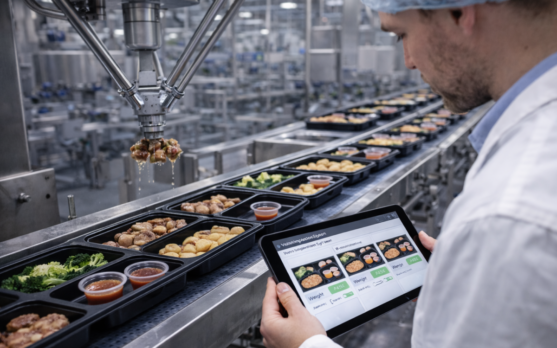
The first AI problem in a frozen food plant may not look like AI at all. It may look like a rejected batch of peas after a camera was cleaned. A strange rise in potato strip rejects after a new supplier delivered crop from another region. A seal-inspection system that suddenly dislikes a recyclable film. A sorter that performed well in the supplier demo and then became oddly nervous in November, when frost, soil load and product colour changed together. The dashboard will show the spike. It may even draw a neat chart. What it will not explain is the part an auditor, retailer or plant director will eventually want to know: which model was making the call, which version was live, what had changed, and who was responsible for trusting it?

The factory bought the machine. Did it also buy the model?
Food factories have always had equipment with personalities. The freezer that behaves differently in August. The bagger that hates one film. The cutter that needs a certain operator. The optical sorter that everyone knows is “a bit aggressive” on one raw material and too forgiving on another.
AI adds a new kind of personality, and it is harder to see.
In frozen food, machine vision and AI-assisted sorting are no longer exotic. They sit above belts, inside inspection tunnels, inside supplier-controlled software, sometimes inside systems that the plant still describes with ordinary words: sorter, grader, label check, seal inspection, forecast tool. The sales literature may talk about artificial intelligence. The factory team may talk about performance. QA may simply inherit the result.
That inheritance is the problem.
If a model changes how product is rejected, how a defect is classified, how a pack is inspected, how demand is forecast or how a machine responds near people, it has entered the control life of the plant. It is no longer a nice screen. It is part of the production story.
The dashboard arrives before the evidence
A dashboard is easy to admire. It gives shape to a messy day. Rejects by hour. Defects by type. Yield loss by shift. Forecast accuracy by customer. Energy by freezer room. It turns noise into coloured boxes.
Useful, yes. Sufficient, no.
After a complaint, nobody serious stops at the chart. They ask what sat underneath it. Which model classified the defect? Which version? Was it trained on this product or on something similar? Did the supplier push an update? Did the technician recalibrate the camera after maintenance? Did an operator change the reject threshold to keep the line moving? Was the model ever validated after the new pack film arrived?
These are not digital-transformation questions. They are factory questions.
A model registry is the place where those answers should live. Not as an academic exercise. As a plain operating record: model name, version, use, line, owner, validation scope, update history, thresholds, overrides, drift checks, rollback option, vendor contact, affected products. In higher-risk cases, it should connect to lots, holds, complaints and release records.
The register does not have to be beautiful. It has to exist.
Frozen food gives AI plenty of ways to get confused
Fresh consultants like clean data. Frozen plants rarely offer it.
A new potato season changes colour, dry matter, defect profile and surface behaviour. Peas arrive with different size distribution. Frozen berries carry more frost than the previous lot. A seafood glaze catches light differently. A bakery topping breaks in another pattern after freezing. Condensation forms on the inspection window during a wet shift. A camera is cleaned and not quite returned to the same position. A recyclable film changes glare. A pack redesign moves the date code to a place the inspection system does not love.
The model still produces an answer. That is the uncomfortable part.
People often discuss model drift as if it were a statistical decay inside a spreadsheet. In a frozen plant, drift may come on a pallet, through a new harvest, through a maintenance job, through a lighting change or through the cold-room door. The model sees the world through sensors. The factory changes that world all the time.
A decent operator may notice that “the line is acting strange today.” The model registry should turn that instinct into a trigger: check the version, compare output, review false rejects, revalidate against new product conditions, record what was changed and who accepted it.
Otherwise, the plant is running on confidence and memory. Both are useful. Neither is audit evidence.
Vendor updates are not harmless by default
Many frozen food companies will not build their own AI. They will buy it hidden inside equipment.
That is normal. It is also where ownership gets slippery. The vendor owns the sorter software. Engineering owns the machine. Operations owns the line. QA owns the release decision. IT owns the network. Nobody wants to own the model when it misclassifies product.
A supplier update may genuinely improve performance. It may reduce false rejects, improve foreign-material detection, sharpen defect classification or fix a bug. Good. But it is still a change. If the model influences product flow or quality judgement, the plant needs to know what changed and whether the new version is approved for its own products, not only for the vendor’s global installed base.
The question for equipment suppliers should be direct: can the site lock a model version, receive release notes, review validation evidence, delay an update, roll back, export logs and see which version ran on a given lot?
If the answer is vague, the risk is not vague.
Food factories have spent years learning to control recipes, allergens, labels and packaging versions. AI models deserve the same suspicion. A version change in software can be as operationally meaningful as a change in seasoning, pack film or metal detector setting.
Regulation is giving the file more weight
The EU AI Act does not automatically make every frozen factory algorithm a high-risk AI system. A demand-planning model for frozen vegetables is not the same as AI embedded in a regulated safety component. That distinction is important; exaggerating it helps nobody.
Even so, the direction is clear enough. Higher-impact AI is being pulled toward risk management, documentation, logging, human oversight, robustness and cybersecurity. The Machinery Regulation brings another layer for factories, especially where software, machine learning or self-evolving behaviour touches safety functions.
That is where food manufacturers need to stop separating “digital” from “engineering.” A model update may be a software note in one room and a machinery documentation issue in another. A camera system may be quality control in the morning and part of a customer complaint investigation by afternoon. An AI tool may begin as a yield improvement project and end up inside a retailer audit question.
The practical point is not panic. It is classification.
Some models belong in commercial governance. Some belong in QA. Some belong in food safety review. Some belong near the technical file for machinery. The plant has to know which is which before the regulator, customer or insurer asks.
Start with the awkward walk
The first step is not a grand AI programme. It is a walk through the plant with fewer assumptions.
Stand at the sorter and ask what algorithm is running. Stand at the pack inspection station and ask what happens after an artwork change. Sit with the planner and ask whether the forecast model changes production volume. Ask maintenance which equipment receives software updates from outside. Ask QA where AI-assisted inspection results are stored. Ask engineering whether any AI-enabled system touches safety behaviour. Ask vendors how model updates are documented.
Then make the uncomfortable list.
There will be systems nobody thought of as AI. There will be tools nobody owns cleanly. There will be vendor portals, local settings, service laptops, old deployments and “temporary” models that became normal because they worked well enough. That is not failure. That is the starting inventory.
By 2028, serious frozen suppliers should know which models influence business decisions, quality decisions, release evidence and machinery behaviour. They should know when a new product, new harvest, new supplier, new packaging material, new camera, new light source or new software version forces a review. They should know who can override the model and whether that override is recorded.
A plant that can answer those questions will sound less exciting than one promising AI transformation. It will also be safer to buy from.